Saudi Arabia Interceptions Put the Oil Risk Premium in Focus
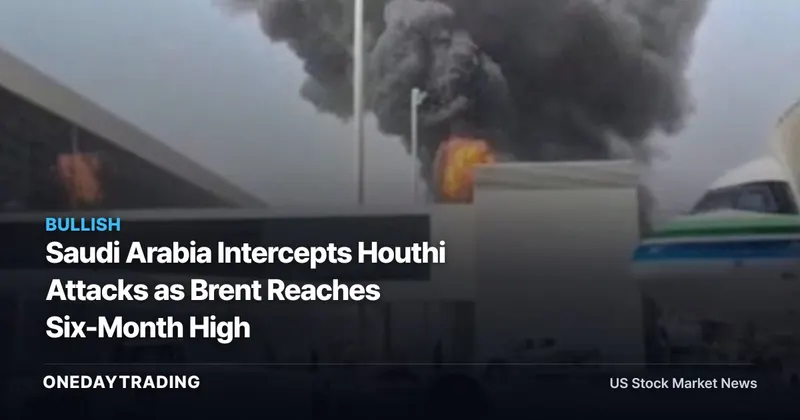
Saudi Arabia said it intercepted missiles and drones launched by the Houthis toward Saudi cities, airports and energy facilities on Sunday, while Brent had already closed Friday at a six-month high. For investors, the central issue is not a confirmed loss of oil supply; it is the widening gap between the severity of the security threat and the absence of verified operational damage at Saudi Aramco.
CNBC reported that Brent futures gained 3.1% Friday and settled at $116.72 per barrel, while U.S. West Texas Intermediate rose 3.8% to $103.27 per barrel. The moves give the event immediate market relevance: crude prices were already carrying greater concern about Middle East escalation before the Sunday interceptions supplied another test of that concern.
What Saudi Arabia and the Houthis Said Happened
The Saudi-led coalition in Yemen said drones and missiles headed toward several Saudi cities, including Riyadh, were intercepted. Turki Al-Maliki said two drones and a ballistic missile traveling toward Riyadh were “intercepted and destroyed.” He also said 10 ballistic missiles headed toward southern Saudi Arabia and a cruise missile traveling toward Khamis Mushait were intercepted.
The Houthis separately claimed seven military operations involving ballistic missiles and drones. They identified King Khalid International Airport, Saudi Aramco facilities in Yanbu, and other airports and energy installations as targets. That claim establishes what the Houthis said they targeted, not independent confirmation that every named location was struck.
In market terms, an interception event is an attempted attack that authorities say was stopped before reaching its intended destination. The distinction matters because the threat can influence crude pricing even when the available reporting does not establish a corresponding interruption to production or transport.
King Khalid International Airport Resumes Operations
King Khalid International Airport announced that Sunday operations were resuming through Terminal 1 for domestic flights and Terminal 2 for overseas routes. That operational notice provides a concrete indicator for the airport, though the fact sheet gives no damage or casualty figures from Sunday’s interceptions or claimed attacks.
The airport had suspended operations on Oct. 10 following a strike that killed at least 13 people and injured around 300 others. CNBC described that earlier event as the deadliest attack on Saudi Arabia in more than a decade. The history raises the stakes around the latest targeting claim without proving that Sunday produced the same outcome.
Saudi Aramco did not immediately respond to CNBC’s request for comment. Its Yanbu facilities’ operational status is therefore unresolved in the available evidence, making a verified company statement or operating update the most important physical-market checkpoint.
Brent and WTI Show What the Market Has Priced
Brent gained 6.2% for the week, marking its third consecutive week of gains, while WTI advanced 2.3% for the week. Those increases show that the oil market entered the interception news with an elevated price response already visible across both benchmarks.
The tape has priced a higher level of concern; it has not established the size, duration or location of any supply loss. Brent’s Friday settlement was its highest since April 29, but the source provides no quantified production outage, export disruption or damage assessment tied to the Sunday event.
This creates an asymmetric information problem for oil investors. Confirmation that energy operations remain unaffected could weaken the portion of the move associated with feared disruption. Verified damage or an operational interruption could support that concern, though neither outcome is established by the supplied facts.
Regional Escalation Extends Beyond Sunday’s Attack
The U.S. ordered non-emergency government employees and their families to leave Saudi Arabia. Donald Trump said the U.S. was not negotiating with Iran and that something would happen “fairly soon,” while the precise timing and confirmation of any future U.S.-Israel strikes on Iran remain unknown.
U.S. officials told The New York Times that the U.S. and Israel had plans for fresh strikes on Iran after the Nov. 3 midterm elections. This is reporting about plans, not evidence that strikes have occurred or that a schedule has been finalized.
Amrita Sen of Energy Aspects told CNBC’s Squawk Box Europe that clients were increasingly focused on when escalation might occur. Her stated view was that action was more likely after the midterms than before. Investors should treat that as attributed analysis, separate from confirmed government action.
Oil Bull and Bear Conditions
Bull case: Continued attacks aimed at airports and energy installations could keep supply-disruption fears embedded in Brent and WTI. The argument draws support from Friday’s six-month high, Brent’s 6.2% weekly advance and the identification of Saudi Aramco facilities among the Houthis’ claimed targets.
Bear case: Saudi Arabia said the incoming weapons were intercepted, King Khalid International Airport announced resumed operations, and no Sunday damage or casualties are given. Without confirmation of impaired energy operations, prices may be carrying risk that has not translated into a documented physical supply loss.
The two scenarios turn on verification rather than rhetoric. Claims of targets, official interception statements and market prices are known; launch locations, the outcome at every claimed target and the status of the Yanbu facilities are not.
Investor Checkpoints After the Saudi Arabia Attack
- Saudi Aramco operations: Check for a direct response and any update on the operational status of its Yanbu facilities. That would clarify whether the event moved beyond a security threat into a physical energy-market disruption.
- Airport continuity: Track whether King Khalid International Airport continues operating through Terminal 1 for domestic flights and Terminal 2 for overseas routes after Sunday’s resumption notice.
- Benchmark confirmation: Compare the next moves in Brent and U.S. West Texas Intermediate with Friday’s settlements of $116.72 and $103.27 per barrel. Those levels provide the clearest supplied reference points for whether concern is intensifying or receding.
- Policy evidence: Separate confirmed U.S. or Israel action involving Iran from statements, reported plans and outside analysis. Nov. 3 is the stated political marker in the reporting, not a confirmed date for military action.
The Next Signal for Brent and WTI
The decisive next signal is evidence about physical operations. The market has already registered a strong price move, while the supplied reporting leaves Saudi Aramco’s response, the Yanbu facilities’ status and the consequences of Sunday’s claimed attacks unresolved.
That keeps the oil setup conditionally bullish rather than conclusive. If subsequent updates document uninterrupted energy operations, the case for an expanding disruption premium weakens; if they confirm operational damage, Friday’s Brent and WTI settlements become the baseline against which the market’s next repricing can be judged.
📊 Analysis
Signal Bullish
Why Oil benchmarks rose sharply as attacks involving Saudi cities and energy facilities intensified concern about regional supply disruption.
This article was independently written by OneDayTrading from public reporting. Read the original (CNBC)