Hormuz Crude Recovery Masks a Refined-Fuel Shortfall
CNBC reported that crude oil moving through the Strait of Hormuz reached a seven-day average of 13.5 million barrels per day as of Monday, matching its prewar baseline. For energy and transportation investors, the critical distinction is that crude availability has recovered while the flow of refined products remains severely constrained.
The Strait of Hormuz is the maritime passage used to move Gulf crude oil and refined fuels toward global customers. Its headline crude volume now signals normalization, but the broader system still depends on military-protected tanker transfers and pipelines exposed to disruption.
Kpler Data Shows Two Different Oil Markets
Kpler, which tracks tankers and global trade flows, measured Middle East regional crude shipments at a seven-day average of 19.5 million bpd as of Monday, above the prewar baseline of about 17 million bpd. Matt Smith, Kpler’s director of commodity research, said strong volumes passing through Hormuz had reduced Iran’s influence over the route.
The product side presents the opposite picture. Kpler data cited by CNBC put refined products shipped through Hormuz at a seven-day average of 677,000 bpd as of Monday, versus 3.6 million bpd before the war. That gap matters because additional crude barrels do not substitute directly for fuels that have already been processed.
Combined crude and product shipments through Hormuz stood at a seven-day average of 14.2 million bpd. CNBC described that as about 80% of the prewar baseline of about 17 million bpd, showing why crude normalization alone overstates the recovery of the complete export chain.
JPMorgan and Bank of America Identify the Bottleneck
Natasha Kaneva, head of global commodities strategy at JPMorgan, said the crude market had largely normalized while refined-product supplies remained constrained. Her distinction is the central investment signal: the physical economy is receiving crude, but the mix of petroleum flows has not returned to its earlier configuration.
Francisco Blanch, head of global commodities at Bank of America, identified diesel as the largest source of strain in a Sept. 8 CNBC interview. Ukraine’s pressure on Russian refineries adds another stated constraint to Middle East fuel availability, although the fact sheet does not quantify its contribution.
This creates a split rather than a uniformly tight or loose oil market. Restored crude throughput can reduce concern about an outright shortage of raw barrels, while weak refined-product shipments can keep the fuel channel constrained. Investors should therefore separate crude volumes from product volumes instead of treating total oil supply as a single measure.
U.S. Navy Protection and Tanker Transfers Carry the Recovery
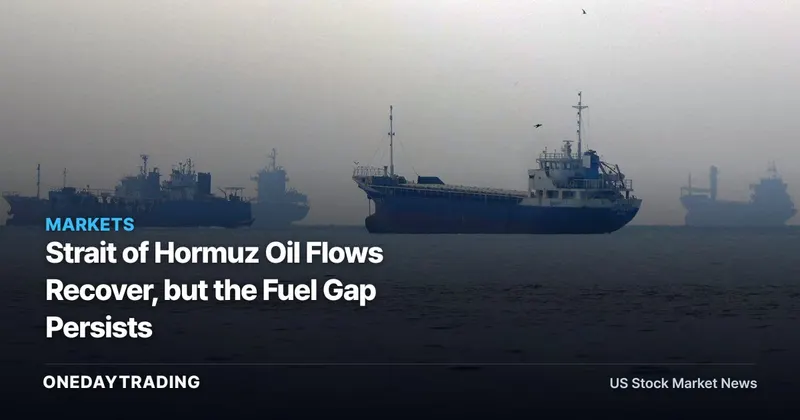
The export rebound rests partly on a shuttle system that moves cargo through Hormuz and transfers it to another tanker off the United Arab Emirates or Oman for delivery to Asia. The U.S. military protects that operation, reducing exposure to attacks during the most vulnerable portion of the journey.
In August, more than 70% of crude crossing Hormuz switched tankers off the United Arab Emirates or Oman, according to Kpler data reported by CNBC. That share demonstrates how heavily the apparent normalization relied on an adapted logistics network rather than ordinary passage conditions.
Helima Croft, head of global commodity strategy at RBC Capital Markets, described the arrangement in her Sept. 25 CNBC interview as “very expensive” and “a huge U.S. military commitment.” The durability of the tanker-shuttle system and the export recovery is unknown, so current throughput should not be treated as guaranteed capacity.
Saudi Arabia and the United Arab Emirates Expand the Bypass
Pipelines operated by Saudi Arabia and the United Arab Emirates provide the second support for crude flows by allowing barrels to avoid Hormuz. About 40% of Gulf crude now bypasses the strait through those pipelines, compared with 17% before the war, according to CNBC’s account of Kpler data.
The bypass offers route diversification, not immunity from disruption. Saudi Arabia shut its East-West pipeline after damage from a drone strike launched from Iraq; subsequent loadings at Yanbu indicated that the pipeline was operating again. During that outage, crude remained resilient because exports could move back through Hormuz using the U.S.-protected shuttle system.
The two routes therefore reinforce each other. Pipelines relieve pressure on Hormuz, and protected tanker transfers can absorb flows when pipeline capacity is interrupted. The same structure also concentrates operational risk in arrangements whose sustainability has not been established.
Iran Policy Adds a Separate Supply Risk
Iran offered to reopen Hormuz in seven days if the United States returned to the June memorandum of understanding. That was a conditional proposal, not a completed reopening, and it did not resolve the underlying uncertainty surrounding future access to the strait.
Scott Bessent told Fox News that Iran would make its final crude deliveries to China in about two weeks from Sunday. The U.S. Navy blockade and economic pressure form a separate channel from the recovery in regional crude flows: Middle East exports can appear resilient even while Iran’s own ability to deliver crude is constrained.
Croft said some officials in Washington favored allowing the blockade to continue pressuring Iran. Scott Modell, CEO of Rapidan Energy and a former CIA officer, said there was no hard evidence that economic pressure would fundamentally change Iran’s positions and characterized the direction as moving toward escalation.
The Wall Street Journal cited unnamed U.S. officials concerning the prospect of renewed military action. Their identities are unknown, and neither the timing nor the effect of any renewed fighting on regional oil supplies has been established.
Market Transmission Across Energy and Transport
- Crude oil: A seven-day average of 13.5 million barrels per day through Hormuz, alongside 19.5 million bpd of regional shipments, supports the view that raw-barrel availability has recovered. The risk is that those volumes depend on costly protection and rerouting.
- Refined fuels: The contrast between 677,000 bpd now and 3.6 million bpd before the war identifies the tightest part of the chain. Fuel-sensitive businesses remain more exposed to this shortfall than the crude headline alone implies.
- Shipping: Ship-to-ship transfers add operational steps and depend on U.S. military protection. The relevant variable is whether the shuttle arrangement can continue handling a large share of Hormuz crude.
- Regional infrastructure: Saudi Arabia and the United Arab Emirates have raised the bypass share from 17% before the war to about 40% now. Pipeline vulnerability prevents that capacity from eliminating route risk.
Investor Checkpoints for the Hormuz Supply Chain
- Compare crude with products: Track whether the seven-day average for refined-product shipments closes the gap between 677,000 bpd and the prewar 3.6 million bpd, rather than relying on crude flows alone.
- Test total normalization: Watch whether combined crude and product shipments move beyond the current 14.2 million bpd, about 80% of the roughly 17 million bpd prewar baseline.
- Monitor logistics dependence: Check whether the share of crude transferred off the United Arab Emirates or Oman declines from the more than 70% recorded in August.
- Follow route substitution: Assess whether Saudi Arabian and United Arab Emirates pipelines can sustain about 40% of Gulf crude bypassing Hormuz without another interruption.
The Next Signal Is Fuel, Not Crude
The constructive case is physical: Hormuz crude volumes have matched their prewar baseline, regional shipments have exceeded theirs, and bypass pipelines provide an alternative route. Those facts show that the export network can move large crude volumes under pressure.
The countercase is structural. Refined-product shipments remain far below their prewar level, the tanker system requires a substantial U.S. military commitment, pipelines remain vulnerable, and diplomacy has not removed the risk of renewed fighting.
The decisive next reading is whether refined-product flows recover without weakening crude throughput. Until that happens, the market should treat 13.5 million barrels per day as evidence of crude resilience—not proof that the Strait of Hormuz energy system has fully normalized.
📊 Analysis
Signal Neutral
Why Recovered crude exports improve physical supply availability, but constrained refined-fuel flows and fragile transport arrangements leave the sector outlook divided.
This article was independently written by OneDayTrading from public reporting. Read the original (CNBC)