Senate Republicans Put Two Market-Relevant Bills to a Test
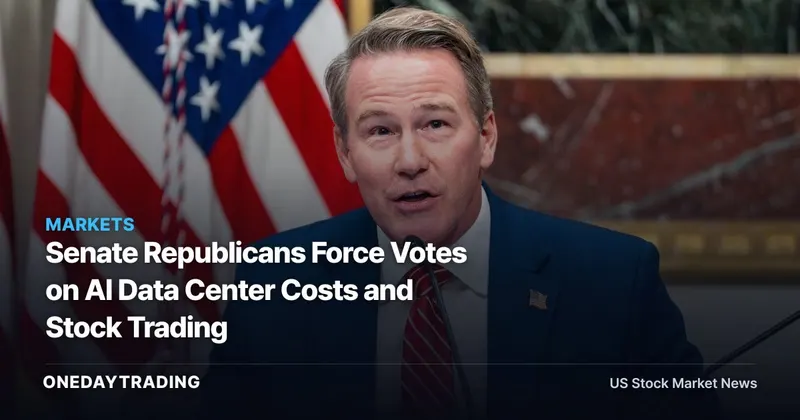
Senate Republicans are expected to bring the Ratepayer Protection Act and Stop Insider Trading Act to procedural votes on Wednesday before the Senate’s pre-election recess, CNBC reported on 2026-09-30. For investors, the votes test two separate policy channels: who may bear energy-infrastructure costs created by large artificial intelligence data centers, and whether sitting members of Congress may continue buying individual stocks.
The immediate market signal is procedural rather than legislative. Neither proposal is likely to overcome the Senate’s 60-vote filibuster threshold as Democrats signal opposition, according to CNBC. That weakens the case for treating either framework as an enacted change while preserving both subjects as live policy risks.
Why the Ratepayer Protection Act Matters to AI Infrastructure
The Ratepayer Protection Act is a proposed regulatory framework that states could consider adopting. Its central provision would require large artificial intelligence data centers to cover their own energy-infrastructure costs instead of passing those costs to customers.
The investor relevance lies in cost allocation. If states adopted the framework, the dividing line would be between costs assigned to large data centers and costs passed to utility customers. The bill does not itself establish that states will adopt the framework, so it cannot support a definitive conclusion about expenses, investment returns or customer bills.
The proposal carries substantial support from the House. CNBC reported that the Ratepayer Protection Act passed on a 417-3 House vote earlier this month. That margin shows broad approval in that chamber, while the expected Senate resistance demonstrates that a large House majority does not resolve the procedural hurdle ahead.
This distinction matters for AI and utility-sector analysis. The proposal addresses physical infrastructure costs rather than demand for artificial intelligence itself. Investors should therefore separate the continued need for data center energy infrastructure from the unresolved question of who would pay for it under any state-level adoption.
Chuck Schumer Challenges an Optional State Framework
Chuck Schumer called the Ratepayer Protection Act a “toothless messaging bill” and said, “The bill is a fraud.” His objection centers on its optional structure: states could consider the framework rather than being compelled to adopt it.
Martin Heinrich had also blocked the bill after Jon Husted sought quick passage. Their disagreement identifies the proposal’s core policy tension. Supporters can point to a framework designed to place infrastructure costs on large data centers, while critics can argue that optional adoption does not ensure the allocation will change.
Jon Husted described both proposals as “commonsense, bipartisan bills.” The procedural vote will reveal the level of Senate support, not whether the Ratepayer Protection Act will become law or whether any state will use its framework.
The Stop Insider Trading Act Leaves Existing Portfolios Intact
The Stop Insider Trading Act would prohibit sitting members of Congress from buying individual stocks. It would not require them to divest portfolios they already own, creating a clear boundary between future purchases and existing holdings.
CNBC reported that the Stop Insider Trading Act passed the House on a 232-198 vote in July. That result was narrower than the Ratepayer Protection Act’s House vote, and the Senate bill faces the same 60-vote threshold amid Democratic opposition.
The absence of a divestment requirement is central to evaluating the proposal’s reach. A ban on new individual-stock purchases would change one category of activity, while leaving existing portfolios in place. Investors should not describe the measure as a complete prohibition on congressional stock ownership.
Republicans also added a voter identification provision. Chuck Schumer called the trading proposal a “theatrical farce” and described that added provision as a “poison pill.” The combined text means senators will be voting on more than the stock-purchase restriction alone.
Why the Two Senate Votes Carry Different Market Channels
- AI data centers and utilities: The Ratepayer Protection Act addresses whether large data centers or utility customers would carry energy-infrastructure costs under frameworks that states could choose to adopt.
- Individual stocks: The Stop Insider Trading Act targets purchases by sitting members of Congress, without requiring the sale of existing portfolios.
- Legislative probability: Both proposals must confront the Senate’s 60-vote filibuster threshold, and Democrats have signaled opposition.
- Scope risk: Optional state adoption limits the certainty of the data center framework, while the lack of mandatory divestment limits the breadth of the stock-trading proposal.
These channels should not be collapsed into a single directional sector call. The data center bill concerns allocation of infrastructure costs; the trading bill concerns lawmakers’ future purchases of individual stocks. The fact sheet identifies no listed company, measured earnings exposure, price movement or enacted outcome, so assigning company-specific winners and losers would exceed the available evidence.
What the Procedural Votes Can Clarify
- Vote support: The first checkpoint is whether either bill receives enough votes to overcome the Senate’s 60-vote threshold.
- Democratic opposition: The tally can show whether the objections signaled by Democrats prevent further progress.
- Bill structure: For the Ratepayer Protection Act, the key issue is whether its optional state framework remains unchanged.
- Trading-ban scope: For the Stop Insider Trading Act, the relevant provisions are the ban on new individual-stock purchases, the absence of required divestment and the added voter identification measure.
The exact date on which the Senate will begin its pre-election recess is not established in the supplied facts. The next observable event is therefore the expected Wednesday procedural votes themselves, followed by whether either measure clears the threshold required to advance.
Outlook for the Ratepayer and Trading Proposals
The strongest case for policy significance rests on the House votes: 417-3 earlier this month for the Ratepayer Protection Act and 232-198 in July for the Stop Insider Trading Act. Those results confirm that both proposals advanced beyond their initial chamber and now place senators on record on politically visible questions.
The limiting case is equally concrete. Democrats have signaled opposition, and neither bill is likely to clear the 60-vote filibuster threshold. Even passage of a procedural stage would not establish that either proposal will become law.
For investors, disciplined interpretation means watching the vote counts and the survival of the contested provisions. A change in the data center bill’s optional framework could alter its relevance to infrastructure-cost allocation; a change in the trading bill’s portfolio or voter identification provisions could alter its reach. Until then, the votes are policy signals rather than confirmed changes to utility economics or securities-market rules.
📊 Analysis
Signal Neutral
Why The proposals could affect how states allocate AI data center infrastructure costs and how lawmakers trade stocks, though neither is likely to clear the Senate threshold.
This article was independently written by OneDayTrading from public reporting. Read the original (CNBC)