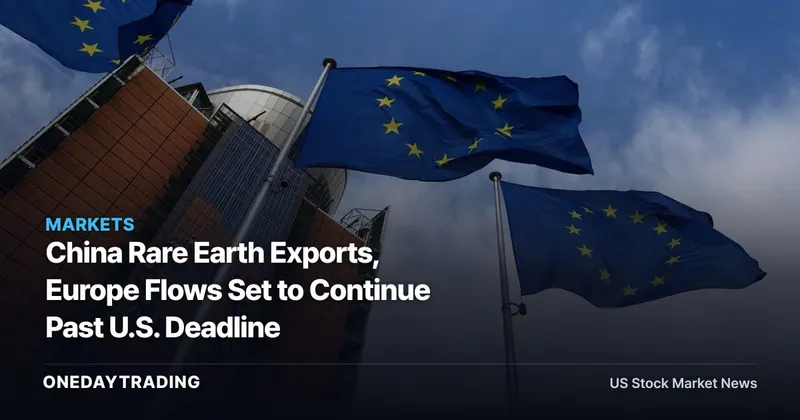
China Separates Europe’s Rare Earth Flow From the U.S. Deadline
China’s promise to keep rare earths flowing to Europe reduces one immediate policy threat for materials-dependent investors, though it does not establish how much supply will move. On Thursday, China’s Commerce Ministry spokesperson He Yadong said Beijing intends to continue approving European licenses regardless of whether the U.S.-China trade arrangement is extended beyond January, according to CNBC Markets.
The distinction matters because export permission is the operating link between policy and physical supply. A commitment to process licenses can preserve that link; it does not guarantee a particular product mix, shipment volume or approval count. Investors therefore have evidence of policy intent, not enough information to calculate a change in availability or commercial exposure.
China, the world’s second-largest economy, is making that assurance after tightening restrictions on all rare-earth exports last October, CNBC Markets reported. Those restrictions reached products containing as little as 0.1% of China-sourced rare earths, giving China’s licensing decisions relevance beyond materials consisting primarily of rare earths.
The “Green Channel” Is a Process Signal, Not a Volume Commitment
A rare-earth export license is official permission for a covered product to leave China under the applicable restrictions. Beijing’s proposed “green channel” for Europe indicates a mechanism intended to keep approvals and shipments moving, while the available facts do not define its eligibility rules, processing speed or covered products.
That gap sets the limits of the investment thesis. The mechanism could support continuity if licenses are approved and the required products are included. It could offer less protection if the channel covers a narrow range of goods or if approvals do not translate into the volumes European users require. None of those outcomes is confirmed.
The European track follows direct engagement in Beijing last week between European trade commissioner Maroš Sefčovič and Chinese Commerce Minister Wang Wentao. China also asked the EU to support Chinese imports of certain products in dual-use sectors, placing rare-earth access within a wider negotiation rather than presenting it as an unconditional, fully specified supply guarantee.
The dual-use request introduces a live countercondition without revealing its commercial scale. The fact sheet does not identify which products China wants the EU to support importing, so investors cannot map the request to particular companies, revenue pools or end markets. The defensible read is narrower: both sides have identified a mechanism for continuity, while important operating terms remain undisclosed.
U.S.-China Timing Still Shapes the Policy Backdrop
The European assurance does not settle the separate U.S.-China question. China and the U.S. agreed in late October 2025 to suspend their respective measures for one year after Chinese President Xi Jinping met U.S. President Donald Trump. That suspension followed a U.S. rule affecting majority-owned subsidiaries of Chinese companies on an entity list, potentially reaching 20,000 Chinese entities, according to CNBC Markets.
Ahead of the leaders’ latest summit last month, U.S. Treasury Secretary Scott Bessent said the truce had been extended by two months to January. Whether it continues after January remains unknown. Beijing’s statement nevertheless indicates that its willingness to approve European rare-earth licenses is not contingent on that decision.
For investors, this creates separate policy paths rather than a single trade outcome. Europe may retain an approval route even if the U.S.-China arrangement is not extended. That separation could reduce the direct read-through from the January deadline to European licensing, although it cannot establish uninterrupted supply without data on actual approvals and shipments.
The balanced case rests on the difference between access and delivery. The constructive scenario is that continued licensing and the “green channel” keep covered rare earths moving to Europe through changes in the U.S.-China trade arrangement. The risk scenario is that limited coverage, unspecified volumes or unresolved dual-use negotiations leave the practical benefit smaller than the policy language suggests.
European Commission Review Defines the Next Checkpoints
European Commission leaders were meeting in Brussels on Thursday and Friday and were expected to review details of the negotiations with China. The outcome of that review is not included in the available evidence, making it the next institutional checkpoint for whether the broad assurance gains more precise terms.
- License approvals: Check whether China discloses how many European rare-earth licenses it approves. The current commitment contains no approval count.
- Product coverage: Look for identification of the rare-earth products eligible for the “green channel.” Without that detail, sector-level exposure cannot be quantified.
- Physical volumes: Separate approval announcements from evidence that specified volumes are being exported to Europe. The present record confirms intent, not shipment quantities.
- January decision: Track whether the U.S. and China extend their trade arrangement beyond January, while recognizing that Beijing has said European licensing will continue regardless.
- Dual-use negotiations: Watch for the EU and China to identify the products covered by Beijing’s import request and for the European Commission to disclose its response.
The investable signal will come from implementation. License counts, named products and shipment volumes would show whether the policy channel is translating into physical supply. Until those details emerge, China’s statement lowers one source of uncertainty for Europe without supporting a bullish or bearish call on individual U.S.-listed stocks.
📊 Analysis
Signal Neutral
Why Continued licensing could support supply continuity for Europe, but unknown products, volumes and approval counts prevent a directional sector call.
This article was independently written by OneDayTrading from public reporting. Read the original (CNBC Markets)