Summary
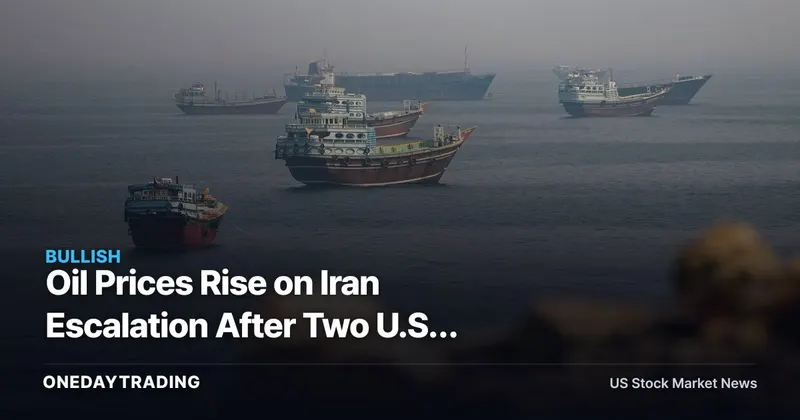
Oil prices rose because the market started pricing a higher chance of disruption, not because supply had already broken. CNBC reported that Tehran urged a return to the June deal while Iran attacked two American bases in Jordan on Monday, in retaliation for the U.S. attack on its Larak Island, and Trump vowed to hit Iran hard.
A geopolitical risk premium is the extra price traders assign to crude when conflict threatens shipping lanes, sanctions enforcement or output security. That premium usually lifts upstream energy names first and leaves refiners exposed if feedstock costs climb faster than product prices.
Why are oil prices rising on Iran news?
Oil prices rise on headlines like this because crude trades on probability, not certainty. The market does not need a supply outage to reprice barrels; it only needs a credible path to more retaliation, tighter transport risk or a longer standoff between Washington and Tehran.
CNBC's report gives traders all three ingredients: a retaliatory strike on two American bases in Jordan, a U.S. attack on Larak Island and a White House that is speaking in hard language. For investors, that is a classic setup for a fast but fragile move higher in oil prices.
What does this mean for energy stocks?
Integrated producers such as Exxon Mobil and Chevron tend to benefit first because a higher crude price can flow through to upstream earnings with limited lag. The stronger the move in front-month crude, the more the market leans toward cash generation rather than volume growth.
Oilfield services names such as SLB and Halliburton usually need the move to last before it matters for budgets, rigs and pressure-pumping demand. Refiners such as Marathon Petroleum face the opposite math: if crude inputs jump faster than gasoline and diesel pricing, margin pressure follows.
Structural background
The deeper issue is that Middle East headlines still set the tone for global crude even when the immediate damage is limited. That makes the oil tape highly sensitive to escalation language, because traders are pricing the chance of a broader physical supply shock before it appears in barrels.
Tehran's call to return to the June deal matters only if it lowers that probability. If the rhetoric cools and no further strike cycle follows, the risk premium can fade just as quickly as it formed.
Stock & Sector Ripple
- Exxon Mobil, CVX: higher crude improves upstream leverage and supports cash flow.
- SLB, Halliburton: a sustained price move can pull through to service demand and capex.
- Marathon Petroleum, Valero: higher feedstock costs can pressure refining spreads.
- XLE: the energy ETF can capture the broad sector bid if crude keeps firming.
Bull vs Bear Scenarios
Bull case: retaliation risk stays elevated, crude keeps a geopolitical premium and energy equities outperform the broad market. Bear case: the exchange of threats proves contained, oil prices give back the headline move and the sector trades back on fundamentals instead of fear.
The key variable is not the rhetoric alone. It is whether the market starts to believe the next headline changes physical supply, transport risk or sanctions enforcement in a durable way.
Investor Action Points
- Watch whether oil prices hold the move after the first reaction to the Jordan strike and Trump's comments.
- Track integrated producers versus refiners; that spread often shows whether the rally is crude-specific or sector-wide.
- Follow the next Iran-U.S. headline for signs of further escalation or de-escalation.
- Use a quick return to calm as the warning signal; risk premiums can fade fast once the market sees no follow-through.
FAQ
Why did oil prices rise after the Iran news?
Oil prices rose because traders immediately priced a higher chance of supply disruption. CNBC reported that Iran attacked two American bases in Jordan and that Trump vowed to hit Iran hard, which raises the odds of a wider regional risk premium.
Which energy stocks gain when oil prices rise?
Exxon Mobil and Chevron usually gain first because higher crude prices improve upstream economics. Oilfield services names such as SLB and Halliburton can benefit too, but only if the move lasts long enough to change spending plans.
What could reverse the move in crude?
A quick de-escalation would do it. If Tehran's push for a return to the June deal starts to look credible and there is no further strike cycle, traders can pull the risk premium back out of oil prices fast.
📊 Analysis
Signal Bullish
Why The news lifts the geopolitical risk premium in crude, which supports upstream energy producers more than refiners.
Tickers$XOM$CVX$SLB$HAL$MPC$VLO
This article was independently written by OneDayTrading from public reporting. Read the original (CNBC)