What Changes
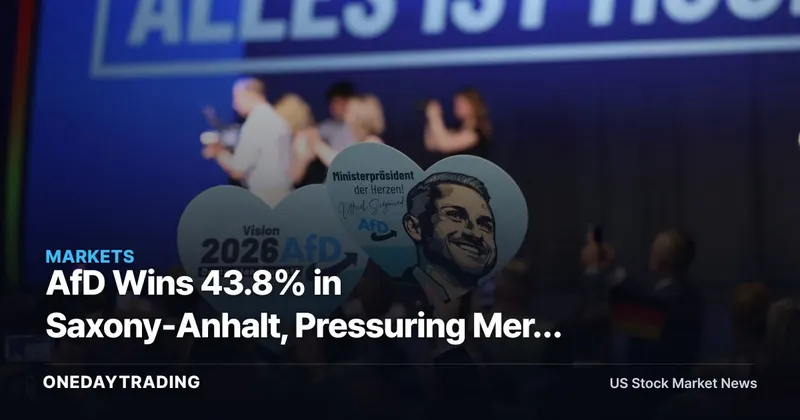
The investor significance is political capacity, not an immediate change in Germany’s budget arithmetic. AfD’s 43.8% result was more than twice the CDU’s 17.2%, while the seat count leaves the party just short of control. Ulrich Siegmund, AfD’s candidate, said he would speak with individual parliamentary groups and lawmakers about support. Those discussions do not establish a governing majority, but they put the firewall under direct pressure.
A state government led or supported by AfD would mark a historic break: analysts described the result as potentially the most consequential German state election of the postwar era and raised the prospect of the hard right taking power in a German state for the first time since the Nazi era. If no coalition can be formed, the immediate outcome is negotiation and uncertainty rather than a new policy regime. Either path gives national parties a more difficult test before elections in Mecklenburg-Western Pomerania and Berlin.
The vote also reflects economic grievances rooted in the physical economy. Saxony-Anhalt has traditionally housed chemicals and motor-supply production, but it suffered heavily from the collapse of eastern German industry after reunification and from the recent rise in energy prices. Former CDU Economic Affairs Minister Peter Altmaier said industry, innovation and welfare dominated the campaign, alongside five years of stagnation, weak job creation and the disappearance of traditional work. Mujtaba Rahman of Eurasia Group said voters seeking a “genuinely radical break” moved to AfD, while liberal and left-wing voters shifted toward the Greens and the Social Democratic Party, squeezing the CDU from both sides.
By the Numbers
AfD’s 43.8% vote share translated into 39 seats; the CDU’s 17.2% left it far behind in the state parliament. The result is therefore significant beyond Saxony-Anhalt’s size because it exposes the federal governing party’s weakness in a region where industrial and labor-market frustration is acute.
At the federal level, Berenberg Chief Economist Holger Schmieding said the state election alone is very unlikely to derail planned increases in defense and infrastructure spending or the package of pension savings, tax and health-care changes, and bureaucracy reductions expected this fall. He judged it more likely than not that Merz’s coalition will continue through the federal parliamentary term ending in early 2029, largely because alternatives are limited. He also called the result a “huge blow” that increases the risk of the government falling apart, making the timeline a probability rather than a guarantee.
Winners & Losers
- Federal reform and spending plans — near-term continuity: The source indicates that higher defense and infrastructure outlays, along with pension, tax, health-care and bureaucracy measures, are unlikely to be cancelled because of this single state result. Their political passage and durability still depend on the coalition’s ability to maintain support.
- AfD — political influence gains: A 43.8% mandate and 39 seats give the party substantial agenda-setting power even without a majority. Its stated anti-refugee and anti-migrant policies, including faster deportations and separate classrooms for refugee children, could shape debate beyond the state.
- Saxony-Anhalt’s chemicals and motor-supply base — continuing structural exposure: These industries already face the legacy of post-unification deindustrialization and higher energy costs. The election highlights those pressures, but the source does not establish a new company-specific earnings effect.
- German sovereign debt — initially stable, longer-term sensitivity: Bund yields were only slightly higher on Monday and moved in line with the rest of Europe. That calm does not remove the risk that prolonged political dysfunction, rising defense debt and weaker growth could challenge Bunds’ status as Europe’s risk-free benchmark.
Risk Check
- Firewall breach: AfD is three seats short of a majority, but cooperation by individual lawmakers could still give it governing influence and force other German parties to reconsider their exclusion rule.
- Coalition breakdown: Merz is already deeply unpopular in polling. A state defeat can intensify disputes over migration, welfare, taxes and industrial policy inside the federal coalition.
- Reform paralysis: The immediate spending and reform agenda is not expected to be derailed, yet a loss of centrist consensus could hamper decision-making and worsen existing economic dislocations.
- European spillover: Ministers in Poland and France called the result worrying as far-right parties gain ground in their own political systems. Germany’s central position in the euro zone means domestic uncertainty could eventually reverberate across neighboring markets.
Bottom Line
Saxony-Anhalt has not overturned Germany’s federal spending plans, and the mild Bund reaction shows that investors are not pricing an immediate institutional crisis. It has, however, increased the political weight of AfD and revealed how strongly industrial stagnation, energy costs and weak job creation are feeding challenger-party support. The next concrete checkpoints are talks over formation of the Saxony-Anhalt government, the federal coalition’s fall votes on spending and reforms, and election results in Mecklenburg-Western Pomerania and Berlin. Investors should distinguish a temporary state-level shock from a pattern that begins to delay national decisions or widens Germany’s borrowing premium against broader European bond moves.
FAQ
What was the AfD result in Saxony-Anhalt?
Alternative for Germany won 43.8% of the vote and 39 of the state parliament’s 83 seats. That leaves the party three seats short of an outright majority, so it cannot govern alone on the initial results.
Can AfD form a state government in Germany?
It is possible but not settled. Germany’s firewall convention discourages other parties from cooperating in a way that gives AfD power, while candidate Ulrich Siegmund said he would approach individual groups and lawmakers for support.
Will the election stop Germany’s defense and infrastructure spending?
Holger Schmieding of Berenberg said the Saxony-Anhalt result alone is very unlikely to derail planned increases in defense and infrastructure spending or the accompanying pension, tax, health-care and bureaucracy reforms. The principal risk is that broader coalition instability weakens or delays those measures over time.
📊 Analysis
Signal Neutral
Why The election is a major political setback for Friedrich Merz, but the source says federal spending and reforms are unlikely to be derailed immediately and markets have remained orderly.
This article was independently written by OneDayTrading from public reporting. Read the original (CNBC)