Key Takeaways
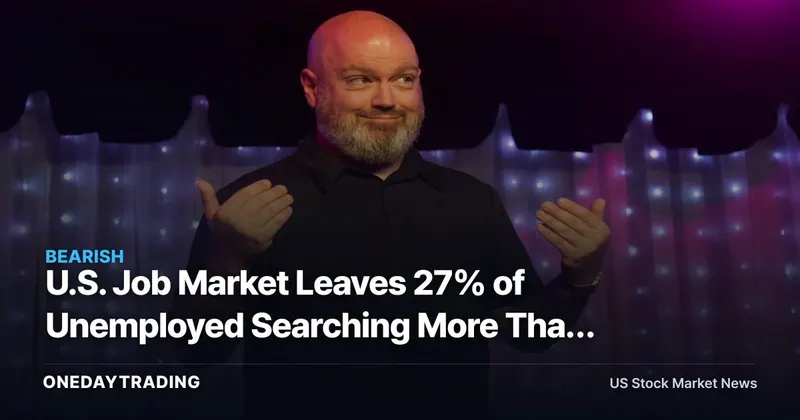
The U.S. job market is sending investors a duration warning, not proof of an accelerating downturn: 27% of unemployed Americans, or nearly 2 million people, have been looking for work for more than six months, according to the latest Bureau of Labor Statistics data cited by CNBC. That concentration of long searches matters because extended unemployment can erode household financial buffers and discretionary demand even without a sharp rise in the headline unemployment rate.
Tim Millard’s experience—at least 300 applications after a July 2025 layoff—shows how a low-fire, low-hire labor market can affect someone already outside payrolls. It cannot, by itself, establish a national trend or justify a company-specific earnings conclusion. The investable question is whether subsequent labor reports confirm persistent hiring weakness and whether that pressure reaches consumer spending.
What Happened
Long-term unemployment means remaining jobless for more than six months, a duration that can reveal labor-market stress not fully captured by the headline unemployment rate. Per CNBC’s Sept. 7, 2026 reporting, Millard, 45, lost his multimedia content-producer role at an Atlanta-based consumer research and review platform in July 2025 after six years with the company.
Millard initially expected his marketable skills to produce a quick return to employment. As the search stretched on, he assembled freelance assignments to pay for housing, bills and food while submitting what he estimates were at least 300 applications. That total does not disclose the mix of positions, interview rate or quality of each application, but it illustrates what weak hiring turnover looks like from the applicant’s side.
In November 2025, when the U.S. unemployment rate reached 4.6%, its highest level in four years, a friend suggested turning the experience into a performance for the Atlanta Fringe Festival. Millard submitted an outline in January 2026, was accepted several weeks later and opened “After Careful Consideration” on May 28 before about 25 people. He ultimately performed the show five times while continuing to look for work.
Background & Context
The relevant macro condition is the mismatch between available workers and employers’ willingness to hire. A low-fire, low-hire market describes an environment with limited dismissals but also limited recruitment. Employment can therefore appear broadly stable while people who have already lost jobs face unusually difficult searches.
Duration determines how labor weakness reaches the real economy. A newly unemployed worker may initially draw on savings, benefits, severance or temporary income; a search exceeding six months increases the risk that those resources diminish and spending must adjust. With nearly 2 million Americans in that category, investors need to track the aggregate data rather than extrapolate from Millard’s case alone.
The source does not provide a prior-period comparison for either the 27% share or the nearly 2 million total. It therefore supports the conclusion that long-term unemployment is a material current feature of the U.S. labor market, but not the stronger claim that this problem has recently intensified.
Market & Stock Impact
- Broad U.S. equities: The source reports no stock-price movement and identifies no listed employer, so attaching the story to a particular company would overreach. The potential transmission is macroeconomic: prolonged joblessness may restrain labor income and consumption, while softer employment conditions can influence rate expectations and the valuation multiples investors assign to future earnings.
- Consumer-facing sectors: Households facing long searches may conserve cash and reduce discretionary purchases as savings and temporary income decline. Millard’s need to use freelance work to cover essential expenses demonstrates the mechanism, but the source provides no retail-sales, credit or corporate-revenue data to quantify its national effect.
- Employment-sensitive businesses: Hundreds of unsuccessful applications suggest scarce hiring opportunities for this individual, not a measured decline in demand across the staffing or recruiting industries. No public employment platform, placement company or employer is identified, and the reporting supplies no vacancy, wage or application-conversion figures.
- Interest-rate expectations: Persistent labor softness can reduce wage and inflation pressure, potentially affecting the expected path of monetary policy. Lower expected rates can support equity multiples, but that benefit can be offset if the same labor weakness points to softer revenue growth. The source provides no Federal Reserve decision, Treasury yield or inflation reading, so neither market response is confirmed here.
What the Tape May and May Not Price
A slow labor market can produce competing equity signals. The rates channel may favor valuations if investors infer less inflation pressure and easier policy, while the earnings channel may turn negative if prolonged unemployment weakens household demand. Which force dominates depends on evidence absent from the source: inflation, yields, consumption and corporate guidance.
The tape can absorb a known unemployment rate more readily than the cumulative effects of unemployment duration. November 2025’s 4.6% rate was observable immediately; depleted savings and reduced spending can surface later. That lag makes the nearly 2 million long-term unemployed an important checkpoint, but not a standalone forecast for the S&P 500 or the economy.
Investor Checkpoints
- Long-term unemployment: At the next Bureau of Labor Statistics labor report, compare the share and total with the cited benchmarks of 27% and nearly 2 million. A lower headline unemployment rate would be less reassuring if extended searches remained prevalent.
- Headline unemployment: Compare future readings with November 2025’s 4.6%, which was then the highest rate in four years. Determine whether any improvement reflects completed hiring rather than workers leaving the labor force.
- Hiring flows: Look for evidence that employers are actually adding workers, not merely avoiding layoffs. Job creation, vacancies and hiring activity would show whether the low-hire side of the market is easing.
- Consumer resilience: In subsequent economic releases and company results, examine whether weaker labor income is reaching household demand. The source documents financial pressure at the individual level but does not establish a national decline in consumption.
Outlook
The bearish scenario is that long searches persist or become more common. More households would then risk depleted financial buffers, weaker bargaining power and cuts to nonessential spending. Equity markets could feel that effect through lower growth expectations and softer consumer revenue before it becomes dramatic in the headline unemployment rate.
The counter-scenario is a labor market that remains slow without deteriorating further, followed by stronger hiring that shortens search duration. Millard is pursuing freelance assignments, personal networking and unconventional outreach, including distributing free water bottles with copies of his résumé near a popular Atlanta walking path. Those efforts may improve one person’s odds, but they cannot replace economy-wide evidence that employers are opening positions and completing hires.
The next decisive trigger is the next labor report: investors should test the 27% share and nearly 2 million total against fresh hiring and participation data. If duration falls alongside firmer hiring, the consumer-risk channel weakens. If duration remains elevated while hiring stays subdued, the market may have to weigh any valuation benefit from lower rate expectations against a more persistent threat to household demand.
FAQ
What does the 27% long-term unemployment figure mean?
It means 27% of unemployed Americans had been searching for work for more than six months in the latest Bureau of Labor Statistics data cited by CNBC. The group numbered nearly 2 million people, making extended searches a significant current feature of the labor market.
Why did Tim Millard create a one-man show about unemployment?
After losing his job in July 2025 and submitting at least 300 applications, Millard described the process as demoralizing, dehumanizing and depressing. A friend suggested turning those experiences into a performance, which Millard staged five times after opening at the Atlanta Fringe Festival on May 28.
What does a low-fire, low-hire job market mean for investors?
It describes a market in which employers conduct relatively few layoffs but also add relatively few workers. The pattern can prolong unemployment, pressure household spending and affect rate expectations, although investors need hiring, consumption, inflation and yield data before drawing a directional conclusion for equities.
📊 Analysis
Signal Bearish
Why Prolonged unemployment creates a downside risk to household spending and growth, although the supplied data do not establish that labor conditions are worsening.
This article was independently written by OneDayTrading from public reporting. Read the original (CNBC)