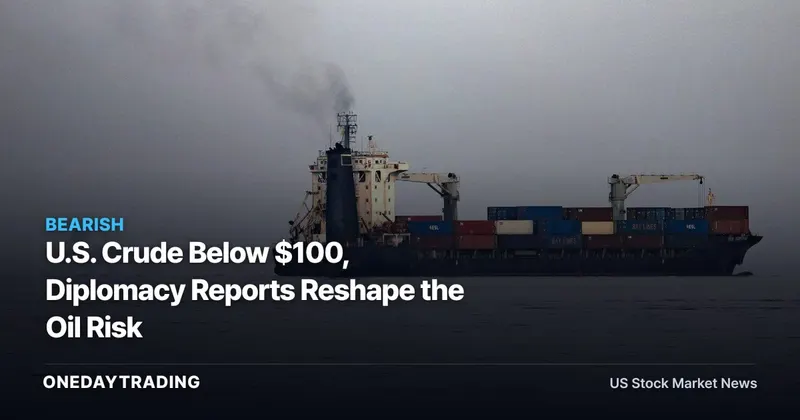
CNBC reported U.S. crude below $100 per barrel as oil futures fell sharply early Monday amid reports that the U.S. and Iran were pursuing diplomatic options. For investors, the move shows the oil market responding to the possibility of a less confrontational path while leaving the outcome of the conflict—and future oil prices—unresolved.
CNBC Oil Prices Show a Sharp Diplomatic Repricing
Oil futures are contracts for delivery during a specified period, so the January Brent and December U.S. West Texas Intermediate prices represent different delivery schedules. CNBC reported that Brent crude futures for January delivery fell 3.91% to $109.00 per barrel as of 4:07 a.m. ET. In the same report, U.S. West Texas Intermediate futures for December declined 4.1% to $99.85 per barrel.
The central market signal is not that diplomacy has succeeded. No agreement was confirmed, and the specific terms sought by the U.S. and Iran were not disclosed. The tape instead moved alongside reports that diplomatic options were being explored, showing that the possibility of talks was relevant enough to coincide with a sharp decline across both crude benchmarks.
The distinction matters. Prices can respond to a change in the range of possible outcomes before any outcome becomes certain. Here, the confirmed facts support a narrower conclusion: crude fell sharply while diplomatic reporting gained attention, even as military risks remained active.
Marco Rubio and Iran Leave Two Paths Open
Marco Rubio said Donald Trump preferred not to use military force and wanted to resolve the Iranian war “diplomatically.” He also said Trump “hasn't made a decision” and added, “But we would prefer to do it peacefully.” Those statements establish a preference for diplomacy without establishing that military action has been ruled out.
Iranian authorities also indicated that a deal remained possible after two days of talks mediated by Qatar, according to reporting cited by CNBC. Their condition was that demands be implemented tangibly. That condition preserves the possibility of an agreement while making clear that talks alone do not amount to a completed settlement.
The market therefore faces a split set of signals. Diplomatic engagement offers a possible route away from escalation, while the absence of disclosed terms prevents investors from judging whether the positions are compatible. The immediate fall in crude reflects the price move already visible; the feasibility and durability of any deal remain outside what the available evidence can establish.
The Wall Street Journal and The New York Times Keep Military Risk Live
The diplomatic reports sit beside a materially different possibility. The Wall Street Journal and The New York Times reported that the U.S. was preparing for possible renewed military actions after the Nov. 3 midterm elections. Preparation is not execution, so those reports should not be presented as confirmation that renewed action will occur.
Tehran’s public posture also remained forceful. On Saturday, Mojtaba Khamenei called on Iran’s armed forces to answer “any level or type of threat” with “an immediate, impactful, and geographically unrestricted response.” That language makes the crude decline a repricing under uncertainty, rather than proof that conflict risk has disappeared.
Tamas Varga, an analyst at PVM Oil Associates, pointed to continuing attacks on ships and refineries in the Middle East and on civilians in Ukraine as reasons for limited confidence in lasting ceasefires. His closing assessment—“Nonetheless, hope springs eternal”—captures the tension in the market: diplomatic hope can affect prices even while ongoing conflict limits conviction.
Oil Investor Checkpoints After the Monday Decline
- Implementation of diplomatic demands: The next substantive test is whether the conditions referenced by Iranian authorities are carried out tangibly. The evidence does not identify those conditions, so headlines about continued contact should be separated from confirmation of implementation.
- Any decision from Donald Trump: Marco Rubio’s statement leaves the choice open. A confirmed decision would carry more informational weight than the stated preference to resolve the conflict peacefully.
- Developments after the Nov. 3 midterm elections: Investors can compare subsequent events with reports of preparations for possible renewed U.S. military action. Those reports describe contingency planning, not a guaranteed outcome.
- Brent and West Texas Intermediate together: CNBC’s reported levels provide the immediate reference points: January Brent at $109.00 per barrel after a 3.91% fall, and December West Texas Intermediate at $99.85 per barrel after a 4.1% decline. Further price direction is unknown.
The bearish near-term signal is the decline already recorded in both benchmarks, not a forecast that oil must continue lower. A tangible diplomatic agreement could reinforce the peaceful path described by Rubio and Iranian authorities; renewed military action or a geographically unrestricted response would challenge that interpretation. Lim Hui Jie contributed to CNBC’s report, which leaves the market with a clear price move but no confirmed resolution to the conflict.
📊 Analysis
Signal Bearish
Why The sharp declines in Brent and U.S. West Texas Intermediate show near-term downward pressure on oil prices amid reports of possible diplomacy.
This article was independently written by OneDayTrading from public reporting. Read the original (CNBC)