Summary
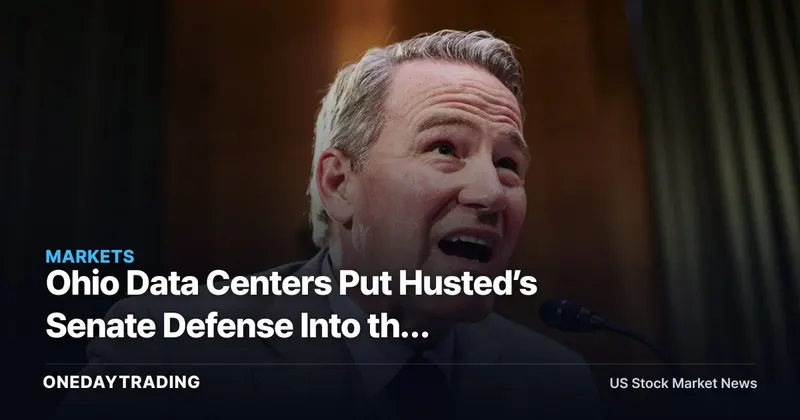
Ohio data centers are becoming an energy-policy test for Senator Jon Husted because CNBC reported that GOP leaders see power demand concerns as a risk to one Ohio Senate seat while Husted defended his policy stance alongside Vice President JD Vance at a Middletown steel plant.
The investor read-through is not a clean stock call; the signal is political. Data center load growth has moved from utility planning rooms into campaign strategy, which means power permitting, grid costs and industrial electricity priorities now carry election-cycle risk.
The Full Story
CNBC reported that Vice President JD Vance joined Senator Jon Husted and other Republican leaders at a steel plant in Middletown, Ohio, as fears over data centers loomed over the state’s energy debate. The setting mattered: a steel plant is a physical reminder that electricity policy is not only about servers, but also about manufacturers competing for power, rates and infrastructure.
Data centers are large computing facilities that house servers, networking gear and cooling systems, and data center power demand can pressure electric grids when new capacity arrives faster than transmission, generation or local rate structures can adjust. In Ohio, CNBC’s report frames that pressure as a political vulnerability for Republicans rather than a narrow zoning or utility issue.
Husted’s defense of energy policy suggests the market issue is policy durability. If state leaders keep courting data center investment while voters worry about bills or grid strain, utilities and industrial users face a more complicated approval path for projects tied to power-intensive growth.
Structural Background
The capital-cycle problem is simple: data centers want reliable electricity, steel plants and other manufacturers already depend on it, and politicians absorb the backlash when voters believe new demand raises costs. CNBC’s report does not name a utility, a megawatt figure or a rate increase, so the only defensible conclusion is that the political channel has become visible.
For investors, that visibility matters because policy friction can slow timelines even when end-demand remains strong. The bull case for AI infrastructure assumes grid access expands; the bear case starts when local politics turns electricity scarcity into a campaign issue.
Stock & Sector Ripple
- Utilities: Ohio-linked power providers face a higher political bar if data center demand becomes associated with household bills or industrial crowd-out.
- Data center developers: The sector benefits from AI and cloud demand, but local approvals become less automatic when Senate campaigns frame electricity as a voter issue.
- Industrial manufacturers: Steel and heavy industry gain from stable energy policy, but large new loads can sharpen competition for power availability and rate treatment.
- AI infrastructure suppliers: Server and networking demand remains the long-term driver, but the Ohio debate shows that grid bottlenecks can become a real constraint outside the semiconductor supply chain.
Bull vs Bear Scenarios
The bull scenario is that Husted and Ohio Republicans keep data center growth politically acceptable by pairing new load with credible energy expansion, preserving investment momentum without alienating industrial users. In that case, data centers stay a local jobs-and-tax-base story rather than a ratepayer backlash story.
The bear scenario is that voter concern over electricity costs turns data centers into a campaign liability, forcing tighter scrutiny of power-intensive projects. If that happens, the risk shifts from demand to execution: permits, grid upgrades and rate structures become the bottleneck.
Investor Action Points
- Track Husted’s next energy-policy statements for whether the defense focuses on supply growth, consumer rates or industrial protection.
- Watch Ohio utility proceedings for any data center-related rate design, interconnection or generation-capacity language.
- Separate AI demand from grid deliverability; strong cloud demand does not remove local power constraints.
- Use the Ohio Senate race as a policy-risk checkpoint for data center markets where electricity has become politically sensitive.
FAQ
Why are Ohio data centers a Senate campaign issue?
Ohio data centers are a Senate campaign issue because CNBC reported that GOP leaders worry data center fears could put one Ohio Senate seat at risk. The concern is that power-intensive development can become politically sensitive when voters connect new electricity demand with costs or grid pressure.
What did Jon Husted defend on Ohio energy policy?
Jon Husted defended his energy policy position in CNBC’s report while appearing with Vice President JD Vance and other Republican leaders at a Middletown, Ohio, steel plant. CNBC did not provide a utility-specific figure, rate number or named data center company in the supplied source material.
How do data center power demands affect utilities and industrial stocks?
Data center power demand affects utilities and industrial companies when large electricity loads compete with manufacturing needs and require grid investment. In Ohio, the CNBC report shows that the market risk is political approval and cost allocation, not a disclosed earnings hit to a named listed company.
📊 Analysis
Signal Neutral
Why The CNBC report signals rising policy risk around Ohio data center power demand but does not identify a listed company, financial figure or direct earnings impact.
This article was independently written by OneDayTrading from public reporting. Read the original (CNBC)