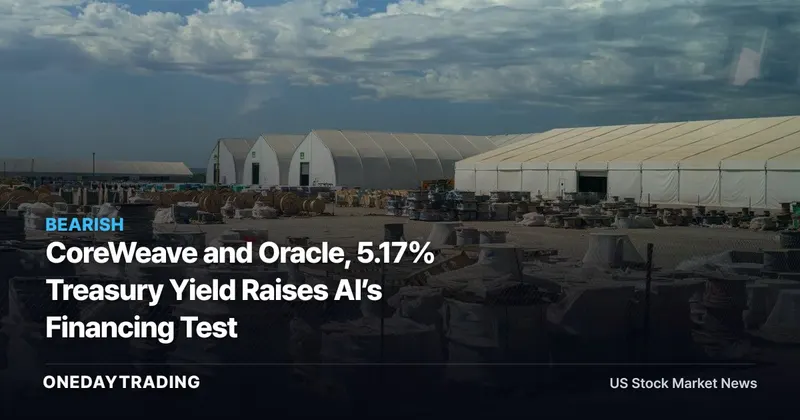
CoreWeave and Oracle Face a More Expensive AI Buildout
CoreWeave, Oracle and other debt-reliant AI infrastructure companies face a tighter financing test after Treasury yields climbed this week to their highest levels since 2007. CNBC reported that the 10-year Treasury yield was near 5.17%, about 1 percentage point higher since the start of the year. For investors, the central issue is no longer whether AI capacity attracts capital, but how much of the higher financing cost borrowers can carry without weakening project economics.
The pressure is directional rather than uniform. CoreWeave rose almost 8% this week, while Oracle fell 7% this week and about 30% this year. That divergence suggests the market has not assigned one financing outcome to every AI infrastructure company, even as the common rate benchmark has moved sharply higher.
The 5.17% Yield Changes the Cost of AI Capital
The AI infrastructure financing chain connects model developers seeking compute capacity, the companies building or supplying that capacity, and the investors funding those projects. A higher Treasury yield raises the baseline return available to lenders, so debt issuers may need to offer more attractive terms to secure capital. Companies with floating-rate obligations also face a more direct path from higher rates to interest expense.
CoreWeave quantified that exposure in its own filing. As of June, the company said each 100-basis-point, or 1-percentage-point, rate increase could add $30 million to interest expense based on its outstanding floating-rate debt balance. The figure does not determine CoreWeave’s future expense, since the ultimate impact of higher Treasury yields on individual projects is unknown, but it gives investors a concrete sensitivity against which to test the balance sheet.
The prospective funding requirement is large. JPMorgan Chase estimated in June that $4.1 trillion of AI-related debt would be issued through 2030. The exact volume and pricing remain unknown, so that estimate should be treated as a measure of potential financing demand rather than a completed funding total.
SoftBank Shows Capital Is Available at a Price
SoftBank raised $11.1 billion in a junk-bond sale this week, with yields reaching 9.75% on the 7-year tranche. The transaction indicates that funding can still clear at elevated yields; it also illustrates how expensive that access may become for a principal provider of capital to AI projects.
Mark Malek of Siebert Financial described such borrowers as price takers because their need for capital can make them insensitive to the offered rate. The investment implication is straightforward: access to debt is not the same as favorable economics. Issuance can continue while a growing portion of project value is claimed by financing costs.
Andrew Giudici, global head of corporate, project, and infrastructure finance at KBRA, expects relatively large issuance to continue. Haim Zaltzman, vice chair of Latham & Watkins’ emerging companies and growth practice, said somebody must absorb the higher cost. Those views support a scenario in which the buildout proceeds, with the financial burden allocated somewhere within the funding and infrastructure chain rather than stopping activity outright.
Credit Selection Is Narrowing Across Neoclouds
Riley Thompson, a vice president at Mitsubishi HC Capital America, said market interest has narrowed from a previous roster of 50 neoclouds to about 20. That distinction matters more than the headline availability of capital: lenders can continue financing the sector while concentrating their commitments among a smaller set of borrowers and projects.
For equity holders, this creates a selection problem. A company can participate in strong compute demand and still face unfavorable financing if its debt structure provides little cushion against higher rates. Conversely, contracts connected to OpenAI or Anthropic may support lenders’ willingness to fund capacity because both model developers are described as securing compute through agreements extending years into the future.
Bernie Margulies, CEO of American Compute, framed the trade-off by asking whether 50 basis points would deter a borrower with an Anthropic deal. American Compute advises on risk management for GPU financing. His question captures the bullish credit case: when access to contracted compute demand matters more than a marginal increase in borrowing cost, financing may continue despite a higher benchmark.
Oracle’s Project Jupiter Adds Execution Risk
Oracle said Project Jupiter “remains on our planned schedule,” while its expected opening year is 2028. Whether the project actually comes online in 2028 is not confirmed. The stock’s 7% decline this week and roughly 30% fall this year show that investors are already applying pressure to the equity, though the supplied evidence does not isolate how much of either move reflects Project Jupiter or interest rates.
The next useful checkpoint is therefore operational as well as financial. Investors need evidence that Project Jupiter stays on schedule, followed by any disclosure showing how Oracle funds the project and absorbs its financing costs. Schedule execution would address one uncertainty; it would not by itself resolve the cost of capital.
Hyperscalers Have a Different Financing Position
Amazon, Google, Meta and Microsoft are the technology hyperscalers providing infrastructure for advanced models and services. Their investment-grade credit ratings give them cheaper access to capital than weaker borrowers, which can make rising yields less restrictive for them than for debt-heavy neoclouds. Hyperscaler capital expenditures were expected to increase in 2027, keeping their financing capacity relevant to the broader buildout.
Demand evidence provides the counterweight to the rate shock. Meta’s Muse recorded more than 2.5 million global downloads in its first two weeks. Evercore’s Mark Mahaney said Muse could reach 100 million users within six to 12 months, though that outcome is not established and should not be treated as a forecast already achieved.
OpenAI and Anthropic were each described at close to a $1 trillion private-market valuation. Their long-dated compute contracts may support infrastructure financing, yet valuations and contracts do not erase rate sensitivity. The investable question is whether demand translates into cash flows capable of carrying the higher interest burden at each borrower.
Stock and Sector Read-Through
- CoreWeave: The nearly 8% rise this week shows that its stock has held up despite the rate move. Its disclosed $30 million interest-expense sensitivity per 100-basis-point increase makes floating-rate exposure the clearest risk metric.
- Oracle: A 7% weekly decline and an approximately 30% fall this year place more execution pressure on Project Jupiter. Confirmation that the project remains on schedule does not establish that it will open in 2028.
- JPMorgan Chase: Its $4.1 trillion estimate through 2030 frames the potential scale of AI-related issuance. Actual future volume and pricing are still unknown.
- Amazon, Google, Meta and Microsoft: Investment-grade ratings provide cheaper capital access, creating a financing distinction between hyperscalers and more debt-dependent infrastructure borrowers.
- SoftBank: Its $11.1 billion sale shows that capital remained available this week, while the 9.75% yield on the 7-year tranche demonstrates the price required in that transaction.
Bull and Bear Paths for AI Infrastructure Debt
Bull case: Borrowers continue issuing because contracts with OpenAI and Anthropic support demand for compute capacity, while user adoption such as Muse’s first-two-week download total reinforces the need for infrastructure. In this path, higher yields reduce economics without preventing the buildout, and lenders keep allocating capital to the strongest projects.
Bear case: Treasury yields remain elevated enough to compound interest expense, narrow lender interest further and pressure projects with less financial cushion. CoreWeave’s rate sensitivity supplies the measurable warning, while Oracle’s performance shows how quickly schedule and funding concerns can weigh on equity sentiment.
A separate constraint comes from local opposition. A cited poll found that 69% of respondents opposed AI data-center construction in their local area. This creates another project-level risk alongside financing, although the evidence supplied does not establish the ultimate impact on any individual development.
Investor Checkpoints After the Treasury Spike
- Track the 10-year Treasury yield: Compare future readings with the current level near 5.17% and the increase of about 1 percentage point since the start of the year.
- Recalculate CoreWeave’s exposure: Use its disclosed $30 million interest-expense sensitivity for each 100-basis-point increase, while checking whether the relevant floating-rate debt balance changes.
- Test Oracle’s schedule: Look for evidence that Project Jupiter remains aligned with its expected 2028 opening and for disclosures clarifying its funding economics.
- Watch credit selectivity: Determine whether lender interest expands beyond the roughly 20 neoclouds identified by Riley Thompson or contracts further from that level.
The next decisive signal will come from the interaction of the 10-year Treasury yield, financing terms and project execution. Strong compute demand can keep issuance moving; it cannot make the price of debt irrelevant.
📊 Analysis
Signal Bearish
Why Higher Treasury yields increase financing pressure on debt-reliant AI infrastructure companies, even as demand signals may sustain borrowing.
Tickers$CRWV$ORCL$JPM$AMZN$GOOGL$META
This article was independently written by OneDayTrading from public reporting. Read the original (CNBC)