Wall Street Flows Shift Toward Institutions
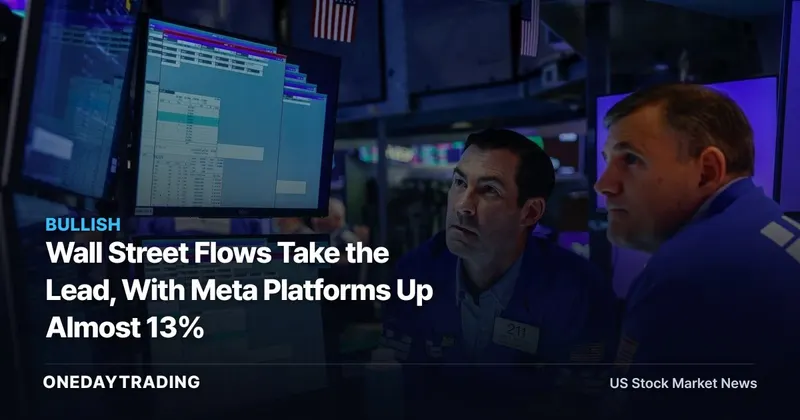
Institutional investors, rather than retail traders, were emerging as the stock market’s driving force on 2026-09-27, with Meta Platforms and selected artificial-intelligence exposure attracting attention. The immediate message for investors is not that rising yields have stopped mattering. It is that large investors have continued accepting equity risk while becoming more selective about where they place it.
CNBC reported that institutional options flows were around three times higher than a typical September. The strength was notable because Vanda Research found that large investors held steady on stocks while U.S. Treasury yields climbed, giving the flow data a clearer macro significance than a broad index gain alone.
What Vanda Research’s Flow Data Says
Institutional flow means the trading activity attributed to large professional investors; options flow captures their activity in contracts linked to underlying securities. Neither measure reveals every investor’s conviction, though both can show whether professional participation is strengthening or retreating during volatility.
Vanda Research strategist Viraj Patel said institutional flows increased over the past five sessions. He described institutional investors as resilient through the week’s macro volatility and called their positioning a “reasonably constructive signal for risk appetite.” That wording matters: the evidence points to continued participation, not indiscriminate enthusiasm.
The rate backdrop raises the bar for that interpretation. CNBC reported that 10-year and 30-year U.S. Treasury yields had reached their highest levels in more than a decade. Higher yields can challenge equities by increasing the return available from Treasurys and by making investors more demanding about the value of future corporate results. Institutions holding their equity exposure under those conditions suggests that the tape had not fully shifted into broad de-risking.
The S&P 500 reinforced that signal by ending the prior week more than 1% higher and remaining positive for the month, according to CNBC. The index move and institutional activity point in the same direction, though they answer different questions: the benchmark shows the market outcome, while the flow data identifies which investor group was helping sustain participation.
Meta Platforms Becomes the Selectivity Test
The institutional bid was concentrated rather than universal. Patel said professional traders were buying selected artificial-intelligence plays and identified Meta Platforms as a top pick in the prior week. That makes the Facebook parent the clearest company-level example of the broader rotation described by Vanda Research.
Meta Platforms shares rose almost 13% in the week following the debut of its Muse Charm device, CNBC reported. The stock had also been building momentum after the company unveiled its Muse personal AI agent earlier in the month, although the exact unveiling and device-debut dates were not provided.
The analytical distinction is crucial. Institutional buying and the share-price advance establish market interest in Meta Platforms around its artificial-intelligence products; they do not establish revenue, adoption or profit contribution from those products. The available evidence supports a momentum and positioning thesis, not a completed commercial thesis.
That gap also explains why selectivity can coexist with macro uncertainty. Investors can maintain equity exposure while concentrating it in companies attached to a favored theme. As Patel put it, macro uncertainty was not preventing risk-taking; it was making investors “far more selective.” Meta Platforms is therefore both a beneficiary of the current flow pattern and a test of whether product attention can support the expectations embedded in its rally.
Goldman Sachs Tracks Retail Traders’ Retreat
The other side of the shift is weaker retail participation. Goldman Sachs said retail investors’ share of S&P 500 trading volume had fallen from its peak nearly a year earlier and now stood more than three percentage points below the five-year average. The exact current share and absolute retail trading volume were not disclosed.
That decline follows a strong 2025 for retail traders. Their performance was associated in part with buying market declines after President Donald Trump’s tariff rollout. The present data does not show that retail investors have abandoned equities; it shows that their share of S&P 500 activity has moved below its longer baseline while institutional participation has strengthened.
This changes the market’s internal leadership more than its direction by itself. Retail traders moving toward the sidelines reduces one source of trading demand, while institutions can offset that absence if their flows remain firm. The key issue is durability: a shift in who drives volume can persist without guaranteeing that the index will keep advancing.
Rates, Risk Appetite and What the Tape Prices
The tape already reflects two supportive facts: the S&P 500 gained more than 1% in the prior week, and Meta Platforms advanced almost 13% in the week after its device debut. It also reflects unusually strong institutional options activity relative to a typical September. Those moves leave less room for investors to treat resilient positioning as a new discovery.
What remains unresolved is whether institutional demand can withstand continued pressure from 10-year and 30-year Treasury yields. The exact yield levels were not supplied, so no specific rate threshold can be inferred. The relevant comparison is directional: institutional participation stayed firm even as yields reached highs not seen in more than a decade.
A constructive scenario would feature institutional flows remaining elevated, the S&P 500 retaining positive monthly territory and selective artificial-intelligence exposure continuing to attract professional capital. In that setting, the market could absorb limited retail participation because large investors would remain willing to carry equity risk.
The counter-scenario is a narrowing market in which strong flows cluster around a small set of favored ideas while rising yields make the rest of the equity market less attractive. Meta Platforms would then face a higher burden of proof after its sharp advance. Without adoption, revenue or profitability figures for Muse Charm or the Muse personal AI agent, price momentum alone cannot demonstrate that the product story is durable.
Investor Checkpoints After the Institutional Takeover
- Institutional flow: Check whether the increase reported over the past five sessions continues or fades. Persistence would support the view that professional risk appetite is durable rather than a brief response to volatility.
- Treasury pressure: Follow the direction of 10-year and 30-year U.S. Treasury yields. Continued equity resilience alongside elevated yields would strengthen the institutional-demand thesis; weakening flows would expose its limit.
- Market breadth through the S&P 500: Track whether the benchmark remains in positive territory for the month. A positive index with increasingly selective flows would signal a different market structure from broad participation.
- Meta Platforms evidence: At the company’s next update, look for concrete information on Muse Charm and the Muse personal AI agent. Product adoption and financial contribution are the missing evidence needed to judge whether the almost 13% weekly advance rests on more than positioning.
The next decisive signal is not another declaration that institutions have taken control. It is whether their flows remain firm when Treasury yields apply pressure, and whether Meta Platforms can replace an artificial-intelligence narrative with measurable product evidence.
📊 Analysis
Signal Bullish
Why Rising institutional flows, selective artificial-intelligence buying and a positive S&P 500 month indicate constructive risk appetite despite rate pressure.
This article was independently written by OneDayTrading from public reporting. Read the original (CNBC)