What the October 2026 PPI Really Changes
The Federal Reserve received a mixed inflation signal in October 2026: producer prices rose less than the Dow Jones consensus forecast, while the annual headline rate accelerated. That combination matters because the monthly surprise can ease the immediate concern without proving that the underlying inflation trend has weakened. The investor question is therefore not whether the report beat one forecast, but whether its breadth is compatible with sustained progress toward the Federal Reserve inflation goal.
The producer price index measures prices received by domestic producers before products reach consumers. Its market relevance comes through two conditional channels. Producers may absorb higher input costs, which can pressure margins, or attempt to pass them onward, which can preserve margins while extending inflation pressure. The supplied evidence does not establish which response will dominate, so company-specific earnings effects cannot be measured from this report.
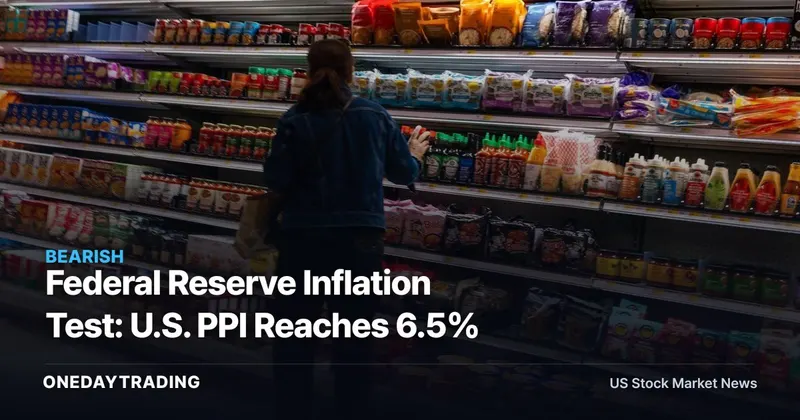
The annual comparison keeps the report from being read as an uncomplicated relief signal. CNBC said headline PPI reached 6.5% on an annual basis in October 2026, an acceleration of 0.2 percentage point and the highest rate since November 2022. A single monthly undershoot carries less weight when the annual rate is moving farther above the Federal Reserve inflation goal of 2%.
Bureau of Labor Statistics Data Show Pressure Beyond Headline PPI
The Bureau of Labor Statistics reported that core PPI rose 0.3% in October 2026, matching expectations. A separate measure excluding food, energy and trade services increased 0.5% in October 2026. That firmer reading limits the case that the headline result can be dismissed as pressure confined to the most volatile components.
Goods prices also increased 0.5% in October 2026. More than 60% of that increase was driven by goods excluding food and energy, even though the supplied data separately state that goods excluding food and energy recorded a 0.1% decrease. Those statements appear together in the evidence, but the full underlying PPI dataset was not provided; investors should avoid inventing a reconciliation that the available figures cannot support.
The goods index rose 10.2% over the 12 months through October 2026, its largest such increase since October 2022. Prices for intermediate processed goods advanced 14.6% from October 2025, the largest annual gain since July 2022. These upstream measures do not guarantee an equivalent change in consumer prices or corporate margins, though they identify where cost pressure may enter production chains.
Services and Freight Broaden the Inflation Test
Final demand services prices rose 0.2% in October 2026, while truck transportation of freight increased 3.9%. Intermediate prices for services posted a 6.9% increase, the largest since November 2022. The mix therefore spans both physical goods and services rather than resting on one narrow category.
For equity analysis, breadth can matter more than one headline surprise. Goods-intensive businesses may face higher input costs, while businesses dependent on freight may encounter pressure through transportation expenses. Whether those costs damage earnings depends on pricing power, contract terms and operating efficiency, none of which are supplied in the evidence; naming individual corporate winners or losers would overstate what this release establishes.
Chicago Fed President Austan Goolsbee captured the policy concern in an interview with CNBC: “We've had some signs of trouble now for several months in a row.” He also said, “Inflation is rising; it's it's proved far more persistent than we predicted at the beginning from the supply shocks.” His comments reinforce the importance of persistence and breadth, while remaining commentary from one named policymaker rather than the stated decision of the Federal Open Market Committee.
Consumer Inflation Adds Context, With a Data Gap
The producer report did not arrive in isolation. CNBC reported that the headline consumer price index rose 0.4% in October 2026 and core consumer prices increased 0.3%; both readings were 0.1 percentage point above expectations. Producer and consumer measures cover different stages of the pricing system, so their monthly figures should not be treated as interchangeable.
A key limitation sits in the consumer comparison. The Bureau of Labor Statistics did not publish a 12-month CPI inflation rate because it could not collect some data during the October 2025 government shutdown. Investors can compare the reported monthly CPI and PPI changes, but the missing annual CPI figure prevents a complete like-for-like assessment of their yearly paths.
The evidence names Donald Trump among the relevant entities, but it supplies no confirmed policy action, numerical market effect or established causal relationship that can be added to this analysis. The same discipline applies to the report’s market implications: policy sensitivity may rise when inflation is broad, yet the data alone do not establish a specific equity-price, yield or currency outcome.
Who Faces the Clearest Conditional Exposure
- Goods producers: The 0.5% increase in October 2026 goods prices and the 10.2% rise in the goods index over the 12 months through October 2026 point to input-cost pressure. Margin effects depend on whether producers absorb or pass through those costs.
- Freight-dependent operations: The 3.9% increase in truck transportation of freight identifies a specific services pressure point. Exposure varies with logistics intensity and contractual arrangements that are absent from the supplied evidence.
- Rate-sensitive equities: Persistent inflation may reduce Federal Reserve policy flexibility, which can challenge valuations through the discount-rate channel. The fact sheet provides no market prices or yields, so the magnitude is unknown.
- Businesses with pricing power: Companies able to pass through costs could defend margins more effectively than those unable to do so. The PPI report contains no company-level revenue mix, pricing or profitability data, preventing supported stock selection.
Risk Check Before the Dec. 8-9 Meeting
- Monthly relief may be overstated: The 0.3% October 2026 PPI rise was below the 0.4% Dow Jones consensus, while the annual headline rate still accelerated to 6.5%.
- Underlying pressure remains visible: Core PPI rose 0.3%, and PPI excluding food, energy and trade services increased 0.5% in October 2026.
- Breadth raises the policy stakes: Goods, final demand services, truck freight and intermediate measures all recorded increases in the supplied data.
- The decision is still unknown: The fact sheet does not state the outcome of the Federal Reserve’s Dec. 8-9 meeting, so any claim about the Federal Open Market Committee’s eventual action would be speculation.
The Next Federal Reserve Checkpoint
The sharpest reading is bearish for the macro backdrop, not a definitive call on every stock. October 2026 PPI undershot consensus by reaching 0.3% rather than 0.4%, offering a limited counterweight to the 6.5% annual headline rate and the strength across several upstream categories. The next concrete checkpoint is the Federal Reserve meeting on Dec. 8-9: investors should assess how the Federal Open Market Committee weighs the monthly undershoot against annual acceleration, core inflation and the breadth of goods and services pressure.
📊 Analysis
Signal Bearish
Why Broad producer-price pressure may constrain policy flexibility and challenge equity valuations, even though the monthly PPI increase was below consensus.
This article was independently written by OneDayTrading from public reporting. Read the original (CNBC)