Donald Trump’s Iran Shift Raises the Risk the Market Cannot Yet Price
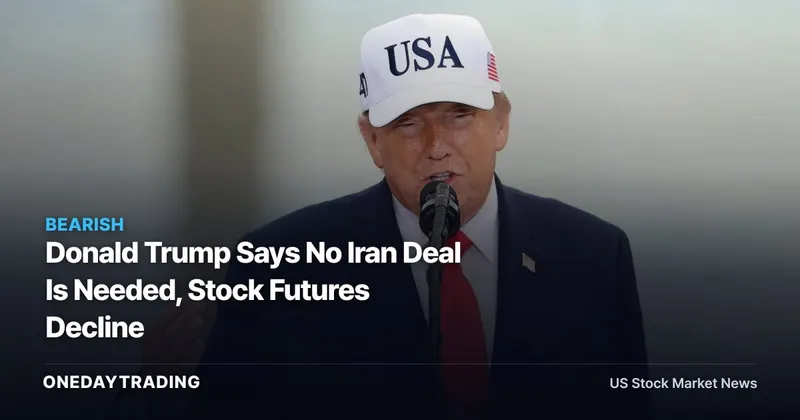
Donald Trump said Thursday that the U.S. should no longer seek an agreement with Iran, and the immediate investor signal was negative: CNBC reported that stock futures declined following his Truth Social post. The statement matters because it publicly moved the administration away from a possible diplomatic opening while the Iran war remained unresolved in its ninth month.
The investable conclusion is narrower than the political language. The tape registered concern, but the supplied evidence gives no index, contract, price, yield or sector-level move. Investors can therefore identify the direction of the initial response without claiming its magnitude, persistence or precise transmission across U.S. equities.
What Donald Trump Said and What Changed
CNBC reported on 2026-11-12 that Donald Trump wrote, “We don't need a deal with Iran. Those days have long since passed.” That is the central policy signal: the president said the U.S. should no longer pursue an Iran agreement, although the evidence does not establish that the government has formally ended every diplomatic effort.
Donald Trump also claimed that the U.S. had Iran’s money—“Hundreds of Billions of Dollars”—and its strait. CNBC did not provide a verified amount beyond that phrase, so investors should treat “Hundreds of Billions of Dollars” as the president’s characterization rather than a quantified financial disclosure.
In this context, the Iran-deal question is whether the U.S. continues seeking a negotiated arrangement with Iran. Trump’s post rejected the need for such a deal, while leaving the formal status of diplomacy unknown. That distinction separates a forceful public statement from a confirmed institutional termination of talks.
JD Vance Moves From Iran Diplomacy to a Domestic Assignment
Donald Trump directed JD Vance to focus his “complete and total attention” on alleged corruption and crime in Democratic-run U.S. cities and states. The reassignment is relevant because Vance had been associated with diplomatic efforts involving Iran, making the president’s instruction a second signal that the administration’s public focus was shifting away from negotiations.
The Wall Street Journal reported Wednesday that JD Vance was considering face-to-face talks with a top Iranian security official. The available facts do not confirm that such a meeting occurred. Investors should not treat consideration of talks as evidence of either a completed negotiation or an agreed diplomatic channel.
Trump separately alleged that “Billions of Dollars” were being stolen each and every month in Democratic-run cities and states and asserted that correcting the activity could quickly balance the budget. Those are attributed political claims in his post; the fact sheet supplies no verification, accounting detail or policy mechanism with which to translate them into a fiscal estimate.
The Ninth-Month War Defines the Macro Risk
CNBC identified the conflict as an Iran war started by the U.S. and Israel in late February. The war was ongoing in its ninth month when Trump made the statement, despite his earlier indication that it would be won in a matter of weeks. Its duration is the strongest supplied measure of the gap between the initial timetable and the unresolved outcome.
That gap matters to markets because the timing and manner of the war’s end remain unknown. A diplomatic route had at least been under consideration through the reported possibility of a Vance meeting; Trump’s statement reduced the clarity around that route without proving that all negotiations had stopped.
CNBC also placed the announcement just over a week after Republicans experienced election losses. Donald Trump had repeatedly suggested during the weeks leading up to Election Day that the U.S. could resume military strikes. These timing facts establish the political and security backdrop, although they do not quantify how much of either risk stock futures had already incorporated.
Reading the Stock-Futures Decline Without Overreaching
The futures decline following Trump’s post is the only confirmed market move in the supplied evidence. It supports a bearish immediate sentiment because prices moved lower after a statement that appeared to narrow the diplomatic path. It does not show which stocks led the move, how long the decline lasted or whether investors ultimately treated the post as a durable policy change.
For macro investors, the distinction between what the tape reflected and what remains unpriced is essential. The initial decline reflected a negative reaction to the post. The market still lacked confirmation on whether diplomatic efforts would formally end, whether the contemplated Vance meeting would occur, and when or how the war would conclude.
No individual U.S.-listed company is directly linked to the event in the fact sheet, so assigning company tickers or declaring sector winners and losers would exceed the evidence. The defensible market framing is broad: unresolved geopolitical policy risk coincided with weaker stock futures, with no supported basis for a company-specific revenue, cost or valuation conclusion.
Bull and Bear Conditions for U.S. Equity Investors
Bear case: Trump’s rejection of the need for a deal becomes formal policy, the prospective diplomatic contact does not occur, and the war remains without a clear endpoint. Under that condition, the futures decline may represent the beginning of a more persistent risk reassessment rather than a brief response to one post.
Bull case: Diplomatic engagement continues despite the president’s language, or subsequent actions clarify that the statement did not terminate negotiations. That outcome could challenge the market’s initial negative interpretation because the most consequential unknown—the status of diplomacy—would look less restrictive than the post implied.
Neither scenario is established by the available record. The evidence confirms the statement, Vance’s new assignment, the reported consideration of talks and the decline in stock futures. It does not confirm a meeting, a formal end to diplomacy or an endpoint for the conflict.
Concrete Checkpoints After Trump’s Truth Social Post
- Formal U.S. policy: Check whether the administration explicitly ends diplomatic efforts with Iran or leaves channels open despite Trump’s statement.
- JD Vance’s role: Look for confirmation that the face-to-face meeting reported as under consideration either occurred or was abandoned.
- Market confirmation: Assess whether the stock-futures decline persists into broader trading once identifiable instruments and sector moves become available.
- War trajectory: Watch for evidence that changes the unknown timing or manner of the Iran war’s conclusion.
The next investable trigger is not another slogan. It is confirmation of whether Trump’s words become formal diplomatic policy, whether JD Vance remains involved in Iran contacts, and whether the initial futures weakness develops into a measurable market move.
📊 Analysis
Signal Bearish
Why Stock futures declined after Donald Trump rejected the need for an Iran deal, signaling a negative immediate market response amid unresolved war risk.
This article was independently written by OneDayTrading from public reporting. Read the original (CNBC)