World Bank Capital Flows Defy the AI-Funding Anxiety
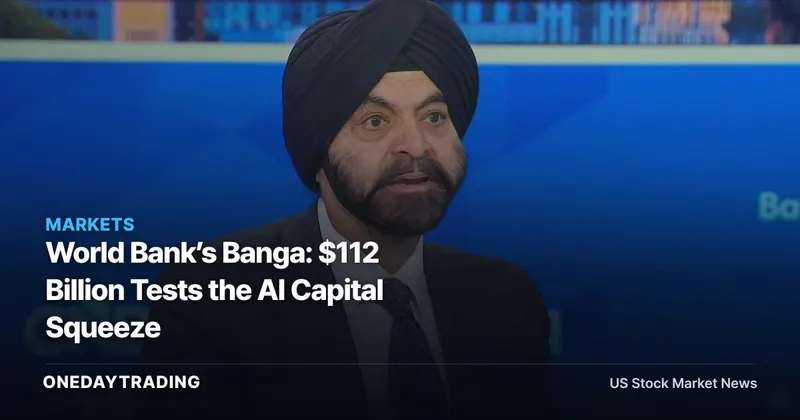
The World Bank’s $112 billion of capital mobilized last year suggests that financing remains available even as investors question how artificial intelligence could affect borrowing costs. President Ajay Banga delivered that assessment during CNBC’s “Squawk Box” interview on Oct. 27, 2026, drawing a crucial distinction for investors: concern about the structure of AI finance has not become a general shortage of capital.
CNBC Markets reported that the World Bank mobilized $112 billion last year, around three times the amount recorded three years prior. That comparison is the strongest evidence in the interview because it measures capital brought into the institution’s work rather than relying on confidence or intention.
Capital mobilization, in this context, means bringing private funding into investments overseen by the World Bank. Banga said that private capital does not go to governments, an important feature when assessing how these flows differ from direct sovereign financing.
Ajay Banga Separates Infrastructure Demand From Large AI Bets
The interview identifies two different funding needs. Emerging markets are directing investment toward physical infrastructure such as bridges and roads while also considering smaller-scale uses of AI. Developed counterparts, according to Banga, seek financing for large use cases—an “exact opposite” pattern of demand.
For investors, the distinction matters more than a broad claim that AI is increasing demand for money. Infrastructure and smaller AI applications rest on different project requirements from large AI use cases. The evidence does not establish returns, financing terms or project outcomes, so the investable signal is the contrast in capital needs rather than a forecast for any company or country.
Banga said emerging markets were not encountering the same hesitancy evident around large AI funding. His explanation ties that difference to the focus on bridges, roads and smaller deployments, not to an absence of financing risk across every emerging market.
The World Bank was founded in 1944 and seeks to end poverty and support economic prosperity through global partnerships and funding. Its institutional role gives Banga visibility into development finance, while his earlier positions as vice chair at General Atlantic and CEO of Mastercard add experience in private capital and payments.
AI Borrowing Concerns Center on Financing Quality
Banga’s “It’s not really an issue” comment referred to the availability of capital. It did not dismiss every financing concern. He said investors may be uneasy about circular financing and the business model attached to AI, separating the quantity of available money from the quality and durability of the activity seeking it.
That is the central tension for markets. Capital can remain accessible while lenders and investors become more selective about large AI uses. The interview supports both propositions: the World Bank’s mobilization has expanded, and questions persist about how AI projects are financed and whether their business models justify the funding they require.
Banga said he still believes AI will be transformative and profitable, alongside a warning that the path will contain unpredictable setbacks. The statement supports a constructive long-term view, not a timetable or measurable earnings conclusion. The interview does not identify which investors raised circular-financing concerns, which countries were under discussion, or the size of any interest-rate increase linked to AI.
Those omissions prevent a direct conclusion about listed equities, bond yields or sector leadership. No affected public company, security or market instrument was identified, so assigning a stock ticker would imply a connection that the evidence does not establish.
What Investors Should Test After Banga’s CNBC Interview
- Capital availability: Check whether subsequent World Bank disclosures continue to show private capital being mobilized at scale. The present benchmark is $112 billion last year, around three times the amount three years prior.
- Use of funds: Separate emerging-market spending on bridges, roads and smaller AI applications from financing sought for large use cases in developed counterparts. A change in that mix would alter the interview’s central distinction.
- Financing structure: Look for disclosures that clarify circular financing and the business model supporting AI investment. Availability alone does not answer whether a funding structure is durable.
- Private-capital destination: Verify that the capital overseen by the World Bank continues to avoid direct transfers to governments, because that feature underpins Banga’s distinction from sovereign borrowing concerns.
The balanced reading is neutral. The mobilization figure argues against treating AI-related borrowing anxiety as a universal capital freeze, while the unresolved financing-model questions limit a more positive conclusion. The next decisive evidence is not another broad statement about AI demand; it is whether later disclosures preserve the scale, destination and infrastructure focus of the capital described by Banga.
📊 Analysis
Signal Neutral
Why Strong capital mobilization and infrastructure demand offset unresolved concerns about AI financing models and borrowing costs.
This article was independently written by OneDayTrading from public reporting. Read the original (CNBC Markets)