At a Glance
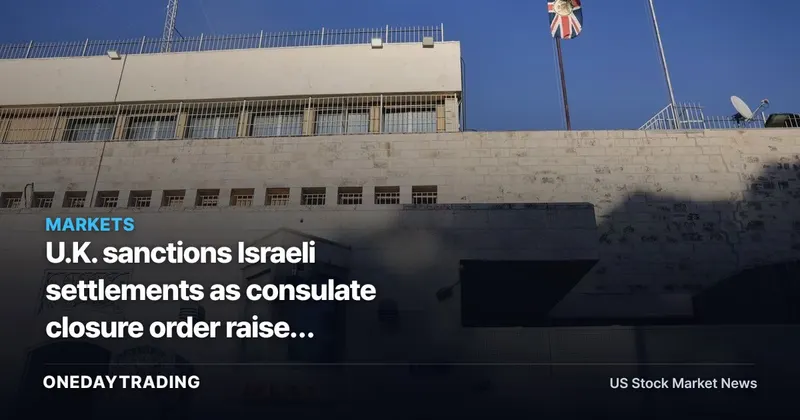
On Tuesday, the U.K. announced sanctions on certain Israeli goods, including a ban on imports from Israeli settlements built on the West Bank, after Israel ordered Britain to close its East Jerusalem consulate within 30 days. CNBC reported on Sept. 9, 2026, that the package also targets companies and individuals facilitating settlement growth and expands an existing arms-export ban to license applications that materially contribute to the occupation.
For investors, CNBC’s reporting points to a policy and diplomatic risk channel rather than a confirmed company earnings shock: the identities of targeted businesses, the sanctions’ effective date and detailed terms, and any U.S. countermeasures were not specified.
Why the U.K. Sanctions Matter Now
Foreign Secretary Ed Miliband said Wednesday morning that the U.K. “could not simply stand by because we feared Israeli reaction.” He said the government’s official view is that the occupation of the West Bank is unlawful and that Britain had to “call out” developments it viewed as undermining the possibility of a two-state solution. Those statements establish the political rationale reported by CNBC; they do not quantify a direct financial cost.
The immediate commercial measure is an import ban covering goods from Israeli West Bank settlements. The broader package adds sanctions on companies and individuals that facilitate settlement growth, while the U.K. expands an existing arms-export restriction to applications materially contributing to the occupation. Until the government publishes the names, scope and start date, investors cannot map exposure by issuer, product line or contract.
CNBC reported that Israel accused the British government of “systematically working against” Israel and barred 12 U.K. lawmakers from entering Israel. Britain was also told to close its consulate in east Jerusalem within 30 days. Whether that closure order will be carried out is unknown, leaving the diplomatic trajectory unresolved.
Settlement Scale and Policy Transmission
A 2025 U.N. report documented 166 West Bank settlements with more than 700,000 Israeli settlers. The United Nations and International Court of Justice regard the West Bank, including East Jerusalem, as occupied territory. These figures provide scale for the policy dispute, but they do not show how much trade is covered by the U.K. ban or which public companies have settlement-linked revenue.
CNBC’s account implies several possible transmission points. Import restrictions can affect firms whose goods require access to the U.K. market; sanctions on facilitators can raise compliance, financing and contracting costs; and expanded arms-export licensing can delay or prevent specific transactions. The magnitude of each effect depends on the final design of the measures, which the fact sheet lists as unknown.
France and Canada announced sanctions on Israeli settlements on Tuesday. A coordinated approach could broaden compliance obligations for companies operating across jurisdictions, while a limited national action would confine the direct legal burden largely to U.K.-linked trade. The available facts do not establish which path will emerge.
Key Debates
- Effectiveness versus symbolism: The U.K. says sanctions are needed to address settlement expansion and preserve a two-state solution. CNBC provides no evidence yet on whether the measures change settlement activity or alter commercial behavior.
- Diplomatic access: Israel’s 30-day consulate closure order creates an operational question for Britain’s representation in East Jerusalem. The order’s implementation is unconfirmed.
- Escalation risk: Israel’s accusation that Britain is “systematically working against” the country and its entry ban on 12 lawmakers show immediate retaliation. Further steps are possible, but no additional measures are confirmed.
- U.S. policy uncertainty: Some U.S. officials and lawmakers warned that British companies could face business restrictions. Secretary of State Marco Rubio said the Trump administration had no comment on an American response, and the White House had been made aware in advance.
Related Stocks & Sectors
- Macro and geopolitical-risk exposure: No specific U.S.-listed company is identified in the fact sheet as a direct target or beneficiary, so assigning an equity ticker would overstate the evidence.
- Defense and aerospace: The expanded U.K. arms-export ban could affect licensing for transactions that materially contribute to the occupation. The source does not identify contractors, programs or revenue amounts, preventing issuer-level analysis.
- Consumer goods and retail supply chains: The import ban could matter to companies sourcing goods from Israeli West Bank settlements, but neither the targeted products nor importing firms are named.
- Compliance-sensitive multinationals: Sanctions on companies and individuals facilitating settlement growth may increase screening and legal obligations. The identities of those targets are unknown.
What to Watch
- U.K. implementation notice: Check the effective date, covered goods and licensing language when the government releases detailed terms.
- Target list: Identify the sanctioned companies and individuals before drawing conclusions about revenue, contracts or counterparties.
- Consulate status: Monitor whether Israel’s order to close the East Jerusalem consulate within 30 days is executed, extended or withdrawn.
- U.S. response: Track any formal statement from the Trump administration or White House on possible restrictions involving British companies; CNBC reported no specific response at publication.
Overall Outlook
The bullish case for policy credibility, as presented by the U.K., is that sanctions demonstrate willingness to enforce its stated position that the West Bank occupation is unlawful. France and Canada taking similar action could reinforce that diplomatic signal. That is a political effect, not a confirmed investment return.
The risk case is fragmentation. Retaliatory measures, uncertain consular access and possible U.S. restrictions could raise costs for firms with affected trade, defense licensing or compliance exposure. Yet the fact sheet supplies no company names, financial amounts or confirmed American action, so the immediate stock-market direction remains indeterminate.
The next useful evidence is procedural: the U.K.’s final sanctions list and implementation date, Israel’s decision on the consulate order, and any concrete U.S. policy. Until those arrive, investors should treat the episode as a high-relevance geopolitical development whose corporate impact cannot be sized from the reported facts alone.
FAQ
What did the U.K. sanction?
The U.K. imposed new sanctions on certain Israeli goods and announced a ban on imports from Israeli settlements built on the West Bank. CNBC also reported sanctions on companies and individuals facilitating settlement growth and an expanded arms-export licensing ban.
Why is the East Jerusalem consulate involved?
Israel ordered Britain to close its consulate in East Jerusalem within 30 days after the U.K. announced the sanctions. CNBC reported the order, but whether it will be carried out remains unknown.
Has the United States announced retaliation?
No specific U.S. response was confirmed in the fact sheet. Marco Rubio said the Trump administration had no comment on an American response, while the White House had been made aware of the U.K. decision in advance.
📊 Analysis
Signal Neutral
Why The sanctions and diplomatic retaliation raise policy and regional-stability risks, but the fact sheet identifies no directly affected listed company or confirmed market outcome.
This article was independently written by OneDayTrading from public reporting. Read the original (CNBC)