Key Takeaways
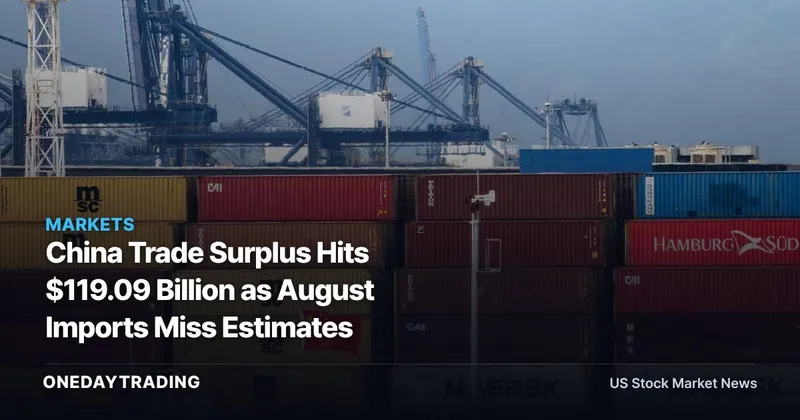
China’s August trade figures delivered a mixed signal for global investors: exports accelerated, but imports fell short of expectations, leaving the economy more dependent on external demand. CNBC Markets reported that exports increased 25% year on year in August, up from 23.9% in July, while imports rose 28.2%, below the 30% estimate and only slightly above July’s 27.5% increase.
The trade surplus consequently widened to $119.09 billion from $112.5 billion in July. That combination supports China’s near-term growth contribution to global manufacturing, while intensifying pressure on Beijing to strengthen domestic demand and address concerns among trading partners.
What Happened to China’s August Trade Data
Official customs data released Tuesday showed China’s exports grew 25% year on year in August in U.S. dollar terms, matching the Reuters-polled forecast cited by CNBC Markets. Imports rose 28.2% year on year, missing the 30% estimate but improving from 27.5% in July. The data therefore showed momentum on both sides of the trade account, with export growth still outpacing the import estimate.
The result was a larger monthly surplus. China recorded a $119.09 billion trade surplus in August, compared with $112.5 billion in July. For investors, the arithmetic matters because a rising surplus indicates that external shipments are contributing more to the growth mix than domestic absorption, even as imports themselves are increasing.
Trade flows with major partners were uneven. Chinese shipments to the United States rose 34.4% year on year in August, while imports from the United States increased 17.8%. Exports to the European Union rose 6.6%, compared with a 0.7% increase in imports from the bloc. Imports from South Korea more than doubled, while exports to South Korea rose nearly 50%; the source does not state the exact size of the increase in South Korean imports.
Why the Import Miss Matters for Domestic Demand
Imports are a broad, imperfect indicator of domestic demand because they also reflect inventories, processing activity and commodity prices. In this case, however, the import result missed the 30% estimate while the surplus expanded, reinforcing the concern described by CNBC Markets that domestic demand remains subdued relative to export performance.
Zhiwei Zhang, president and chief economist at Pinpoint Asset Management, said China “continues to rely on exporters to support the economy.” That interpretation links the trade data to a wider growth imbalance: overseas demand is cushioning weakness in domestic consumption and investment, but it also leaves China exposed to policy reactions from trading partners.
China’s growth target for this year is 4.5%-5%, while GDP growth slowed to 4.3% in the second quarter. CNBC Markets also reported that domestic demand and investment weakened in July and that manufacturing activity contracted for a second straight month. Those figures create a demanding policy equation: authorities must preserve export momentum while encouraging households and businesses to absorb more output at home.
Trade Pressure, the Yuan and Beijing’s Policy Position
The offshore yuan stood at 6.7099 per U.S. dollar after Tuesday’s data release. CNBC Markets reported that the Chinese currency had strengthened 3.8% year to date against the U.S. dollar. Brad Setser, a senior fellow at the Council on Foreign Relations, estimated last month that the currency was undervalued by 20%.
A stronger yuan could reduce the local-currency value of exporters’ foreign revenue and make Chinese goods relatively more expensive abroad, while increasing purchasing power for importers. Those are general transmission channels rather than a reported forecast for China’s currency or trade balance. The relevant investor question is whether appreciation proceeds quickly enough to alter export competitiveness without adding pressure to already-soft domestic activity.
Beijing has rejected the criticism surrounding its surplus, calling it “an excuse to pressure and restrict China.” People’s Bank of China Governor Pan Gongsheng said China has never actively pursued a trade surplus or depreciated the currency to gain trade competitiveness, and he said the market would remain open to foreign businesses. These statements describe Beijing’s position; they do not resolve the underlying disagreement with its trading partners.
Earlier this month, Group of 20 finance ministers issued a statement criticizing economies that rely heavily on exports, with China the only dissenting member. Xi Jinping was scheduled to visit Washington, D.C., later this month. The exact meeting dates were not provided in the source, so investors should treat the visit as a scheduled diplomatic checkpoint rather than a confirmed policy outcome.
Market and Stock Impact
- Chinese export-sensitive manufacturers: The 25% August export increase provides evidence of strong overseas shipment activity, particularly toward the United States, where Chinese shipments rose 34.4% year on year. That can support revenue for companies with export exposure, but the data does not identify individual listed beneficiaries or quantify company-level earnings effects.
- Global industrial and technology supply chains: CNBC Markets attributed part of China’s export strength to demand for high-tech components amid a global build-out of AI infrastructure. This establishes a demand channel for component shipments, but the source does not name specific U.S. suppliers, customers or publicly traded companies, so no individual stock conclusion is supported.
- Chinese banks and insurers: The Chinese government planned a $54 billion capital injection into several state-owned banks and insurers. The plan could improve the sector’s policy support and balance-sheet capacity, but CNBC Markets did not report execution timing, recipient institutions or earnings effects.
- Currency-sensitive exporters and importers: The yuan’s 3.8% year-to-date appreciation and the reported 6.7099 offshore rate are relevant to the value of export receipts and import costs. The direction of any stock impact depends on each company’s currency exposure, which is not provided in the source.
Investor Checkpoints
- Next trade release: Check whether imports continue to close the gap with exports and whether the monthly surplus remains near the August level of $119.09 billion.
- Domestic-demand data: Track the next releases covering consumption, investment and manufacturing activity, given the reported weakness in July domestic demand and investment and the second consecutive month of manufacturing contraction.
- Currency policy: Monitor the offshore yuan around 6.7099 per U.S. dollar and assess whether further appreciation changes the competitiveness of exporters or the purchasing power of importers.
- Policy implementation: Watch for details on the planned $54 billion capital injection into state-owned banks and insurers and for signals about the one or two interest-rate cuts Shan Guo of Hutong Research expects by year-end. The timing, size and recipients of any cuts or capital deployment remain unspecified.
Outlook
The constructive case rests on the export engine. August shipments rose 25% year on year, U.S.-bound shipments increased 34.4%, and Neo Wang of Evercore ISI pointed to a sense of urgency and determination in Beijing’s recent policy communications. Stabilizing manufacturing activity in August, as described by Wang, could help the economy regain momentum in the second half of the year.
The countercase is that a wider surplus keeps the rebalancing problem visible. Imports missed the 30% estimate, GDP growth was 4.3% in the second quarter against a 4.5%-5% annual target range, and foreign officials continue to criticize export-dependent growth. A stronger yuan could ease some external criticism, but it could also challenge exporters if appreciation outpaces improvements in domestic demand.
Shan Guo expects one or two Chinese interest-rate cuts by year-end, with the pace tied to Federal Reserve policy, Ministry of Finance bond issuance and the yuan’s appreciation. That makes the next macro signal a policy interaction rather than a single number: investors need to see whether fiscal support, possible monetary easing and currency movements can lift imports without undermining the export sector that is currently carrying the growth burden.
FAQ
What were China’s August export and import growth rates?
China’s exports rose 25% year on year in August, compared with 23.9% in July. Imports increased 28.2% year on year, below the 30% estimate and above July’s 27.5% increase, according to CNBC Markets.
Why did China’s trade surplus increase in August?
China’s trade surplus rose to $119.09 billion in August from $112.5 billion in July because export growth remained strong while imports did not reach the 30% estimate. The wider surplus is one reason economists and foreign officials are pressing Beijing to support domestic demand and rebalance trade.
What policy measures are being considered in China?
The Chinese government planned a $54 billion capital injection into several state-owned banks and insurers. Shan Guo of Hutong Research expected one or two interest-rate cuts by year-end, with the pace linked to Federal Reserve policy, Ministry of Finance bond issuance and the yuan’s appreciation.
📊 Analysis
Signal Neutral
Why Stronger exports support growth, but the import miss and wider surplus underscore weak domestic demand and rising trade-policy pressure.
This article was independently written by OneDayTrading from public reporting. Read the original (CNBC Markets)