Key Takeaways
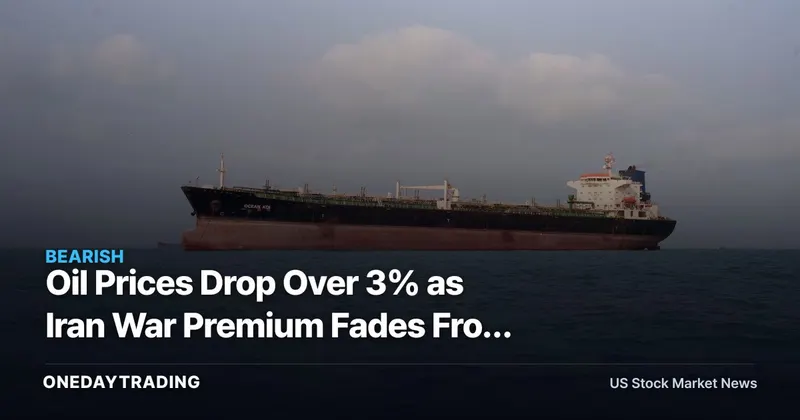
Oil prices fell more than 3% after CNBC reported on Aug. 25, 2026, that the United States shifted toward economic pressure on Iran, reducing the immediate war-risk premium embedded in crude and energy stocks.
For investors, the move matters less as a single commodity print than as a reset in the pricing of geopolitical supply risk across Exxon Mobil, Chevron, refiners, airlines and the broader energy sector.
What Happened
CNBC reported that oil dropped more than 3% as investors looked past the latest U.S.-Iran developments and focused on Washington's turn toward economic pressure rather than renewed military escalation.
The mechanism is direct: crude prices rise when traders price a higher probability of supply disruption, and crude prices fall when the market removes part of that disruption premium. A more-than-3% decline says the tape assigned lower near-term odds to a fresh war shock than it did before the report.
Geopolitical risk premium is the extra price buyers pay for oil when potential conflict threatens production, shipping routes or sanctions enforcement. In this case, CNBC's report points to economic pressure on Iran as the active channel, not a new round of immediate battlefield escalation.
Background & Context
Oil is unusually sensitive to U.S.-Iran headlines because investors price not only barrels produced, but also the probability that conflict changes flows, insurance costs, shipping behavior and sanctions risk.
The source report gives one hard market number: oil fell more than 3%. That figure is enough to show positioning changed, but not enough to prove a lasting shift in supply, demand or spare capacity.
Market & Stock Impact
- Exxon Mobil: Exxon Mobil stock is exposed to lower crude realizations because upstream earnings benefit when oil prices rise and lose torque when the commodity falls more than 3%.
- Chevron: Chevron shares face the same crude-price channel, with investor focus likely moving from geopolitical upside to cash-flow sensitivity if oil holds the decline.
- Energy Select Sector SPDR Fund: XLE tracks large U.S. energy equities, so a lower war premium can pressure sector leadership when crude weakness outweighs defensive cash-return narratives.
- Marathon Petroleum: Marathon Petroleum can benefit if lower crude reduces input costs, though refinery margins depend on product prices as much as feedstock prices.
- Delta Air Lines: Delta Air Lines gets a potential cost tailwind from cheaper jet fuel, but the benefit only reaches earnings if fares and demand do not weaken at the same time.
Investor Checkpoints
- Track whether oil extends or reverses the more-than-3% decline after the U.S. economic-pressure signal toward Iran.
- Watch Exxon Mobil and Chevron trading against crude, because underperformance would show equity investors accepting lower upstream cash-flow expectations.
- Monitor refiners and airlines for a fuel-cost read-through, especially where lower crude can widen margins without a matching drop in end-market pricing.
- Use the next U.S.-Iran policy headline as the catalyst test: sanctions language supports economic-pressure pricing, while military escalation rebuilds the risk premium.
Outlook
The bearish read for oil is straightforward: CNBC's report says investors shrugged off the latest U.S.-Iran war developments because U.S. pressure has moved through economic channels, and crude responded with a decline of more than 3%.
The counter-scenario is equally important. If U.S.-Iran tensions shift back from economic pressure toward renewed war risk, the same premium that left crude can return quickly, lifting producers and squeezing fuel-sensitive sectors.
FAQ
Why did oil prices drop more than 3% today?
Oil prices dropped more than 3% after CNBC reported that the United States shifted toward economic pressure on Iran. The market reduced the near-term probability of renewed war disrupting crude supply or transport.
What does lower Iran war risk mean for Exxon Mobil and Chevron stock?
Lower Iran war risk can pressure Exxon Mobil and Chevron because both companies have earnings exposure to crude-price realizations. If oil keeps the more-than-3% decline, investors are likely to mark down part of the geopolitical upside in upstream cash flow.
Which stocks benefit when oil falls on easing geopolitical fears?
Fuel-sensitive companies such as Delta Air Lines can benefit when oil falls because jet fuel is a major operating cost. Refiners such as Marathon Petroleum can also gain from cheaper crude input costs, but product prices determine whether that benefit reaches margins.
📊 Analysis
Signal Bearish
Why The reported move removes part of the geopolitical risk premium from crude, creating a negative catalyst for oil producers and the energy sector while helping fuel-sensitive users.
Tickers$XOM$CVX$XLE$MPC$DAL
This article was independently written by OneDayTrading from public reporting. Read the original (CNBC)