Summary
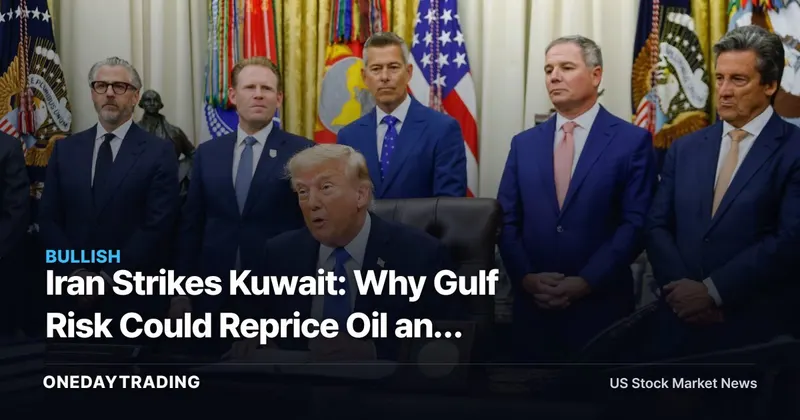
Iranian missile and drone attacks reported by Kuwait on Thursday raise a direct market question: can a contained military exchange become a physical-energy shock? Kuwait’s army said it was confronting the attacks, while President Donald Trump said renewed Middle East hostilities would not last too long. The immediate read-through favors higher risk premiums for Gulf oil, shipping and defense assets, but the direction depends on whether infrastructure and export routes remain intact.
For investors, the event matters less as a headline than as a test of supply continuity. Exxon Mobil and Chevron have global earnings exposure to crude prices, while transport and industrial companies face a different channel through fuel, insurance and logistics costs.
The Full Story
Kuwait’s military response confirms that the conflict has reached another Gulf state through both missiles and drones. That combination increases uncertainty around airspace, ports, refineries and offshore facilities even before any confirmed physical damage is reported. Trump’s statement that the hostilities will not last too long is a political signal, not proof that commercial operations are secure.
Oil markets price barrels, but they also price the probability of interruption. Kuwait is a major Gulf producer, so a strike that damages loading infrastructure would tighten available supply; an attack that is intercepted would still lift insurance and security costs without necessarily reducing output. The distinction separates a short-lived volatility spike from a longer capital-cycle shock for producers, refiners and carriers.
Structural Background
Gulf energy assets are interconnected through terminals, pipelines, shipping lanes and regional power systems. Missile and drone defenses can limit direct damage, yet repeated attacks raise operating costs and force companies to reroute vessels or delay maintenance. Those physical constraints can affect realized prices and margins even when headline production remains unchanged.
The key macro variable is duration. Trump’s expectation of a short conflict supports a rapid risk-premium fade; continued strikes would challenge that assumption and broaden the impact from crude benchmarks to freight, aviation fuel and industrial input costs.
Stock & Sector Ripple
- Exxon Mobil (XOM): Higher crude-risk premiums can lift upstream realizations, but disruption at Gulf facilities would also increase security and logistics costs across the global portfolio.
- Chevron (CVX): Chevron’s integrated model provides some protection if crude rises, while refining and fuel-demand effects create offsetting margin uncertainty.
- Oil and tanker operators: Any rerouting or higher war-risk insurance would raise voyage costs and potentially tighten vessel availability; confirmed damage is required for a lasting earnings upgrade.
- Airlines and transport: A sustained oil premium would pressure jet-fuel and diesel expenses, with limited ability to pass costs through immediately.
- Defense contractors: Persistent Gulf demand for missile and drone defenses could support orders, but a single incident does not establish a backlog or revenue change.
Bull vs Bear Scenarios
The bullish energy case requires a supply interruption: damaged export infrastructure, blocked routes or prolonged production outages would tighten barrels and expand upstream cash flow. The bearish case is rapid containment, with Kuwait’s defenses holding and hostilities ending on Trump’s expected timetable; in that outcome, oil’s risk premium and defense enthusiasm can reverse.
Investors should also account for valuation. Energy shares can rally on crude exposure before any additional barrels are sold, while transport stocks may discount fuel stress before costs appear in reported results. The market can therefore move ahead of the physical data in both directions.
Investor Action Points
- Track confirmed damage to Kuwaiti terminals, refineries and pipelines rather than relying on battlefield claims.
- Compare crude futures with tanker rates and war-risk insurance; a synchronized move signals broader supply stress.
- Read the next XOM and CVX updates for realized prices, production guidance and security-related costs.
- Monitor Trump’s diplomatic timeline and any further announcements from Kuwait’s army for evidence that the conflict is contained.
FAQ
Why did oil and energy stocks react to Iran’s Kuwait attacks?
Iranian missile and drone attacks increase the probability of disruption around Gulf production and export infrastructure. Exxon Mobil and Chevron can benefit from higher crude prices, but their earnings response depends on whether actual output or shipping is impaired.
What is the main risk to Gulf oil supply after the Kuwait strikes?
The main risk is damage to terminals, pipelines, refineries or vessel access that removes barrels from the market. Intercepted attacks would raise insurance and security costs without necessarily creating a lasting supply deficit.
When will investors know whether the conflict is market-moving?
Investors need verified operating updates from Kuwait and energy companies, plus evidence in crude futures, tanker rates and insurance pricing. A short conflict consistent with Trump’s statement would likely limit the premium; repeated strikes would indicate a wider earnings risk.
Market data check: XOM
XOM last traded near $165.17 (+0.62%). Our composite signal — blending price momentum and news flow — reads 🟡 neutral. Price momentum scores 55/100.
Data as of publication. Price via market feeds; for reference only, not investment advice.
📊 Analysis
Signal Bullish
Why The attacks raise the probability of Gulf supply disruption and higher crude-risk premiums, creating a near-term positive read-through for integrated energy producers despite substantial containment risk.
This article was independently written by OneDayTrading from public reporting. Read the original (CNBC)