Key Takeaways
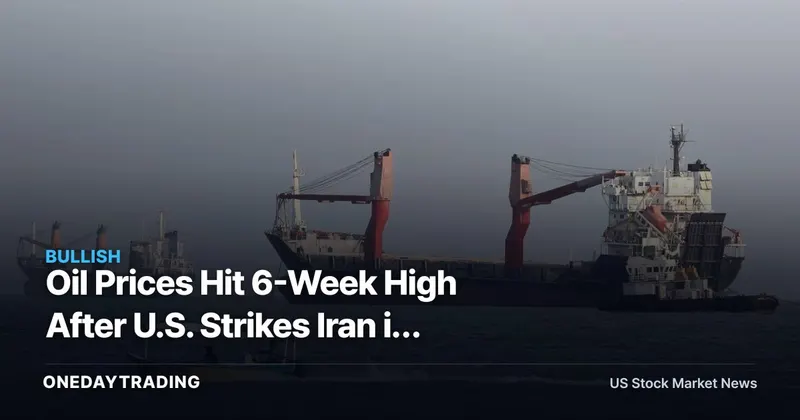
Oil prices settled on Tuesday at their highest level in nearly six weeks after the U.S. said it struck Iranian targets in the Strait of Hormuz. For investors, that is a geopolitical risk-premium event first and a demand story second, with upstream energy names better positioned than refiners and airlines.
The market is not pricing a confirmed supply outage. It is pricing the chance that shipping through a vital corridor gets harder, more expensive or delayed, and that distinction can reverse quickly if the tension eases.
What Happened
MarketWatch reported Tuesday that oil prices climbed after the U.S. military said it struck Iranian targets in the Strait of Hormuz in response to Tehran's overnight attacks on ships transiting the waterway. The move pushed crude to its highest close in almost six weeks.
The Strait of Hormuz matters because it concentrates shipping risk in one narrow route. When that route looks less secure, crude prices can jump on fear alone as traders price in higher insurance costs, rerouting risk and the possibility of delayed cargoes.
Why did oil prices jump after the U.S. strike in Hormuz?
Because oil markets react to the probability of disruption before they see the disruption itself. A U.S. strike tied to attacks on ships makes the shipping lane look more vulnerable, and that is enough to lift the risk premium embedded in crude.
Background & Context
This is a physical-market story before it is a sentiment story. If ships face more risk in Hormuz, buyers and sellers have to price in tighter prompt supply, even if broader global demand has not changed.
That is why the first beneficiaries usually sit upstream. Producers benefit when benchmark crude firms, while refiners and fuel-intensive transport names feel the cost pressure fastest because their input bills move before product prices fully reset.
Market & Stock Impact
- XOM, CVX: Integrated producers gain leverage to higher crude because upstream realizations usually move faster than operating costs.
- OXY: A firmer oil tape can lift realized pricing and cash generation if the geopolitical premium holds.
- MPC, VLO, PSX: Refiners face margin pressure when feedstock costs rise faster than gasoline and diesel pricing.
- AAL: Airlines absorb higher jet-fuel costs quickly, so a crude spike can hit margins before traffic data changes.
- SLB: Oil-field services can lag the first move, but a sustained crude premium tends to support spending discipline across the upstream cycle.
Investor Checkpoints
- Watch whether crude holds near the new six-week high or fades if the shipping risk eases.
- Track fresh headlines on the Strait of Hormuz, because the market is trading route risk more than a demand shock.
- Compare upstream strength with refiners and airlines to judge whether this is a brief spike or a more durable repricing.
- Focus on the next policy or military escalation headline, since that is the cleanest trigger for another move.
Outlook
The bullish case is clear: a tighter geopolitical backdrop supports crude and improves the setup for producers. The bearish case is just as clear: if the response stays contained and shipping normalizes, the premium can unwind as fast as it formed.
For now, the market is paying for uncertainty. The next catalyst is whether the Strait of Hormuz stays a trading lane or becomes a persistent supply-risk headline.
FAQ
Why did oil prices rise today?
Oil prices rose on Tuesday after the U.S. said it struck Iranian targets in the Strait of Hormuz following overnight attacks on ships. The market treated that as a fresh disruption risk for crude moving through a vital waterway.
Which stocks usually benefit when oil prices spike?
Integrated producers such as XOM and CVX usually benefit first because higher crude lifts upstream pricing. OXY can also gain if the move sticks and cash flow improves with it.
What does the Strait of Hormuz mean for investors?
The Strait of Hormuz is a key shipping route for oil, so tension there raises the risk premium in crude prices. If the route stays under pressure, refiners, airlines and other fuel-heavy businesses feel it before broad demand data changes.
📊 Analysis
Signal Bullish
Why The U.S. strikes in Hormuz lifted crude's geopolitical premium, which favors upstream energy names more than refiners and airlines.
Tickers$XOM$CVX$OXY$MPC$VLO$AAL
This article was independently written by OneDayTrading from public reporting. Read the original (MarketWatch)