Key Takeaways
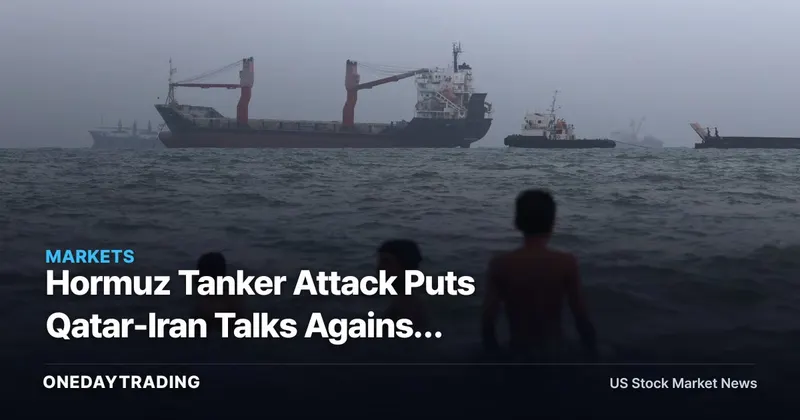
Hormuz tanker attack risk matters for oil, energy stocks and shipping because CNBC reported Thursday that Qatar's prime minister traveled to Iran to de-escalate tensions between Tehran and Washington after a tanker attack tested President Trump's Hormuz claim.
The investable issue is not one diplomatic visit; the issue is whether the market prices the Strait of Hormuz as a contained headline or as a renewed supply-security premium for crude, refiners, insurers and tanker operators.
What Happened
CNBC reported Thursday that the prime minister of Qatar, a U.S. ally, was in Iran for talks aimed at de-escalating tensions between Tehran and Washington. CNBC tied the visit to a tanker attack that tested President Trump's claim about Hormuz.
The Strait of Hormuz is the maritime chokepoint between Iran and the Arabian Peninsula, and a tanker attack near that route can raise perceived risk for crude cargoes, freight insurance and energy security even before physical supply changes.
CNBC's source material did not provide an oil price move, tanker name, cargo volume, casualty count or U.S. policy deadline. That absence matters: investors have a geopolitical catalyst, but not yet the operating data needed to size the earnings impact.
Background & Context
Qatar's role is unusually important because Qatar is both a U.S. ally and a regional actor with channels to Iran. A Qatari prime minister visit to Iran on Thursday signals that Washington's pressure channel and Tehran's security channel are being managed through diplomacy, not only military posture.
For markets, Hormuz is a commodity-risk story before it is an earnings story. The first transmission runs through crude risk premium, then through refining margins, shipping costs, airline fuel bills and the valuation investors assign to energy-sector cash flow.
Market & Stock Impact
- Exxon Mobil (XOM): Exxon Mobil stock can benefit if Hormuz headlines add a crude-risk premium, because upstream revenue is tied to realized oil and gas prices; the risk is that diplomacy led by Qatar on Thursday removes that premium before earnings estimates move.
- Chevron (CVX): Chevron stock has similar leverage to a higher oil-risk narrative, but Chevron investors should separate spot-market fear from sustained production economics because CNBC gave no confirmed supply loss.
- United Airlines (UAL): United Airlines can suffer if tanker-security concerns lift jet-fuel expectations, because fuel is a direct operating cost; the offset is that a fast Tehran-Washington de-escalation would limit fare or margin pressure.
- Delta Air Lines (DAL): Delta Air Lines faces the same fuel-cost channel, with the market likely to focus on whether crude volatility starts to affect travel-margin assumptions rather than Thursday's diplomacy alone.
- Energy ETFs: Broad U.S. oil exposure should react more cleanly than single-company equities because the CNBC-reported event is geopolitical and sector-wide, not company-specific.
Investor Checkpoints
- Track whether WTI crude and Brent crude add or lose risk premium after the Thursday Qatar-Iran talks reported by CNBC.
- Watch for U.S., Iranian or Qatari statements that clarify whether the tanker attack changes Hormuz security policy.
- Check next airline earnings guidance for fuel-cost language if crude prices react to the Hormuz tanker attack.
- Check Exxon Mobil and Chevron commentary for realized-price sensitivity, not just production volumes, in the next reporting cycle.
Outlook
The bull case for energy equities is straightforward: a tanker attack near Hormuz can make barrels in secure jurisdictions more valuable, and U.S. producers such as Exxon Mobil and Chevron receive that signal through realized pricing. The countercase is equally important: CNBC's Thursday report centered on de-escalation talks, and a credible Qatar-Iran diplomatic channel would push the event back toward headline risk rather than durable supply risk.
The next change in the market story comes from confirmation, not commentary. If official statements show the tanker attack is contained, oil-risk premium should fade; if Hormuz security restrictions tighten, the next earnings impact moves first into crude prices, then into airline fuel costs and energy-sector revenue assumptions.
FAQ
Why does the Hormuz tanker attack matter for oil stocks?
The Hormuz tanker attack matters for oil stocks because CNBC reported Thursday that the event tested President Trump's Hormuz claim while Qatar's prime minister sought to de-escalate Tehran-Washington tensions. Exxon Mobil and Chevron can benefit if investors price higher crude-security risk, but CNBC reported no confirmed supply outage.
What did Qatar's prime minister do in Iran on Thursday?
CNBC reported Thursday that Qatar's prime minister traveled to Iran for talks intended to de-escalate tensions between Tehran and Washington. Qatar's position as a U.S. ally makes the visit relevant for markets because diplomacy can reduce the oil-risk premium created by tanker-security concerns.
Which U.S. stocks are exposed to Hormuz tensions?
U.S. energy producers such as Exxon Mobil and Chevron are exposed through crude-price expectations after the Hormuz tanker attack reported by CNBC on Thursday. U.S. airlines such as United Airlines and Delta Air Lines are exposed through fuel-cost risk if crude prices rise after the Tehran-Washington tension shock.
📊 Analysis
Signal Neutral
Why The tanker attack creates a bullish oil-risk channel for energy stocks, but CNBC's report centered on Qatar-led de-escalation and provided no confirmed supply disruption or price move.
This article was independently written by OneDayTrading from public reporting. Read the original (CNBC)