Summary
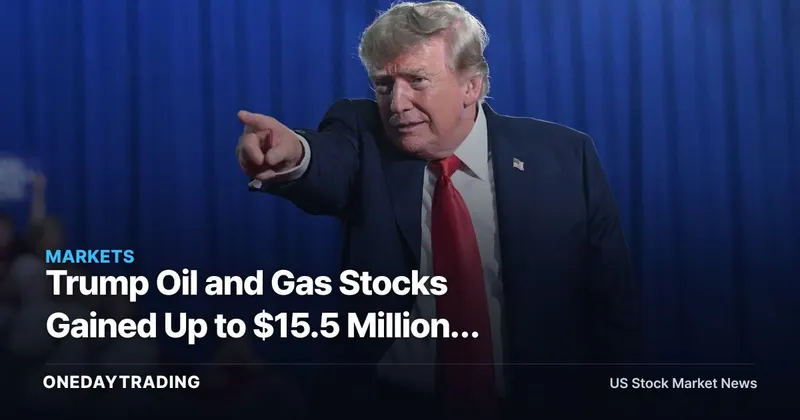
Trump oil and gas stocks matter for investors because congressional Democrats said Donald Trump’s energy-stock holdings gained up to $15.5 million amid the Iran war, turning a sector rally into a governance and political-risk question for U.S. oil equities.
The source’s reporting frames the issue less as a commodity call than a scrutiny channel: if Democrats retake either chamber in the midterms, Trump’s stock trading could face heightened congressional review.
The Full Story
Per CNBC’s reporting, congressional Democrats said Trump’s oil and gas stock gains reached as much as $15.5 million during the Iran war. That figure gives the story its market relevance because wartime energy moves can lift oil-linked equities while also raising questions over conflicts, disclosure and political exposure.
Oil and gas stocks are listed companies whose earnings and valuation often move with crude prices, natural-gas prices, refining margins and geopolitical risk premiums. In this case, the reported gain sits at the intersection of the energy capital cycle and Washington oversight, not at the level of one named company’s drilling plan or quarterly guidance.
The investor issue is narrow but real: the source does not identify the specific oil and gas stocks, so the clean read-through is to the sector’s political risk, not to a single ticker. Energy shares can benefit when geopolitical stress supports commodity prices, but public scrutiny can change the discount rate investors apply to politically exposed holdings.
Structural Background
Iran-war risk matters to oil markets because supply fears can reprice barrels before actual production changes. Equity investors usually capitalize that risk through exploration-and-production cash flow, integrated-major upstream earnings and broader energy-sector factor exposure.
The Democrats’ midterm angle changes the calendar. The source’s reporting says Trump’s stock trading could face heightened scrutiny if Democrats retake either chamber, which makes election control a potential catalyst alongside crude prices and energy earnings.
Stock & Sector Ripple
- U.S. oil and gas sector: The reported gain of up to $15.5 million reinforces how quickly geopolitical risk can transmit from crude expectations into energy-stock values.
- Exploration and production shares: Companies most tied to upstream price realization would be the cleaner earnings beneficiaries if Iran-war risk supports oil prices.
- Integrated energy majors: Large diversified oil companies can absorb geopolitical volatility better than pure producers, but their public profile also makes political narratives harder to ignore.
- Energy ETFs and factor baskets: Broad energy exposure can move on the same commodity impulse without depending on the unidentified stocks cited in the source’s reporting.
Bull vs Bear Scenarios
The bullish scenario for U.S. oil equities is mechanical: if Iran-war risk keeps energy prices firm, upstream cash flow and sector earnings expectations receive support. The bearish scenario is political: if Democrats win either chamber in the midterms and pursue trading scrutiny, investors may demand a higher governance-risk discount for politically linked energy positions.
Investor Action Points
- Track whether follow-up reporting identifies the specific oil and gas stocks behind the reported gain of up to $15.5 million.
- Watch crude-price moves around Iran-war headlines because the commodity channel drives the first-order earnings effect for oil equities.
- Use the midterms as a policy-risk checkpoint because the source ties heightened scrutiny to Democrats retaking either chamber.
- Separate energy-sector fundamentals from political exposure when evaluating broad oil and gas holdings.
FAQ
Why did Trump oil and gas stocks gain amid the Iran war?
CNBC reported that congressional Democrats said Trump’s oil and gas stock holdings gained up to $15.5 million amid the Iran war. The likely market mechanism is that geopolitical conflict can raise energy-risk premiums and support oil-linked equities, although the source does not name the specific stocks.
What is the market risk from congressional scrutiny of Trump’s stock trading?
The market risk from congressional scrutiny of Trump’s stock trading is not an earnings estimate; it is a governance and political-risk premium. CNBC reported that scrutiny could intensify if Democrats retake either chamber in the midterms.
Which oil stocks are directly affected by the Trump trading report?
The CNBC source provided here does not identify the individual oil and gas stocks tied to the reported gain of up to $15.5 million. Investors should avoid assigning the reported figure to any specific U.S.-listed oil company until named holdings are disclosed by the source or filings.
📊 Analysis
Signal Neutral
Why The report is market-relevant for oil-sector political risk, but the source does not identify specific holdings or prove a directional earnings impact on named stocks.
This article was independently written by OneDayTrading from public reporting. Read the original (CNBC)