Summary
Critical metals and U.S.-Canada tariffs matter for investors because the source's reporting says the trade fight has already repriced metals and materials stocks and ETFs, while the longer-term economic impact depends on tariff scope, supply substitution and whether industrial buyers absorb higher input costs.
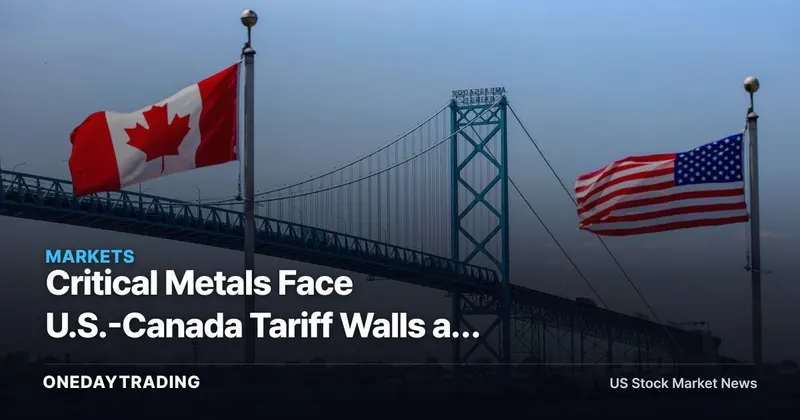
CNBC's report frames the issue as a tariff-wall shock in U.S.-Canada trade tied to critical metals, but the source provided no tariff rate, no metal-by-metal list and no company-specific earnings exposure.
The Full Story
The market reaction is the easy part: metals and materials stocks and ETFs moved because tariff risk changes the value of domestic supply, imported feedstock and downstream manufacturing margins at the same time. The harder question is whether the repricing reflects durable scarcity value or a short-lived policy premium.
Critical metals are industrial inputs used in strategic supply chains, and tariff walls are taxes or restrictions on cross-border trade that can raise delivered costs for buyers while protecting selected producers. In a U.S.-Canada metals dispute, the same policy can support miners with domestic leverage and hurt manufacturers that rely on cross-border material flows.
Per the source's reporting, longer-term investors should be wary after the initial repricing in metals and materials stocks and ETFs. That warning matters because tariff rallies often confuse pricing power with policy luck; a miner can benefit from tighter supply only if volumes, permits and customer contracts convert the price move into cash flow.
Structural Background
Metals are not software revenue. Supply responds through mines, processing capacity, transport routes and power costs, so a tariff wall can lift spot sentiment faster than the physical system can expand output.
Canada is central to North American resource supply chains, and a U.S.-Canada trade fight creates a different risk than a distant import dispute. The economic channel runs through input availability, inventory behavior and capital spending decisions across mining, materials, autos, utilities and defense-related manufacturing.
Stock & Sector Ripple
- SPDR S&P Metals and Mining ETF XME: XME is a U.S.-listed metals and mining proxy that can capture broad repricing when investors rotate toward materials exposure after a tariff shock.
- iShares MSCI Global Metals & Mining Producers ETF PICK: PICK gives investors diversified producer exposure, but global holdings can dilute the benefit of a specifically U.S.-Canada tariff wall.
- Freeport-McMoRan FCX: FCX is a liquid U.S.-listed copper and metals proxy, and tariff-driven metal scarcity can help sentiment only if realized pricing offsets cost and volume risk.
- MP Materials MP: MP is a U.S.-listed critical-minerals name, so policy attention can support the stock while execution risk stays tied to processing, customer demand and capital needs.
Bull vs Bear Scenarios
The bull case is that tariff walls make North American critical-metals supply more valuable, lifting producer multiples and attracting capital into mining and processing assets. The bear case is that the market already repriced the obvious policy trade, while higher input costs pressure downstream users and political terms can change before capacity responds.
The source's lack of tariff rates, metal lists and company-level exposure keeps conviction bounded. If future policy text names specific critical metals and sets durable tariff levels, the trade becomes more investable; if the dispute softens, the tariff premium can unwind.
Investor Action Points
- Track the next official U.S.-Canada tariff details, especially named metals, effective dates and exemption language.
- Compare ETF flows and price action in XME and PICK against underlying metals prices to separate policy rotation from commodity demand.
- For FCX and MP, focus on the next earnings call language around realized pricing, costs, customer contracts and capital spending.
- Watch downstream sectors such as autos, utilities, industrial equipment and defense for margin commentary tied to metals inputs.
FAQ
Why did metals stocks move on U.S.-Canada tariff news?
Metals stocks moved because CNBC's source reporting says the U.S.-Canada trade fight repriced metals and materials stocks and ETFs. Tariffs can raise the value of protected supply while lifting input costs for industrial buyers.
What are critical metals in the U.S.-Canada trade war?
Critical metals are strategic industrial inputs used across manufacturing, energy, defense and technology supply chains. The source identified critical metals as the economic focus of the U.S.-Canada tariff-wall story but did not provide a metal-by-metal list.
Are materials ETFs a safe way to trade tariff walls?
Materials ETFs spread single-company risk, but CNBC's source reporting warned that longer-term investors should be wary after the repricing. ETF exposure can still fall if tariff details disappoint, commodity prices weaken or downstream demand absorbs the shock poorly.
Market data check: XME
XME last traded near $118.74 (-3.46%). Our composite signal — blending price momentum and news flow — reads 🟡 neutral. Price momentum scores 22/100 (soft).
Data as of publication. Price via market feeds; for reference only, not investment advice.
📊 Analysis
Signal Neutral
Why The tariff shock is directionally supportive for some metals producers but the source gives no tariff rate, company exposure or policy durability, making the sector impact balanced rather than clearly bullish or bearish.
This article was independently written by OneDayTrading from public reporting. Read the original (CNBC)