What Changes
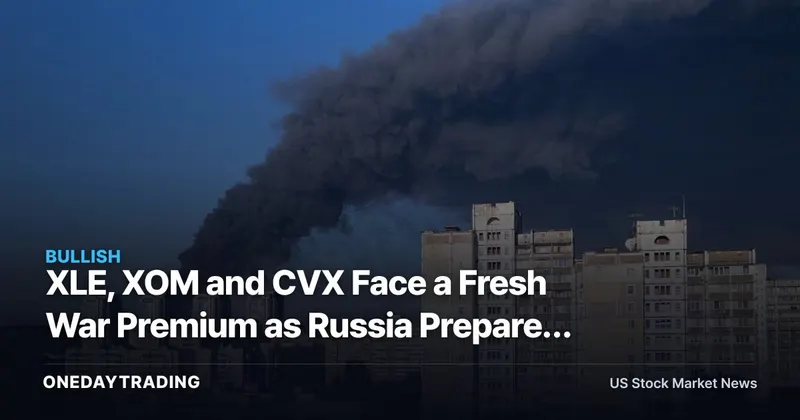
Energy infrastructure means the power generation, transmission and fuel systems that keep a country running. When Russia signals those assets are in scope, investors stop asking only about the battlefield and start asking about crude, transport costs and the durability of the risk premium.
XLE, XOM and CVX can respond because geopolitics changes the probability distribution for supply, not just the next quarter's earnings. The market does not need a full supply shock to re-rate the group; it needs enough threat for traders to keep paying for optionality in energy exposure.
Defense names read differently. LMT, RTX and NOC do not need immediate order flow to benefit from the headline, but they do need the market to believe escalation keeps air defense, interceptors and replenishment relevant. If the announcement fades into rhetoric, that premium fades with it.
By the Numbers
The source gives one concrete timeline marker and one severity marker: Russia's announcement came after what CNBC described as the deadliest attack of the year. Those two facts matter because markets price escalation in sequence, not in isolation.
There is no casualty count or damage total in the report, so the trade is not about a hard data point. It is about whether the next headlines confirm disruption, and whether crude-linked stocks keep outperforming after the first reaction is digested.
Winners & Losers
- XLE, XOM and CVX: a higher war premium supports upstream energy cash flow narratives and keeps the market focused on supply risk.
- LMT, RTX and NOC: renewed strike risk keeps missile defense and replenishment demand in focus.
- DAL, UAL and AAL: airlines can face a fuel-cost headwind if escalation lifts crude and refined-product prices.
- Broader industrials: the read-through is weaker unless the situation spills into logistics, repairs or a wider European risk-off move.
Risk Check
- If Russia's statement is a warning rather than an actual precursor to damage, the move in energy and defense names can unwind quickly.
- If crude and defense shares already price in escalation, the next headline may produce little follow-through.
- If markets decide the conflict is contained, the premium shifts back to the next macro driver instead of geopolitics.
- If the response widens, the trade changes from headline risk to a longer-duration earnings story.
Bottom Line
Russia's plan for massive strikes on Ukraine's energy infrastructure is constructive for XLE, XOM, CVX and selected defense contractors only as long as investors believe the threat can become physical disruption. The real checkpoint is not the wording of the announcement; it is whether the next round of headlines shows outages, fuel stress or a broader escalation that keeps the war premium alive.
FAQ
Why does Ukraine energy infrastructure matter for U.S. oil stocks?
Russia's threat matters because energy markets price expected disruption, not just confirmed damage. XLE, XOM and CVX can gain when investors decide the next shock is more likely to tighten supply than to fade.
Which defense stocks react most to Ukraine escalation headlines?
LMT, RTX and NOC usually get the cleanest read-through because the market links escalation with air defense and replenishment demand. The move lasts only if investors expect more than a one-day headline cycle.
What would make the trade fade?
If Russia's announcement does not lead to visible damage, supply stress or a broader response, the premium can disappear fast. XLE, XOM, CVX, LMT, RTX and NOC all lose momentum once the market decides the threat was priced too far ahead of the facts.
Market data check: XLE
XLE last traded near $63.55 (+1.39%). Our composite signal — blending price momentum and news flow — reads 🟡 neutral. Price momentum scores 69/100 (firm).
Data as of publication. Price via market feeds; for reference only, not investment advice.
📊 Analysis
Signal Bullish
Why Escalation risk supports energy and defense premium pricing, although the trade depends on follow-through.
Tickers$XLE$XOM$CVX$LMT$RTX$NOC
This article was independently written by OneDayTrading from public reporting. Read the original (CNBC)