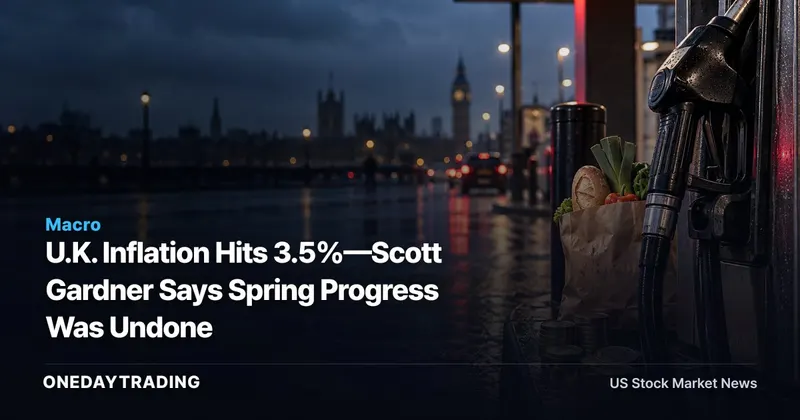
Scott Gardner’s Warning Frames the 3.5% Inflation Shock
Scott Gardner’s warning that inflation had undone earlier progress captures the risk for investors: the U.K. price trend is strengthening while markets already assign an exceptionally high probability to tighter monetary policy. On October 21, 2026, CNBC Markets reported that U.K. annual inflation rose to 3.5% in the 12 months to September, above the 3.4% rate economists had forecast. The immediate relevance extends beyond the inflation surprise because the next Bank of England decision is already heavily reflected in market pricing.
Inflation is the change in the general price level over a stated period; here, the 3.5% figure compares U.K. prices with their level in the corresponding period a year earlier. The September reading was the highest annual inflation figure in almost a year. It also extended a sequential pattern in which annual inflation increased from 2.9% in July to 3.1% in August and then to 3.5% in September.
Motor Fuel Prices Put the Headline Under Pressure
Motor fuel provides the clearest source of pressure disclosed in the available evidence. CNBC Markets reported that U.K. motor fuel prices rose 29.8% in the year to September, while the motor fuel inflation rate reached its highest level since August 2022. That comparison establishes the scale and historical reference point of the fuel move without establishing its exact contribution to the overall 3.5% inflation rate.
The distinction matters for the policy interpretation. A large fuel-price increase can lift the headline reading, while the Bank of England’s eventual response remains a separate decision. The supplied evidence does not quantify how much of the September acceleration came from motor fuel, so investors cannot use the 29.8% figure alone to reconstruct the full inflation basket or determine how policymakers will weigh its components.
Scott Gardner of J.P. Morgan Personal Investing said the renewed increase had “undone the progress we saw in the spring.” His formulation highlights the change in direction visible in the confirmed data: the annual rate did not merely exceed the 3.4% forecast; it rose from both the 3.1% August reading and the 2.9% July reading.
Bank of England Pricing Leaves Little Room for a Mild Surprise
The market has already converted the inflation backdrop into a strong policy expectation. According to the LSEG data reported by CNBC Markets, traders assigned a 98% chance to a 25-basis-point increase in the Bank of England’s key interest rate to 4% next month. Traders were also pricing another 25-basis-point increase at the final meeting of the year in December.
This is the central market tension. The inflation release strengthens the case embedded in current pricing, but a 98% probability means the anticipated next-month increase is already close to fully reflected in those expectations. The portion that remains unresolved is not the market’s base case; it is whether the Bank of England ultimately delivers that increase and whether the separately priced December move remains credible.
Suren Thiru described the policy setup by saying that “the pieces are falling firmly into place for a November rate rise.” That is an assessment, not an announced Bank of England outcome. The eventual interest-rate decision remains unknown, and the distinction between a market-implied probability and a completed policy action is essential for investors evaluating the next move.
The Pound and Government Bonds Resist the Headline
The first market response was restrained rather than disorderly. Following the data release, the British pound was flat against both the euro and the U.S. dollar, while U.K. government bond yields were little changed. Those moves indicate that the 3.5% result did not produce an immediate repricing large enough to move either market materially in the reported reaction.
That muted tape is consistent with a market that had already assigned a 98% chance to the next rate increase, though the supplied facts do not prove why the pound and bond yields were stable. Investors should therefore separate observation from inference: the confirmed observation is limited movement after the release; the plausible interpretation is that substantial tightening risk was already in the price.
The remaining risk is asymmetrical around expectations rather than around the published inflation number. If the anticipated increase occurs, attention can shift toward the separately priced December decision. If it does not occur, the gap between the 98% implied probability and the actual outcome would become the more important market fact.
John Healey Faces Inflation With Debt Above £3 Trillion
Monetary policy is only one side of the constraint. Separate data estimated that U.K. national debt exceeded £3 trillion, or $4 trillion, in September for the first time. The exact final September debt value was not provided, leaving the confirmed threshold more informative than any unsupported estimate beyond it.
John Healey was set to present his first fiscal shakeup the following week during the U.K. Autumn Budget. He said he would be “maintaining our fiscal discipline,” while the contents and fiscal impact of that budget remained unknown. Investors therefore have a stated fiscal posture, not a completed package whose effect can be measured.
Suren Thiru called the situation “a perilous high-wire act for the Chancellor.” The phrase captures the tension supported by the sheet: annual inflation has reached 3.5%, national debt has crossed £3 trillion, and a 25-basis-point Bank of England increase to 4% next month carries a 98% market-implied probability. None of those facts reveals which measures John Healey will select or what their eventual effect will be.
Equity and Sector Read-Through: Keep the Claim Narrow
- Rate-sensitive valuations: The evidence supports a more restrictive U.K. rate backdrop because markets price a 98% chance of a 25-basis-point increase to 4% next month. It does not identify individual U.S.-listed companies whose earnings or valuation changed because of the release.
- Consumer-facing sectors: A 29.8% annual rise in U.K. motor fuel prices establishes a substantial household price pressure. The fact sheet provides no company-level sales, traffic, pricing or margin data, so a specific retail or consumer-stock conclusion would exceed the evidence.
- Financials: The expected policy move is directly relevant to the rates environment, while no bank-level net interest margin, credit-cost or capital data are supplied. The appropriate conclusion is macro directional pressure, not a forecast for an individual financial institution.
- Energy exposure: Motor fuel inflation reached its highest rate since August 2022, but the evidence does not establish a direct relationship with any listed producer, refiner or distributor. That prevents a supported company-specific beneficiary call.
Bull and Bear Conditions Around the U.K. Rate Path
The bearish case rests on persistence and limited policy flexibility. Annual inflation climbed from 2.9% in July to 3.1% in August and 3.5% in September, while motor fuel prices rose 29.8% in the year to September. At the same time, debt exceeded £3 trillion and markets priced both a near-certain next-month increase and an additional 25-basis-point move in December.
The counter-case begins with what the tape has already absorbed. The pound was flat against the euro and U.S. dollar after the release, U.K. government bond yields were little changed, and the probability assigned to the next increase already stood at 98%. A confirmed decision matching that expectation would not, by itself, establish that markets had underestimated the policy path.
The dividing line is persistence. The supplied evidence shows a three-reading upward sequence and an unusually strong motor fuel increase, while it does not reveal motor fuel’s precise contribution to headline inflation. That missing decomposition limits confidence about how broadly the pressure extends and prevents a definitive forecast of the Bank of England’s response.
Investor Checkpoints After the September Inflation Release
- Bank of England decision: Compare the eventual action with the market’s 98% probability of a 25-basis-point increase to 4% next month.
- December pricing: Check whether expectations for another 25-basis-point increase at the final meeting of the year strengthen or weaken after the next policy decision.
- Autumn Budget: Assess the measures John Healey presents the following week rather than treating his fiscal-discipline statement as an achieved outcome.
- Market confirmation: Monitor whether the British pound and U.K. government bond yields continue their muted response or begin to reflect a different inflation and policy assessment.
The next decisive signal is the Bank of England’s actual decision, not another restatement of the 3.5% headline. With a 98% probability already attached to a 25-basis-point increase to 4% next month, the investable question is whether policy validates the priced path—and whether expectations for the additional December increase survive once that first checkpoint passes.
📊 Analysis
Signal Bearish
Why Hotter inflation, a near-fully priced rate increase and record national debt create a restrictive backdrop, even though the immediate currency and bond-market reaction was muted.
This article was independently written by OneDayTrading from public reporting. Read the original (CNBC Markets)