What Changes
Strait of Hormuz oil-market exposure rises when Iran makes diplomacy conditional on Gaza, Lebanon and Syria, because crude buyers, refiners and shippers must price not just a possible talks track but the operational risk around a critical Middle East transit route.
The Strait of Hormuz is the maritime chokepoint between the Persian Gulf and the Gulf of Oman, and in market terms a chokepoint means a narrow transport route where political disruption can change freight costs, insurance pricing and crude availability before production itself changes.
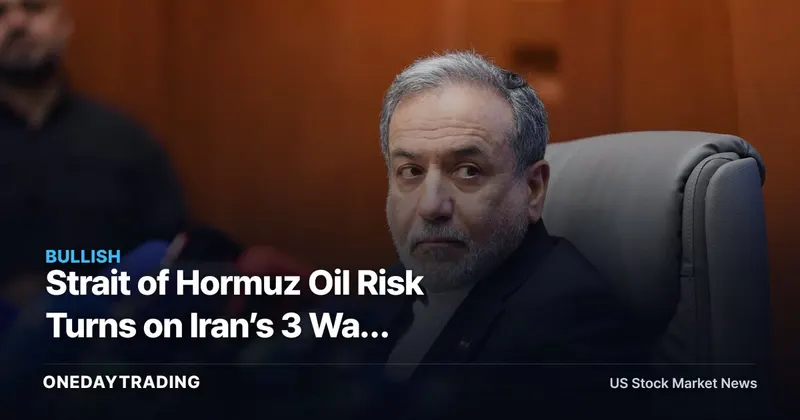
CNBC reported that Iran said a return to diplomacy is not impossible, but Iran also said the Gaza Strip conflict has to end, Israel has to withdraw from Lebanon and Israel has to stop attacks on Syria. That framing matters because a diplomatic off-ramp now depends on three theaters moving together, which lowers the value of any single headline that sounds conciliatory.
By the Numbers
The clean number in CNBC’s report is three: Iran attached diplomacy and the reopening of Hormuz to the Gaza Strip, Lebanon and Syria. One condition would be a negotiation; three conditions make this a regional risk bundle.
Exxon Mobil (XOM) and Chevron (CVX) do not need a confirmed supply outage to benefit from a crude risk premium, because upstream earnings respond to higher benchmark prices while integrated balance sheets absorb volatility better than smaller producers. Valero Energy (VLO) faces the opposite mix: if crude input costs rise faster than product prices, refining margins can compress even when headline energy prices look stronger.
Winners & Losers
- Exxon Mobil (XOM): Exxon Mobil (XOM) benefits if Hormuz risk lifts crude prices, because Exxon Mobil’s upstream production has direct leverage to oil benchmarks.
- Chevron (CVX): Chevron (CVX) gains from the same crude-price channel, but Chevron’s stock reaction depends on whether investors see the risk premium as durable or only headline-driven.
- Valero Energy (VLO): Valero Energy (VLO) can lag oil producers if higher crude costs pressure refining spreads and end-market fuel demand does not absorb the input shock.
- Tanker and shipping exposure: Frontline (FRO) and ZIM Integrated Shipping (ZIM) face freight-rate upside if rerouting or insurance costs rise, but higher operating uncertainty can also reduce cargo visibility.
Risk Check
- Iran’s statement, per CNBC, says diplomacy is not impossible, so a direct de-escalation headline can quickly remove part of the oil risk premium.
- The source report gives no crude-price move, no supply-loss figure and no timeline, so investors should avoid treating the statement as a confirmed disruption.
- Energy equities can underperform crude if the broader market reads the event as a demand shock or a geopolitical volatility tax rather than a clean commodity tailwind.
- Refiners and transport stocks have different exposures: producers like Exxon Mobil (XOM) prefer higher crude prices, while refiners like Valero Energy (VLO) need product margins to keep pace.
Bottom Line
The Hormuz headline is modestly bullish for oil-linked producers and less clean for refiners and shippers: Iran left diplomacy open, but CNBC’s reported three-front condition means the market must price a regional-policy hurdle, not just a single negotiation. The next checkpoint is whether Gaza, Lebanon or Syria headlines move from rhetoric into a dated diplomatic process; without that, the risk premium stays conditional rather than confirmed.
FAQ
Why does the Strait of Hormuz matter for oil stocks?
The Strait of Hormuz matters for oil stocks because transport risk can affect crude pricing before any company reports a change in production. Exxon Mobil (XOM) and Chevron (CVX) have upstream earnings exposure that can benefit when investors add a geopolitical premium to oil.
What did Iran say about reopening Hormuz?
Iran said a return to diplomacy is not impossible, but CNBC reported that Iran tied the reopening of Hormuz to the Gaza Strip conflict ending, Israel withdrawing from Lebanon and Israel halting attacks on Syria. That makes the market trigger regional rather than bilateral.
Which stocks are most exposed to Hormuz oil risk?
Exxon Mobil (XOM) and Chevron (CVX) are exposed through crude-price sensitivity, while Valero Energy (VLO) is exposed through refining margins. Frontline (FRO) and ZIM Integrated Shipping (ZIM) are exposed through freight, insurance and routing risk.
📊 Analysis
Signal Bullish
Why Iran’s three-condition stance keeps a geopolitical risk premium alive for crude-linked producers, while the benefit is less direct for refiners and shippers.
Tickers$XOM$CVX$VLO$FRO$ZIM
This article was independently written by OneDayTrading from public reporting. Read the original (CNBC)