At a Glance
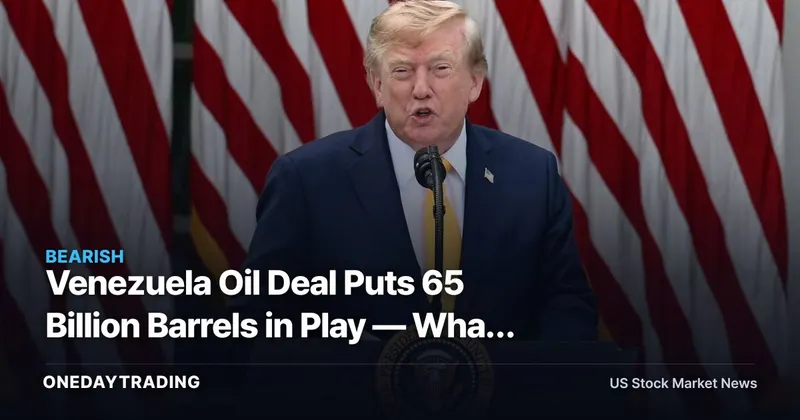
In CNBC's report, Trump said the U.S. struck a deal with Venezuela to secure majority control of more than 65 billion barrels of oil reserves. For investors, that is a crude-supply headline first and a cash-flow story much later: the market can reprice expectations before a single barrel moves.
Venezuela oil reserves are not the same thing as production. Reserve control changes who may benefit from future output, but it does not solve the political, legal, and infrastructure hurdles that turn geology into sales.
What does majority control of Venezuela's oil reserves mean for crude prices?
The read-through is directional for oil, but only in the long-dated part of the curve. More than 65 billion barrels is a large number, and if that reserve base becomes accessible, the global supply picture looks looser than before.
That is why crude-linked equities react before barrels do. Traders will trade the possibility of lower future scarcity, while operators still need financing, export access, and a policy framework that can survive beyond a single headline.
Which oil stocks and service names could react first?
- XOM and CVX are the cleanest large-cap read-throughs because integrated producers live off global crude assumptions and downstream margins.
- COP and OXY are more exposed to price moves because upstream cash flow usually reacts faster when the oil deck shifts.
- SLB and HAL need real drilling, maintenance, and development budgets before reserve control turns into service revenue.
- VLO and MPC could benefit only if the story eventually pressures feedstock costs more than product demand.
Key Debates
- Does majority control mean operational access, or only political leverage?
- How fast can any reserve claim become exportable barrels?
- Will the market discount future supply, or dismiss the announcement as headline risk?
- Does the deal lower crude price expectations enough to matter for producer multiples?
What to watch next
- Any follow-up on legal authority, sanctions, or operating terms.
- Whether the oil market moves more on WTI than on the stock tape.
- Reactions from XOM, CVX, SLB, HAL, COP, and OXY.
- Whether the reserve story shifts discussion on supply later this quarter.
Overall Outlook
The bull case is that a credible path to majority control of more than 65 billion barrels would alter long-term supply math and pressure the oil premium. The risk case is that the market is pricing a claim, not a flow, and claims can fade fast when the mechanics stay unresolved.
For now, the trade is about optionality. If the deal advances into enforceable terms, the read-through leans bearish for crude and mixed for producers, while if it stalls, the headline likely fades back into geopolitics.
FAQ
Does the Venezuela oil deal add barrels to the market right away?
No. Trump's announcement describes control over reserves, not immediate output, and those are different market events. Oil prices move on deliverable supply, so the first reaction is about expectations rather than physical barrels.
Why would oil stocks care about 65 billion barrels of reserves?
Oil stocks care because reserve access can change the long-term pricing deck. XOM, CVX, COP, and OXY all trade partly on assumptions about future crude scarcity, while SLB and HAL depend on whether reserves become funded projects.
What is the main risk for traders reading too much into this headline?
The main risk is confusing control with monetization. Without legal clarity, infrastructure, and export logistics, the market can reprice the story and then reverse when the execution gap stays open.
📊 Analysis
Signal Bearish
Why A claim over more than 65 billion barrels is a long-run supply overhang for crude and upstream valuations, even if no barrels move immediately.
Tickers$XOM$CVX$COP$OXY$SLB$HAL
This article was independently written by OneDayTrading from public reporting. Read the original (CNBC)