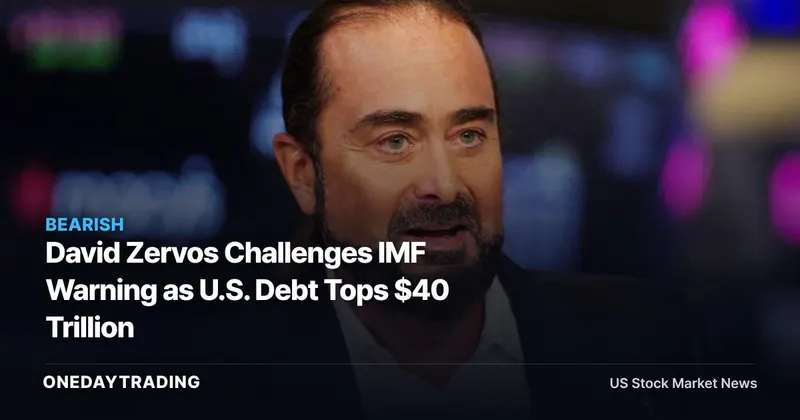
David Zervos Turns a Fiscal Dispute Into a Rates Question
David Zervos dismissed International Monetary Fund Managing Director Kristalina Georgieva’s warning after U.S. government debt surpassed $40 trillion, putting the sustainability of American fiscal policy back at the center of the Treasury-market debate. For investors, the immediate issue is not whose forecast wins the argument. It is whether growth can restrain the debt-to-GDP ratio while interest payments and the deficit continue to raise concern.
CNBC Markets reported that 10-year U.S. Treasury yields remained above 5% as scrutiny of the fiscal outlook intensified. That level gives the disagreement market relevance: sustained high yields can challenge equity valuations, while a retreat would reduce the pressure attributed to long-term rates. The supplied evidence does not establish either path, so the current signal is elevated uncertainty rather than a confirmed fiscal break.
What the International Monetary Fund Warning Actually Says
Debt sustainability describes whether a government can carry its obligations without entering an adverse cycle of rising borrowing costs and mounting debt burdens. Georgieva’s position was narrow but consequential: strong U.S. economic growth would not, by itself, place mounting federal debt on a sustainable course. The warning did not claim that a crisis had already begun.
Scott Bessent had presented the countercase to CNBC in August, saying the United States could “grow our way out” of a rising debt-to-GDP ratio. The two positions therefore divide over sufficiency, not over whether growth matters. Bessent’s argument requires growth to improve the ratio; Georgieva’s warning says growth alone cannot be assumed to complete that adjustment.
Many economists cited in the supplied reporting warn that high deficits and mounting interest payments raise the risk of an unsustainable debt spiral. They remain divided over whether those pressures could push the United States into a true fiscal crisis. That distinction matters because a rising risk is not the same as a realized outcome.
Why David Zervos Attacked the Forecasting Record
Zervos, the newly appointed counselor to the Treasury Secretary, challenged the International Monetary Fund’s credibility rather than supplying a specific fiscal-consolidation program. In emailed comments to CNBC, he said the institution’s forecasts had been “messy” and should be treated with caution. He previously served as chief market strategist at Jefferies.
David Zervos cited the International Monetary Fund’s 2008 World Economic Outlook forecast of 3% world growth as one example in his critique. He also pointed to the institution’s assessments involving Southeast Asia in 1997 and Russia in 2022, using those episodes to argue that its record should temper confidence in the current warning.
His other example concerned Argentina: David Zervos invoked a $57 billion bailout and said the country was basically in default again by 2020. These examples support his criticism of forecast reliability. They do not establish that the International Monetary Fund’s U.S. debt assessment is wrong, because challenging a forecaster’s history does not determine the outcome of the present fiscal question.
The Global Debt Context Behind the Exchange
The dispute extends beyond Washington. CNBC Markets reported that global debt topped $365 trillion in the first half of the year, while institutions were warning about the rising cost of servicing that debt. The figure frames the U.S. argument as part of a wider constraint on public finances, not as an isolated disagreement between Treasury officials and the International Monetary Fund.
In a September report, the Institute of International Finance described a “vicious cycle between elections and short-term quick fixes.” It said short-term responses to debt challenges were reducing governments’ ability to spend on public services. That observation adds a political constraint to the arithmetic: near-term responses can compete with the longer-term discipline required to address debt burdens.
Georgieva has also directed fiscal-consolidation warnings at other large economies. On Oct. 7, she summarized her message to France as “Get your house in order.” The FACT_SHEET does not specify which consolidation measures the International Monetary Fund advocates for the United States, so investors cannot infer a particular tax, spending or financing outcome from her warning.
Rates, Equity Multiples and Sector Leadership
The cleanest market instrument for this story is the 10-year U.S. Treasury yield. The tape already reflects an elevated long-term rate; it does not resolve whether that rate represents temporary caution, persistent fiscal concern or the opening stage of a debt spiral. Investors should separate the observable yield from the disputed explanation for it.
For equities, the transmission channel runs through valuation. A higher discount rate can reduce the present value assigned to future earnings, placing greater pressure on stocks whose valuations depend heavily on distant cash flows. This is a general market mechanism, not evidence that any named company has suffered a measurable impact from the Zervos-Georgieva exchange.
Sector leadership could therefore respond to the direction and persistence of long-term yields, though the FACT_SHEET provides no company-specific exposure, earnings sensitivity or stock-price response. Naming individual beneficiaries or victims would overstate the evidence. The investable question is whether the fiscal debate keeps long rates elevated, not whether one set of comments produces a durable equity rotation by itself.
The Growth Case Versus the Debt-Spiral Risk
Growth case: Bessent’s view leaves open the possibility that economic expansion could reduce the U.S. debt-to-GDP ratio. If the ratio improves, the argument that growth can carry more of the adjustment would gain support. The supplied facts do not confirm that this process is occurring, so it remains a scenario rather than a result.
Fiscal-risk case: Georgieva’s warning becomes more persuasive if strong growth fails to improve debt sustainability while interest payments and the deficit remain sources of concern. Continued pressure in long-term Treasury yields would keep that risk visible to equity investors. Even then, economists’ disagreement means the evidence would not automatically prove that a fiscal crisis is unavoidable.
The strongest conclusion is conditional. Zervos has offered reasons to question the International Monetary Fund’s forecasting confidence, while Georgieva has identified a limit to relying on growth alone. Neither position settles whether U.S. debt will enter an unsustainable spiral.
Investor Checkpoints After the IMF-Treasury Clash
- Follow the 10-year U.S. Treasury yield: persistence above the reported threshold would keep discount-rate pressure and fiscal scrutiny in focus; a reversal would weaken the immediate rates signal without resolving debt sustainability.
- Test Bessent’s growth argument against the debt-to-GDP ratio: the relevant confirmation is whether growth actually reduces that ratio, not whether economic activity is described as strong.
- Track interest-payment and deficit concerns: those are the stated channels behind economists’ warnings about a possible debt spiral.
- Wait for specific fiscal measures: Georgieva’s warning does not identify the U.S. consolidation policies the International Monetary Fund favors, leaving the policy path undefined.
The next decisive signal will come from the relationship among growth, the debt-to-GDP ratio and long-term Treasury yields. Until those measures move consistently, the market is pricing a fiscal argument whose outcome remains open—not a crisis that the available evidence has already confirmed.
📊 Analysis
Signal Bearish
Why Elevated Treasury yields, rising interest payments and a high deficit create a negative rates backdrop, even though a fiscal crisis remains uncertain.
This article was independently written by OneDayTrading from public reporting. Read the original (CNBC Markets)