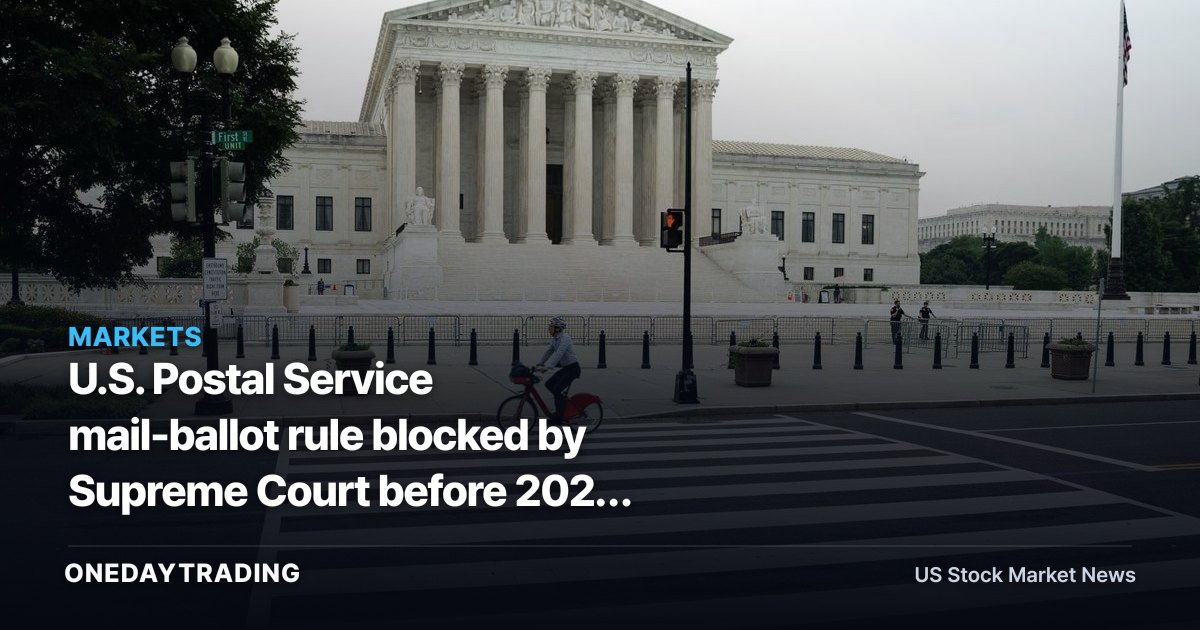
Supreme Court ruling leaves the 2026 mail-ballot process unchanged for now
Investors should read the Supreme Court’s September 14, 2026 decision as a timing and administrative constraint, not as a new business catalyst. The nine-justice court rejected the Trump administration’s request to lift a preliminary injunction blocking a U.S. Postal Service mail-in-ballots rule nationwide in November’s 2026 midterm elections, leaving the rule unavailable less than two months before Election Day. That removes an immediate change to election-mail procedures, while preserving uncertainty about whether the rule could be used in future elections.
CNBC reported that the court said the administration was unlikely to succeed on the merits of its challenge to the injunction. Because the case concerns election administration rather than a company’s financial results, the supplied record does not establish a direct effect on revenue, margins, capital spending or valuation for any listed stock.
What the unsigned order decided on September 14
The Supreme Court issued an unsigned order refusing to stay the preliminary injunction issued by a federal judge in Boston in late August. The injunction blocks the Postal Service rule across all 50 states for November’s elections. The precise vote count and individual votes in the order are not provided in the available facts.
The order addresses the rule’s use in the 2026 elections; it does not resolve whether the regulation is lawful for every later election. The court’s statement that the administration was unlikely to prevail on its challenge explains why the stay request failed, but the record does not state the Supreme Court’s ultimate view of the rule’s future validity.
Justice Brett Kavanaugh concurred. In his statement, he wrote that applying the rule in the 2026 elections “would be arbitrary and capricious,” because state and local election officials did not have enough time to implement it reasonably before voting. Justices Samuel Alito and Clarence Thomas dissented from the denial of the stay.
What the Postal Service rule would have changed
The blocked regulation established new standards for ballot envelopes and required states to create lists of voters eligible to obtain mail ballots. It implemented an executive order issued by Donald Trump in March. With the injunction still in force, those standards and eligibility-list requirements cannot be used for November’s 2026 elections under this order.
The practical issue identified by Kavanaugh is implementation capacity. Election officials would have been asked to adapt envelope procedures and voter-list systems close to the election. His concurrence accepts that the rule might fall within the Postal Service’s statutory authority while finding the election-year timing legally defective under the Administrative Procedure Act. That distinction separates a possible long-term rule from its immediate application.
The source does not provide the rule’s technical envelope specifications, the design of the eligibility lists, or operating instructions for postal employees. Those details therefore cannot support a more granular assessment of processing costs or delivery performance.
Why timing matters for the election administration system
The November contests will determine which political party controls each chamber of Congress. Republicans currently hold slim majorities in both the House of Representatives and the Senate, making administration of mail ballots part of a high-stakes political environment even though the court’s order is procedural.
For states and local election offices, the immediate takeaway is continuity: the procedures in place before the blocked rule remain the applicable framework for November’s elections. That continuity can reduce the need for last-minute changes to ballot-envelope handling and voter-eligibility records. It does not eliminate litigation risk, because the court has not announced its ultimate decision on use of the rule in future elections.
Celina Stewart, CEO of the League of Women Voters, one of the plaintiffs, welcomed the decision and said the court had prevented federal action from throwing elections into chaos. New York Attorney General Letitia James, part of the coalition suing to block the rule, said she was relieved by the reprieve. Those statements describe the plaintiffs’ position; they are not an independent finding about election outcomes or Postal Service performance.
Market and stock implications: policy visibility without a confirmed earnings read-through
- U.S. Postal Service operations: The rule’s nationwide block means no confirmed November implementation of its new envelope standards or state eligibility-list requirements. The facts supplied do not include a publicly traded Postal Service parent or any quantified financial effect, so an earnings estimate cannot be derived.
- Election-technology and administrative vendors: A halt to near-term rule changes may limit immediate demand for projects tied specifically to new envelope or eligibility-list procedures. The record names no vendors, contracts or spending amounts, so company-level beneficiaries or losers cannot be identified responsibly.
- Broader U.S. equities: The decision does not report changes to interest rates, fiscal policy, consumer demand or corporate earnings. Any index or sector reaction would therefore be an interpretation of political risk rather than a confirmed fundamental transmission mechanism.
The neutral market stance follows from that evidence gap. The ruling is significant for election administration and legal timing, but the supplied facts do not connect it to a listed issuer’s cash flow. A more directional view would require disclosures showing implementation spending, litigation exposure or a measurable change in operating conditions.
Investor checkpoints before November’s elections
- Further court action: Track any subsequent Supreme Court ruling on whether the Postal Service rule may be used in future elections. The current order resolves only its use in November’s 2026 elections.
- Implementation guidance: Watch for instructions from election officials or the Postal Service confirming that existing mail-ballot procedures remain in place while the injunction stands. The supplied facts do not give a publication date for such guidance.
- Congressional control: The elections will decide control of the House of Representatives and Senate. The exact Election Day date and the eventual electoral outcome are not provided.
- Company disclosures: For any logistics, election-services or government-contracting company under review, look for an earnings filing that quantifies exposure to federal election administration. No such company-specific exposure is established in the source.
Outlook: continuity now, legal uncertainty later
The near-term scenario is operational continuity. The injunction remains nationwide, and the rule cannot be applied in November’s 2026 elections under the Supreme Court’s September 14 order. That removes a last-minute procedural change less than two months before Election Day.
The counter-scenario is a later ruling that permits the regulation in future elections. The current decision does not settle that question, and the facts do not indicate when the court will address it or what its final judgment will be. Investors should avoid treating the stay denial as a permanent repeal.
The live risk is therefore legal and administrative rather than an identifiable corporate earnings shock. The next observable signals are any ruling on the rule’s future use and concrete election-administration guidance for November. Until those arrive, the evidence supports a neutral market assessment: meaningful policy uncertainty, but no confirmed listed-company financial outcome.
📊 Analysis
Signal Neutral
Why The ruling changes election-rule timing but provides no confirmed earnings, revenue or operating impact for a listed company or sector.
This article was independently written by OneDayTrading from public reporting. Read the original (CNBC)