Summary
Pizza Pod, Bradley Alvelo's New York City mobile pizzeria built around a Smart car, is less a restaurant-chain story than a test of whether spectacle can convert into repeat food demand without the fixed cost of a storefront.
Pizza Pod is a privately held food concept, so the CNBC-reported profile does not create a direct U.S.-listed equity catalyst; the investor read-through sits in consumer behavior, quick-service competition and urban food-service cost structure.
The Full Story
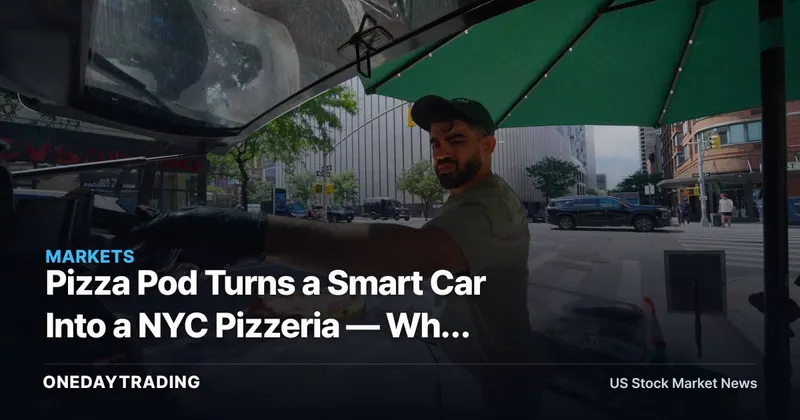
CNBC reported that 38-year-old founder Bradley Alvelo runs Pizza Pod as a mobile pizzeria out of a Smart car in New York City, after starting from the question of whether a tiny car could become a pizza operation.
Pizza Pod's operating edge is attention before advertising: a Smart car configured as a pizzeria naturally draws foot traffic in dense New York City locations, and that lowers the burden usually carried by paid marketing or prime retail frontage.
The constraint is also physical. Pizza Pod can use novelty to win the first order, but Pizza Pod must still prove throughput, food consistency and repeat purchase if the concept is more than a live-service stunt.
Structural Background
A mobile pizzeria is a food-service format that moves production closer to customers, replacing a fixed dining room with a compact operating footprint and relying on location, queue management and speed to drive sales.
For investors, the relevant mechanism is behavior-to-balance-sheet: consumers stop for the spectacle, but revenue quality comes only if the product, price and wait time turn that stop into recurring demand.
Stock & Sector Ripple
- Quick-service restaurants: Pizza Pod highlights how small-format food concepts can pressure traditional storefront economics by competing for impulse occasions without a full dining-room buildout.
- Food trucks and mobile kitchens: Pizza Pod reinforces the appeal of flexible location-based selling in dense cities where visibility and mobility can substitute for expensive permanent real estate.
- Urban retail landlords: Pizza Pod's model points to a consumer channel that can bypass storefront leases, though the source does not provide sales volume or rent-comparison data.
- Food delivery platforms: Pizza Pod is a reminder that not every convenience model starts with an app; visible street-level demand can matter before digital ordering economics enter the discussion.
Bull vs Bear Scenarios
The bull case is that Pizza Pod turns a strange format into a repeatable brand asset: New York City gives Bradley Alvelo dense foot traffic, and the Smart car setup gives Pizza Pod a marketing hook that a conventional slice shop cannot copy cheaply.
The bear case is that Pizza Pod's same novelty caps scalability. If customers treat Pizza Pod as a one-time attraction, the model becomes labor- and location-dependent rather than a durable restaurant format.
Investor Action Points
- Track whether CNBC or Pizza Pod later discloses unit economics such as daily order volume, average ticket or operating hours.
- Watch for evidence that Pizza Pod expands beyond one Smart car without losing food quality or service speed.
- Compare Pizza Pod's visibility-led customer acquisition with traditional quick-service restaurant traffic and delivery-platform demand.
- Treat Pizza Pod as a private consumer trend signal, not a standalone public-stock catalyst, until a listed company becomes directly involved.
FAQ
What is Pizza Pod in New York City?
Pizza Pod is Bradley Alvelo's mobile pizzeria operating from a Smart car in New York City, according to CNBC reporting. Pizza Pod belongs to the food-service and mobile-kitchen category rather than the public restaurant-chain universe.
Why does Pizza Pod matter for restaurant investors?
Pizza Pod matters for restaurant investors because Pizza Pod tests whether visibility, mobility and low-format novelty can pull customers without a conventional storefront. Pizza Pod does not provide public financial data in the CNBC source, so the signal is qualitative rather than earnings-driven.
Is Pizza Pod connected to any U.S.-listed stock?
Pizza Pod is not identified in the CNBC source as a U.S.-listed company. Pizza Pod therefore has no direct ticker read-through, although the concept touches quick-service restaurants, food trucks, urban retail and food delivery competition.
📊 Analysis
Signal Neutral
Why Pizza Pod is a private food-service concept with no disclosed sales data or direct U.S.-listed company catalyst in the source.
This article was independently written by OneDayTrading from public reporting. Read the original (CNBC)