What Changes
The Strait of Hormuz matters to oil investors because tanker traffic through the waterway connects crude supply with refinery demand; a record flow of more than 17 million barrels on Monday indicates that barrels were moving at exceptional wartime intensity, according to CNBC reporting. The renaming proposal is political symbolism, but the transit figure is the investable fact.
That distinction sets up the sector read-through. If high-volume passage continues, crude-risk premiums can compress because physical availability is being demonstrated rather than merely promised. If the record proves temporary, any renewed interruption would hit expectations for supply security first, lifting volatility across oil producers, refiners and transport users.
Oil majors such as Exxon Mobil and Chevron would gain revenue leverage from firmer crude prices, but higher prices also raise fuel and feedstock costs for airlines, chemicals companies and other industrial buyers. The market therefore has to price both sides of the same channel: producer cash flow improves with stronger benchmarks, while energy-intensive businesses face margin pressure.
By the Numbers
Chris Wright, the U.S. energy secretary, said more than 17 million barrels of oil transited the Strait of Hormuz on Monday. CNBC characterized that volume as a new wartime record, giving investors a concrete baseline for judging whether subsequent flows are normalizing or retreating.
The source provides no oil-price move, company earnings change or duration for the elevated traffic. That limits the conclusion: the record confirms passage capacity on one day, not a guaranteed trend in supply, prices or corporate margins.
Winners & Losers
- Exxon Mobil (XOM): Higher crude prices would generally provide revenue and operating leverage to an integrated producer, although the source does not report a price response.
- Chevron (CVX): Chevron carries similar upstream sensitivity; sustained secure transit would support volumes, while disruption risk would increase benchmark volatility.
- Oil producers: A durable wartime flow record would support confidence in market access, but a reversal could quickly restore a geopolitical premium.
- Airlines and transport: Any crude-price spike would feed into jet-fuel and diesel costs, pressuring margins unless carriers can pass prices through.
Risk Check
- The 17-million-barrel figure covers Monday only; one exceptional day cannot establish a continuing flow pattern.
- Political rhetoric around a proposed “Trump Strait” name may distract from the operational question of whether passage remains open.
- Higher crude prices would help upstream producers but could weaken demand-sensitive industries through fuel and input inflation.
- Because CNBC reports no market-price, inventory or earnings data, investors should avoid treating the transit record as a complete valuation signal.
Bottom Line
The bullish case for oil producers rests on sustained, high-volume passage translating into tighter geopolitical risk premiums and stronger crude realizations. The counter-case is that Monday’s record is a one-day statistic, while any subsequent disruption would reverse the read-through and widen costs for energy users. The next checkpoint is the next reported transit volume and the accompanying crude-price reaction.
FAQ
Why did Trump propose renaming the Strait of Hormuz?
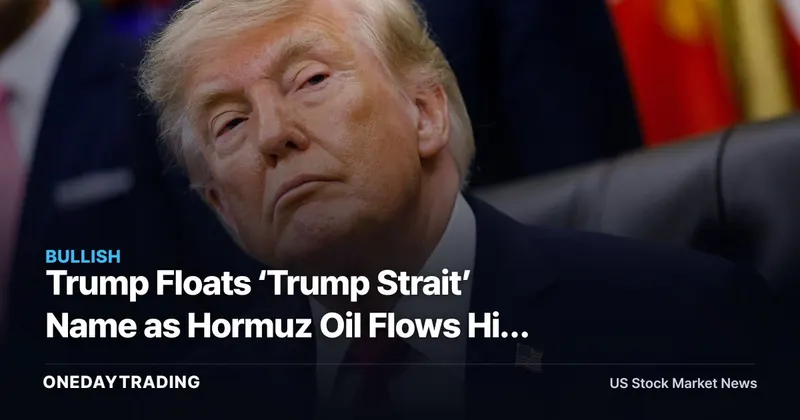
Donald Trump floated the idea of calling the Strait of Hormuz the “Trump Strait,” according to CNBC. The source gives no operational policy attached to the proposal, so its market significance is symbolic rather than a documented change in shipping rules.
How much oil crossed the Strait of Hormuz on Monday?
U.S. Energy Secretary Chris Wright said more than 17 million barrels transited the Strait of Hormuz on Monday. CNBC described the volume as a new wartime record, but did not provide a longer time series.
What does the Hormuz oil-flow record mean for oil stocks?
A sustained high-volume flow could support oil producers if it keeps supply available while geopolitical risk lifts crude prices. A one-day record does not prove that outcome, and any renewed disruption would increase volatility while raising fuel costs for airlines and other transport companies.
Market data check: XOM
XOM last traded near $163.07 (-0.90%). Our composite signal — blending price momentum and news flow — reads 🟡 neutral. Price momentum scores 43/100.
Data as of publication. Price via market feeds; for reference only, not investment advice.
📊 Analysis
Signal Bullish
Why The record 17-million-plus-barrel transit supports oil-supply resilience while preserving upside risk premiums for producers, though the signal is limited to one day.
This article was independently written by OneDayTrading from public reporting. Read the original (CNBC)