What Changes
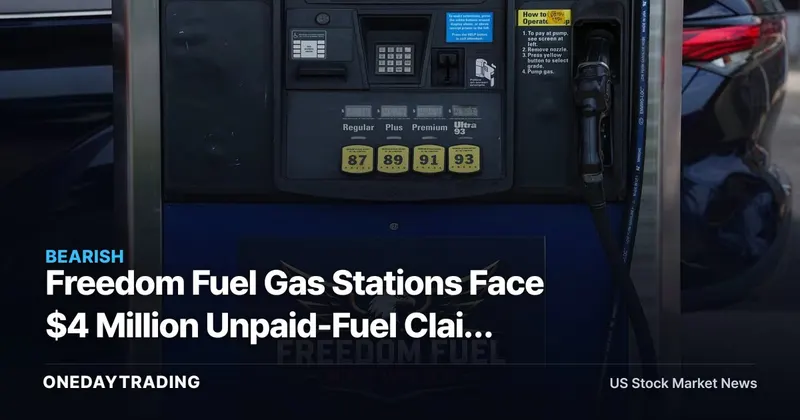
Freedom Fuel gas stations are not a public-equity story by ticker, but CNBC's reporting creates a clear read-through for retail fuel investors: unpaid supply bills can damage station economics faster than demand headlines can repair them. In fuel retail, the invoice cycle matters because gasoline inventory is expensive, perishable in margin terms, and usually financed before the pump sale becomes usable cash.
A federal lawsuit is a civil court claim asking a court to resolve a dispute, and CNBC reported that the claim says KRSM failed to pay for $4 million worth of fuel. The important mechanism is not only the dollar amount; the important mechanism is whether suppliers tighten credit, demand faster payment, or restrict deliveries to operators linked to the disputed fuel flow.
Freedom Fuel's Trump-promoted branding may attract attention, but the CNBC-reported lawsuit points to a harder variable: whether the network's distributors can keep fuel moving without supplier confidence eroding. Gas stations do not sell a story if tanks are underfilled or supply terms become punitive.
By the Numbers
CNBC reported that a fuel distributor claims KRSM failed to pay for $4 million worth of fuel in a federal lawsuit. CNBC also reported that some of the fuel allegedly unpaid for by KRSM was sold to the Freedom Fuel network.
The $4 million figure is the only hard number in the source reporting, so the analysis should stay anchored there. For a station network, the next meaningful figures would be court filings, supplier-payment terms, delivery continuity, and any documented exposure by individual locations.
Winners & Losers
- Freedom Fuel network: Negative signal because CNBC reported that some fuel tied to the alleged $4 million nonpayment was sold through the network, creating reputational and supply-chain questions.
- KRSM: Direct legal and commercial pressure because CNBC reported that a distributor says KRSM failed to pay for $4 million worth of fuel.
- Fuel distributors: Potential beneficiaries if suppliers respond by enforcing tighter payment discipline, faster collections, or stricter delivery controls across higher-risk accounts.
- Independent gas stations: Potential pressure point because supplier confidence can influence fuel availability and working-capital flexibility even when consumer pump demand holds.
Risk Check
- Legal uncertainty: CNBC described the matter as a federal lawsuit claim, so the allegation is not the same as a court finding.
- Limited disclosure: The source provides no public financial statements for Freedom Fuel or KRSM, which limits balance-sheet conclusions.
- Sector read-through: The event is company-specific unless filings show broader supplier exposure or repeated payment failures.
- Counter-scenario: If KRSM resolves the $4 million dispute without delivery disruption, the market relevance stays narrow and operational damage may be contained.
Bottom Line
Freedom Fuel's issue is not gasoline demand; it is supplier trust. The CNBC-reported $4 million unpaid-fuel claim against KRSM is bearish for the affected fuel-retail chain if the lawsuit leads to tighter credit or delivery constraints, but the risk remains bounded unless new filings show broader exposure across the network.
FAQ
What happened with Freedom Fuel gas stations?
CNBC reported that a federal lawsuit claims fuel distributor KRSM failed to pay for $4 million worth of fuel. CNBC also reported that some of that fuel was sold to the Trump-promoted Freedom Fuel network.
Why does an unpaid fuel lawsuit matter for gas stations?
An unpaid fuel lawsuit matters because gas stations depend on steady distributor deliveries and supplier credit. If suppliers question payment reliability after CNBC's reported $4 million claim against KRSM, fuel availability and payment terms become the key operating variables.
Is Freedom Fuel publicly traded?
The CNBC source material does not identify Freedom Fuel or KRSM as U.S.-listed public companies. Without a direct listed parent in the source reporting, the clean market read-through is to fuel-retail credit risk rather than a specific stock ticker.
📊 Analysis
Signal Bearish
Why The reported $4 million unpaid-fuel lawsuit creates negative credit, supplier-confidence and operating-risk signals for the Freedom Fuel network and KRSM.
This article was independently written by OneDayTrading from public reporting. Read the original (CNBC)