What Changes
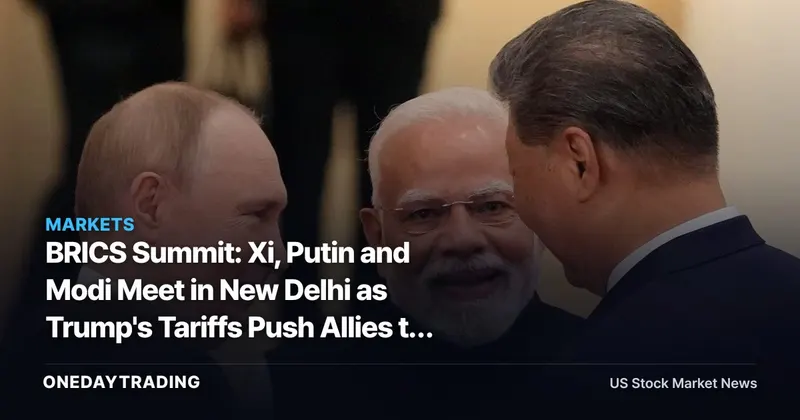
The read-through here isn't that BRICS is coalescing into an anti-dollar bloc — it's that U.S. tariff and sanctions pressure is a new input into relationships that were already shifting on their own terms. India and Russia have been close for decades, and the India-China detente predates the current U.S. trade friction, per CNBC's reporting. What Trump's approach adds is a reason for members to keep more channels open at once, rather than a reason to pick a side.
That shows most clearly in India's posture. New Delhi sits inside the Quad with the United States, Japan and Australia, while simultaneously advancing the China reset that an August meeting between Beijing's foreign minister and India's national security advisor pushed forward on the border dispute, Bajpaee wrote. Bajpaee's own framing — that recent strains with the Trump administration pushed New Delhi to "reinvest in other relationships" — is his interpretation, not a confirmed policy shift, but it identifies the mechanism worth tracking: friction with Washington raising the value India places on its China and Russia options, without India abandoning the Quad.
For Russia, the calculus is more binary. Western sanctions over Ukraine have made China and India the load-bearing partners for its trade, with China as an economic lifeline and India a major buyer of Russian oil, per CNBC. That dependency is structural, not a summit talking point, and it's the clearest concrete shift in the fact pattern here.
By the Numbers
The one hard figure tied directly to this story is the UAE's pledge to invest $46 billion in Germany across a range of sectors, cited by CNBC. It's notable less for the size than for what it signals: the UAE, a BRICS member since the bloc's expansion beyond Brazil, Russia, India, China and South Africa to include Iran, Egypt, Ethiopia and Indonesia, is simultaneously deepening ties with a core Western economy. That's the tension running through the whole summit — expansion has given BRICS more economic weight, and Quincy Institute's Sarang Shidore's blunter label, a "dysfunctional family," captures why that weight hasn't translated into unified action, particularly given Iran and the UAE sit on opposite sides of the Middle East conflict.
Winners & Losers
- U.S. dollar, near term: the Kremlin's statement that Moscow isn't pursuing outright de-dollarization, and India's preference — per Bajpaee — for local-currency and digital-payment efficiency over a broader anti-dollar push, both cut against a near-term reserve-currency shock.
- Germany and Western capital recipients: the UAE's $46 billion pledge shows Gulf capital still flowing into core Western economies even from a BRICS member, evidence that diversification and Western investment aren't mutually exclusive for this bloc.
- India's diplomatic leverage: holding a Quad seat while advancing the China reset — helped along by August's foreign-minister-level border progress — gives New Delhi optionality that a more binary alignment would forfeit.
- Russia's dependency on China and India: sanctions have made these the primary channels for Russian trade and oil sales; that's a structural reliance that deepens rather than a temporary arrangement, per CNBC's reporting.
Risk Check
- No specific trade, energy or payments agreement from this summit has been confirmed — the "unknown" here is the actual output, not just the geopolitical framing.
- BRICS members diverge sharply on how far to go on de-dollarization, and Iran-UAE tensions over the Middle East war illustrate how security splits limit what the bloc can agree on, per Shidore.
- Xi's planned trip to the United States later this month means Beijing is managing the Washington relationship in parallel with the New Delhi optics — a signal this is hedging, not a break.
- The India-China border dispute and India's trade deficit with Beijing remain unresolved even as diplomatic contacts (flights, visas, the August NSA-level meeting) resume.
Bottom Line
The summit is real evidence that U.S. tariff and sanctions pressure is nudging India, Russia and China toward more contact with each other, but the Kremlin's own denial of a de-dollarization push and India's preference for a narrower, efficiency-focused agenda argue against reading this as a coordinated move against the dollar. The upside case is that BRICS becomes a more useful "pragmatic club," in Shidore's phrase, for trade and payments efficiency among members with overlapping but not identical interests. The risk is that expansion to ten-plus members with active security disputes among them — Iran and the UAE chief among them — keeps consensus elusive regardless of how much U.S. pressure builds.
FAQ
Is BRICS trying to replace the U.S. dollar?
Not according to the reporting here: the Kremlin said this week Moscow isn't seeking outright de-dollarization, and India has steered the group toward local-currency and digital-payment efficiency rather than a broader anti-dollar campaign, per Chatham House's Bajpaee. Trump has nonetheless called BRICS an "attack on the dollar" and threatened tariffs against members he sees as undermining it.
Why does Xi's visit to India matter?
It's Xi's first trip to India since 2019, following deadly 2020 clashes on the disputed Himalayan border, and it extends a reset that a Modi-Xi meeting at the 2024 BRICS summit helped start. An August meeting between China's foreign minister and India's national security advisor made progress on the border dispute, according to Bajpaee, though the underlying territorial and trade-deficit tensions remain unresolved.
Does this summit conflict with India's relationship with the U.S.?
Not directly — India remains a member of the Quad alongside the United States, Japan and Australia even as it advances the BRICS-based reset with China. That dual-track approach is consistent with India's long-standing strategic-autonomy posture rather than a pivot away from Washington.
📊 Analysis
Signal Neutral
Why The summit shows BRICS members hedging against U.S. tariffs and sanctions, but the Kremlin's denial of an outright de-dollarization push and India's resistance to a broader anti-dollar agenda leave no confirmed catalyst for currency or asset markets.
This article was independently written by OneDayTrading from public reporting. Read the original (CNBC)