At a Glance
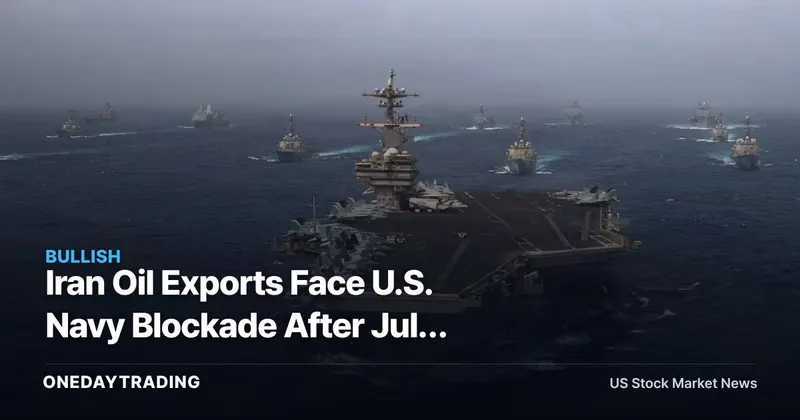
U.S. Navy blockade Iran oil exports is the core market signal: CNBC reported that the Trump administration moved toward economic warfare after a dozen July airstrike waves failed to force Tehran to abandon its claim to Hormuz, putting crude supply risk back into oil equities and inflation-sensitive assets.
Hormuz, as framed in CNBC's report, is the strategic dispute point tied to Iran oil exports, and a blockade is a military effort to restrict physical flows rather than a conventional sanctions order.
Why It Matters Now
The investable issue is not only whether Iranian barrels fall; the issue is whether traders price a wider risk premium into seaborne crude. Exxon Mobil, Chevron and U.S. refiners react through different channels: producers benefit from higher realized prices, while refiners face pressure if crude input costs rise faster than product margins.
CNBC's supplied report gives one hard sequence: a dozen waves of U.S. airstrikes in July did not force Tehran to abandon its claim to Hormuz, and the Trump administration then shifted to economic warfare. That sequence matters because policy escalation moved from destructive strikes to a pressure campaign aimed at oil-export revenue.
The constraint for investors is data quality. CNBC's supplied excerpt says the blockade slashed Iran oil exports, but CNBC's supplied excerpt does not provide a barrel-per-day figure, a percentage decline or a dated export baseline, so the price signal must be tested against crude futures, tanker data and company guidance.
Key Debates
- Supply risk: If Iran oil exports stay restricted, global crude balances tighten at the margin and integrated oil producers gain operating leverage to price.
- Inflation channel: If oil prices rise on the blockade, transportation, airlines and consumer fuel costs become the second-order equity risk.
- Refining math: Valero and Phillips 66 do not automatically benefit from higher crude; refiners need product cracks to widen enough to absorb feedstock inflation.
- Policy uncertainty: The Trump administration's economic-warfare shift can support oil risk premiums, but any de-escalation around Hormuz would remove part of that premium quickly.
Related Stocks & Sectors
- XOM: Exxon Mobil has direct upside to higher crude realizations if Iran oil export disruption lifts benchmark prices.
- CVX: Chevron benefits from the same upstream price channel, though the stock still depends on realized crude and gas pricing.
- VLO: Valero faces a margin test because higher crude costs can compress refining economics when product prices lag.
- PSX: Phillips 66 is exposed through refining spreads, not just headline oil direction.
- Airlines: Delta Air Lines and other fuel-heavy transport names face cost pressure if crude risk premiums flow into jet fuel.
What to Watch
- WTI and Brent price reaction after CNBC's reported U.S. Navy blockade of Iran oil exports.
- Any reported export-volume baseline for Iran, because the supplied CNBC excerpt gives no barrel-per-day number.
- Next earnings commentary from Exxon Mobil, Chevron, Valero and Phillips 66 on crude realizations and refining margins.
- Any U.S. or Iranian statement on Hormuz, because the blockade thesis depends on whether economic warfare escalates or eases.
Overall Outlook
The setup is bullish for U.S. oil producers and more mixed for refiners, airlines and rate-sensitive equities. The bull case rests on restricted Iran oil exports adding a durable crude risk premium; the risk case is that the market has already priced the blockade before hard export numbers confirm the size of the disruption.
FAQ
Why are Iran oil exports important for U.S. energy stocks?
Iran oil exports affect U.S. energy stocks because restricted supply can raise crude benchmarks and improve realized prices for producers such as Exxon Mobil and Chevron. CNBC's supplied report says a U.S. Navy blockade slashed Iran oil exports, but the supplied report does not give a specific export-volume decline.
Did the Trump administration use airstrikes before the oil blockade?
CNBC reported that a dozen waves of U.S. airstrikes in July failed to force Tehran to abandon its claim to Hormuz. CNBC reported that the Trump administration then shifted to economic warfare, with the U.S. Navy blockade targeting Iran oil exports.
What stocks move if the U.S. Navy blockade lifts oil prices?
Exxon Mobil and Chevron can benefit if the blockade raises crude prices and producer realizations. Valero, Phillips 66 and airlines face a tougher setup if crude and fuel costs rise faster than refined-product margins or ticket pricing.
📊 Analysis
Signal Bullish
Why The reported blockade is a positive crude-price catalyst for U.S. oil producers, though refiners and transport stocks face margin risk.
Tickers$XOM$CVX$VLO$PSX$DAL
This article was independently written by OneDayTrading from public reporting. Read the original (CNBC)