S&P 500 Rally After the Democrats’ Sweep
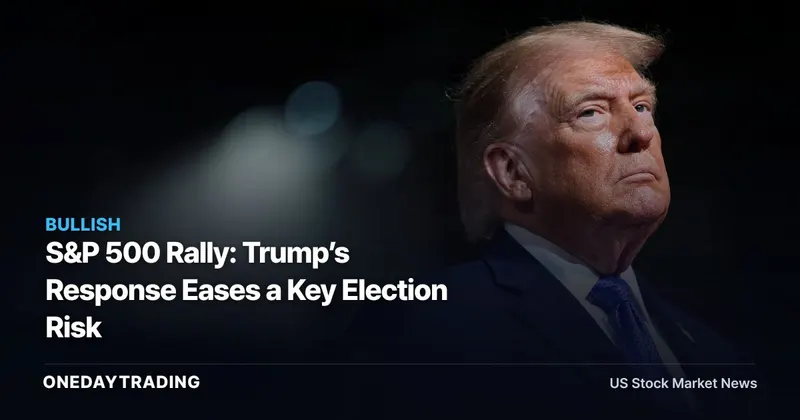
The S&P 500 gained more than 1% on Wednesday after Democrats swept the midterm elections and Trump accepted the results while expressing openness to working with them. For investors, the sharpest interpretation is not that one political outcome guarantees stronger markets. It is that an immediate source of uncertainty—the possibility of a prolonged dispute over the result—appeared to diminish.
- The market move: The broad market index rose more than 1% on Wednesday, while stock market futures had rebounded around the time headlines about Trump’s response appeared.
- The political signal: Trump told The New York Times and The Wall Street Journal that he accepted the results and would work with Democrats.
- The unresolved issue: The evidence does not establish how much of the rally came from the election result, how much came from Trump’s response, or whether his stated position will persist.
What Trump’s Acceptance Changed for the Market
Election uncertainty, in this context, means uncertainty about whether legal challenges could delay clarity over political control. That distinction matters because the confirmed development was not simply a decisive victory for Democrats. Trump’s acceptance of that outcome reduced concern about an immediate contest over the result, at least at the time of Wednesday’s trading.
The sequence supports a cautious market interpretation. Democrats completed a decisive sweep, Trump communicated acceptance through two major newspapers, and futures rebounded around the time those reports appeared. That timing makes his response relevant to the move, though it does not prove that the response caused a specific portion of the gain.
Thomas Hempell is a senior economist at Generali Investments, while George Saravelos heads FX Research at Deutsche Bank. Their institutional roles place the political development within a broader market debate over uncertainty, rather than turning the election outcome itself into a forecast for earnings, policy or index returns. None of those future effects is quantified in the available evidence.
CNBC Survey Shows the Risk Investors Had Priced
CNBC’s Fed Survey covered 30 fund managers, strategists and economists, and 63% said extended uncertainty from legal challenges to election results posed some market risk. That reading was above the 61% reported for September, showing that concern about an unsettled result had not been confined to a marginal group of respondents.
In the same CNBC survey, 14% of respondents classified that uncertainty as a significant market risk, compared with 7% in the prior comparison. The split is important: most respondents identifying a risk did not place it in the most severe category, while the share assigning greater significance had increased.
Those figures help explain why acceptance of the result could matter to market sentiment without proving that it accounted for Wednesday’s entire advance. A feared source of uncertainty became less immediate. The survey does not measure the portion of the S&P 500’s move attributable to that change, and the article supplies no separate attribution model.
The S&P 500’s 8,000 Scenario
The S&P 500’s Wednesday close left the index roughly 4% below an 8,000 year-end level, according to CNBC. Philip Blancato of Osaic discussed that level as a possibility rather than a reported outcome. It therefore belongs in a scenario analysis, not in the headline as an achieved milestone or a firm forecast.
A roughly 4% gap is concrete, but the evidence does not provide the index’s exact Wednesday closing value. It also does not establish a path to 8,000. The more than 1% Wednesday gain describes what happened in one session; the year-end level describes a conditional destination that the market had not reached.
This separation is essential for investors reading a politically driven rally. The tape registered relief, while the future path still depends on developments absent from the fact sheet. Treating the 8,000 discussion as a certainty would erase the difference between an observed index move and an analyst’s conditional scenario.
Market Winners, Constraints and Transmission
- S&P 500: The broad market index was the direct beneficiary in the confirmed trading data, gaining more than 1% on Wednesday as immediate election-related uncertainty appeared to ease.
- Broad equity sentiment: Futures rebounded around the time reports of Trump’s acceptance emerged. This supports a positive reading of the initial reaction, without assigning a precise share of the rally to those reports.
- Investors exposed to an extended dispute: The diminished threat of prolonged uncertainty addressed a risk identified by 63% of CNBC’s 30 survey respondents as some market risk and by 14% as significant market risk.
- No evidence-supported sector ranking: The supplied facts do not identify individual companies or sectors that led the rally. Naming specific stock winners or losers would go beyond the available record.
Trump Remains the Rally’s Central Risk Check
- Durability: The evidence confirms Trump’s stated willingness to work with Democrats, not that this posture will continue.
- Attribution: Wednesday’s gain cannot be divided precisely between the Democrats’ sweep, Trump’s response and other unquantified influences.
- Index path: The S&P 500’s exact Wednesday close is not provided, even though the distance to 8,000 is described as roughly 4%.
- Future outcome: No subsequent market result is established, so the Wednesday rally cannot by itself validate the year-end scenario.
What Investors Should Check Next
Jay Woods of Freedom Capital Markets described the market-sensitive issue as Trump’s “initial tone and reaction to the results,” then captured the continuing uncertainty more directly: “He is an X factor.” The next checkpoint is therefore behavioral rather than numerical—whether Trump continues to accept the result and engage with Democrats in subsequent statements and actions.
Investors should also compare that political signal with the S&P 500’s progress toward the discussed 8,000 year-end level. The relevant test is not whether one strong session can be extrapolated, but whether the index sustains its advance while the election-result uncertainty identified in CNBC’s survey continues to recede.
Blancato supplied the most useful discipline for interpreting the move. “The president's always going to be a wildcard,” the Osaic strategist said, adding, “Let's not let one day make a year.” That frames the live trade-off cleanly: Wednesday delivered a bullish market reaction, while the premise behind part of that relief remains conditional.
Bottom Line on Wednesday’s S&P 500 Move
The confirmed evidence supports a bullish reading of Wednesday, not an unconditional forecast. The S&P 500 rose more than 1% after Democrats swept the elections and Trump accepted the result, addressing a form of uncertainty that a majority of CNBC’s surveyed professionals had identified as a market risk. Further upside toward 8,000 remains a scenario rather than an outcome; its credibility will depend on whether the cooperative signal persists and whether the index can build on the initial reaction.
📊 Analysis
Signal Bullish
Why The S&P 500 advanced more than 1% as a contested election outcome appeared less likely, although the durability of Trump’s position remains uncertain.
This article was independently written by OneDayTrading from public reporting. Read the original (CNBC)