Saudi Arabia’s Capital Cycle Changes Direction
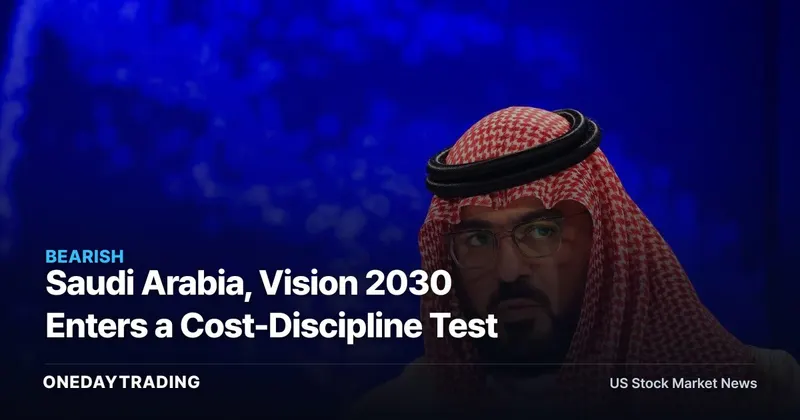
Saudi Arabia is tightening Vision 2030 capital allocation as economic contraction and regional security pressure expose the cost of delivering its diversification program. For investors, the central issue is no longer whether projects can attract funding at any cost, but which projects survive a more selective test of returns, strategic importance and private-sector participation.
CNBC reported that Saudi Arabia’s real GDP contracted 3.8% in the third quarter, while oil activities decreased 20.4% year-on-year and non-oil activities rose 1.9%. That split is the investment tension in one line: diversification is still producing non-oil growth, though it is not large enough in the reported period to offset the contraction in oil activity.
Vision 2030 is Saudi Arabia’s economic diversification plan, launched in 2016 to reduce reliance on oil revenue. The current shift does not end that program; it changes the standard governing how state capital is deployed.
From Project Scale to Capital Discipline
Economy Minister Faisal Alibrahim described the new approach as “spending and delivery at the right cost,” according to CNBC. That language points to a capital-cycle reset: execution, cost and strategic priority now matter more than the sheer scale or speed of development.
The evidence is visible across several projects. Saudi Arabia reassessed or reduced spending on initiatives including NEOM and The Line, withdrew funding from LIV Golf, halted construction of a planned giant skyscraper in Riyadh and postponed the 2029 Asian Winter Games at Trojena, a planned part of NEOM.
The Public Investment Fund, or PIF, is Saudi Arabia’s sovereign wealth fund and a central financing vehicle for Vision 2030. It has become more selective in capital allocation and is seeking greater private-sector participation, shifting part of the funding burden away from automatic state support. The article does not disclose the monetary value of spending reductions or identify every project facing delay or retrenchment, so the full size of the adjustment cannot be quantified from the available evidence.
Contraction Raises the Return Threshold
Foreign capital is also moving in the wrong direction. CNBC reported that Saudi Arabia’s net foreign direct investment inflows decreased 19.5% year-on-year in the second quarter. When external investment weakens as state funding grows more selective, projects must compete more intensely for both public and private capital.
The Saudi Ministry of Finance expects the Saudi economy to contract 2.1% this year and rebound 10.9% next year. Oxford Economics is more cautious, forecasting a 3.4% contraction this year and a 4% contraction in 2027. These forecasts are not confirmed outcomes, and the divergence makes the next economic releases more important than any single projection.
Akanksha Samdani, lead economist at Oxford Economics, said the government is redirecting budget spending toward essential services and strategic priorities. Her assessment also preserves the longer thesis: “But the overarching goal of economic diversification remains unchanged.” The distinction matters because slower or narrower deployment is not the same as abandonment; it implies a higher hurdle for projects seeking capital.
Security Pressure Meets the Physical Economy
Houthi strikes hit the PIF tower, Riyadh Airport and Saudi Arabia’s largest oil refinery. Those targets connect security risk directly to the physical systems supporting state investment, transport and energy production. Faisal Alibrahim captured the dual burden when he said, “The human cost of crisis has been real, and so has been the economic cost.”
Saudi Arabia’s infrastructure investment provided some resilience. The energy sector restored production to near pre-crisis levels, while the country shifted its import and export hub from east to west through land-based transport. These adaptations show that installed capacity and alternative routes can reduce operational disruption, even though no confirmed date was given for a full restoration of energy production.
Neil Quilliam, managing director of Azure Strategy, is relevant to the investor debate because repeated attacks can shape perceptions of persistent vulnerability. The transmission mechanism runs through confidence: greater uncertainty around infrastructure, logistics and project execution can make private participation harder to secure precisely when PIF wants more of it.
Tax Clarity Versus Investment Friction
Saudi Arabia also announced a 15% minimum effective tax rate on multinational profits, CNBC reported, without providing an exact announcement date. The stated policy direction is a clearer operating environment for the private sector. For capital allocators, clarity can support planning, while the effective burden and its interaction with project economics cannot be assessed from the supplied facts.
This creates a two-sided test for Vision 2030. More disciplined state spending and a clearer regulatory framework could direct capital toward projects with stronger strategic value. Weaker foreign investment, economic contraction and continued infrastructure risk could narrow the private-sector pool expected to replace part of the state’s role.
Energy, Logistics and Project-Sector Read-Through
- Energy: The 20.4% year-on-year decrease in Saudi Arabia’s third-quarter oil activities is the sharpest reported sector signal. Restored production near pre-crisis levels is supportive operationally, while attacks on the largest oil refinery keep infrastructure security central to the outlook.
- Logistics and transportation: Moving the import and export hub from east to west through land-based transport demonstrated route flexibility. The next test is whether that arrangement continues to preserve cargo movement under further pressure.
- Construction and major projects: Reduced spending on NEOM and The Line, the halted Riyadh skyscraper and the postponed Asian Winter Games indicate a tougher selection process. Without disclosed project budgets, the effect on aggregate construction demand cannot be measured.
- Private capital: PIF’s greater selectivity creates opportunity for outside participation, yet the 19.5% year-on-year decrease in second-quarter net foreign direct investment inflows shows that attracting that capital is not automatic.
Bull and Bear Cases for Vision 2030
Bull case: Cost discipline concentrates resources on essential services and strategic priorities, infrastructure keeps energy and cargo systems functioning, and the 1.9% rise in third-quarter non-oil activities develops into a broader diversification base. A rebound closer to the Saudi Ministry of Finance’s 10.9% expectation next year would strengthen this scenario.
Bear case: Security incidents continue to disrupt critical assets, foreign investment remains weak and project reductions deepen as PIF protects capital. An outcome closer to the Oxford Economics forecasts—a 3.4% contraction this year followed by a 4% contraction in 2027—would challenge the capacity of non-oil activity and private participation to carry more of the program.
Neither case is settled. The available evidence supports a shift in spending discipline, not a confirmed end state for Vision 2030 or a guaranteed economic rebound.
Investor Checkpoints After Saudi Arabia’s Spending Shift
- Next GDP release: Compare oil activities with non-oil activities to determine whether diversification is offsetting more of the economic contraction.
- Next foreign-investment update: Track whether net foreign direct investment inflows improve from the reported 19.5% year-on-year second-quarter decrease as PIF seeks greater private participation.
- Next project decisions: Separate projects receiving continued capital from those scaled back or delayed. New disclosures on NEOM, The Line and other initiatives would clarify the boundaries of the spending reset.
- Next infrastructure status report: Check whether energy production advances from near pre-crisis levels and whether the westward land-based trade route continues to maintain cargo movement.
📊 Analysis
Signal Bearish
Why Economic contraction, weaker foreign investment and attacks on critical infrastructure outweigh the near-term support from non-oil growth and restored energy capacity.
This article was independently written by OneDayTrading from public reporting. Read the original (CNBC)