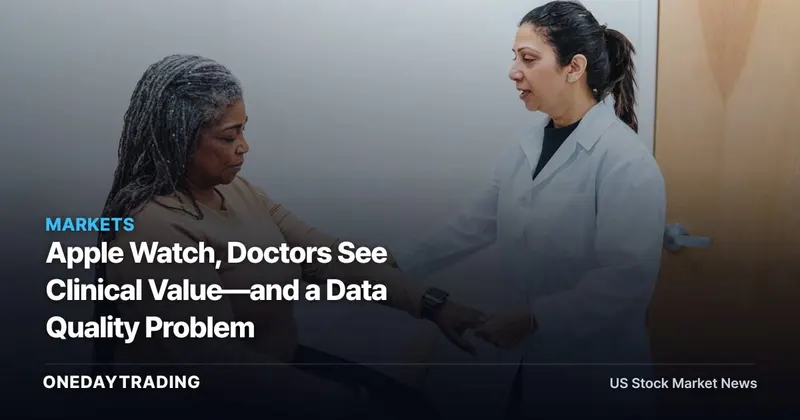
Apple Watch Data Enters the Exam Room
Apple Watch and other wearable health trackers are becoming part of annual checkups, giving doctors more patient data while raising unresolved questions about accuracy and anxiety. CNBC reported the clinical debate alongside an estimated $71 billion market for wearable health trackers in 2025. For investors following Apple and the broader device category, the evidence supports relevance to patient care, not a measurable commercial or clinical-outcomes conclusion.
A wearable health tracker is a device that collects health information outside the doctor’s office, including signals related to heart rate, activity and sleep. The investment issue is whether that stream becomes useful enough for clinicians to strengthen the product relationship without generating so much questionable or distracting information that it erodes trust.
The Clinical Case: More Than a Single Office Measurement
Dr. Neha Vyas, a family physician at Cleveland Clinic, said wearable information can start conversations with patients and add context beyond a single measurement taken during an office visit. “They actually start a conversation,” she said. That distinction matters: the strongest evidence in the account concerns wearables as inputs to clinical discussion, rather than replacements for professional judgment.
Dr. Linda E. Tepper, an internist at NYU Langone Health, described a more urgent use case. According to CNBC, an Apple Watch detected a fall involving her 89-year-old patient and contacted the police, an ambulance and his daughter. The patient fractured three bones, and Tepper said, “He would have died out there.”
The incident illustrates the device category’s clearest potential value: collecting information when a patient is away from a clinician and initiating contact after a dangerous event. The patient was not named, and the incident has not been independently verified, so it should be treated as a physician-attributed case rather than broad proof of effectiveness.
Tepper also said devices worn by some patients detected atrial fibrillation that was later confirmed and treated. The American Heart Association identifies atrial fibrillation as a condition that can affect patients, while the supplied evidence does not establish how often wearable alerts lead to confirmed diagnoses or treatment changes. The difference between a useful individual case and a reproducible outcome remains the central evidence gap.
The Data Problem Behind a $71 Billion Category
CNBC placed Apple Watch, Whoop, Oura and Fitbits within an estimated $71 billion wearable health tracker market in 2025. Apple, Google, Samsung and Garmin each sell fitness-tracking products, while Whoop and Oura sell health wearables. Scale makes data quality more consequential because readings increasingly enter conversations that patients once had without a continuous device-generated record.
Whoop and Oura have each announced valuations of more than $10 billion since October 2025, according to CNBC. Those valuations show the commercial significance attached to the category, though the fact sheet does not provide the companies’ specific valuations beyond that threshold. It also supplies no revenue, profitability, unit-sales or subscription figures from which to assess the durability of those valuations.
Accuracy questions have followed wearable health trackers over the past 10-plus years through class-action litigation. Oura was sued in August over allegedly inaccurate sleep-stage tracking, and Oura disputes the claim. The year of that lawsuit and device-level accuracy rates are not provided, preventing a comparison among products or a judgment about the allegation’s broader significance.
Where Wearable Signals Can Mislead Patients
- Actionable data versus abundant data: Dr. Neha Vyas framed the clinical challenge directly: “How do we take all this data and actually make it actionable?” More readings do not establish that each reading requires intervention.
- Alerts versus symptoms: Vyas said patients should consider how they feel and bring continuing concerns to a doctor before acting on device information themselves. This preserves the distinction between a tracker’s signal and a clinician’s assessment.
- Sleep scores versus treatment decisions: Dr. Linda E. Tepper said some patients took sleeping pills unnecessarily because sleep scores made them nervous. “I don’t want everybody on a sleeping pill,” she said.
- Monitoring versus reassurance: Vyas said plentiful data can create health anxiety, repeated reassurance and further monitoring. That feedback loop can turn engagement into a burden for both patients and clinicians.
Apple, Google and the Evidence Investors Actually Have
- Apple: Apple Watch is the product most directly connected to the reported fall-detection incident and to Tepper’s account of atrial-fibrillation detection among patients. These examples support clinical relevance, while the fact sheet provides no associated sales, retention or treatment-outcome metrics.
- Google: Google sells fitness-tracking products, and Fitbits are among the wearable formats doctors discussed. No company-specific clinical result or financial figure is supplied for Google.
- Samsung and Garmin: Both companies sell fitness-tracking products. Their inclusion confirms participation in the category, not comparative accuracy, market position or financial impact.
- Whoop and Oura: Their announced valuations of more than $10 billion since October 2025 show substantial value attached to specialized health wearables. Oura’s disputed sleep-stage allegation also places data credibility at the center of the category’s risk analysis.
CNBC Select may earn a commission from affiliate partners on links. That disclosure does not change the physicians’ attributed statements, though readers should keep editorial evidence, affiliate economics and company claims analytically separate.
Checkpoints for Wearable Health Investors
- Clinical confirmation: Examine whether future device alerts are confirmed by medical evaluation and whether they change diagnoses or treatment. The current evidence contains cases, not a frequency measure.
- Accuracy disclosure: Look for product-specific accuracy rates, especially for health and sleep signals. None are available in the fact sheet, so comparisons among Apple Watch, Oura, Whoop and Fitbits would be speculative.
- Patient behavior: Track whether doctors describe wearables as starting productive conversations or producing repeated reassurance and unnecessary self-directed action. Both patterns appear in the reported experience.
- Company economics: Assess future disclosures for revenue, profitability, device sales and subscription performance. The $71 billion market estimate and more than $10 billion valuations do not reveal how much economic value any listed company captures.
The Investment Read-Through for Wearable Health Trackers
The constructive case rests on utility between appointments. Wearables can supply information beyond a single office measurement, prompt patient conversations and, in attributed cases, help detect falls or atrial fibrillation. That usefulness could reinforce the role of devices in patient care as doctors become more accustomed to interpreting their data.
The risk case is evidentiary. Inaccurate or misunderstood readings can heighten anxiety, require repeated reassurance and encourage patients to act on scores without adequate clinical context. Litigation concerning sleep-stage tracking, even when disputed, underscores why trust must accompany engagement.
The current record therefore supports a neutral sector view. “Just as with other forms of technology, it’s not going away,” Dr. Neha Vyas said. The next meaningful change in the investment thesis will come from evidence that connects device signals to confirmed clinical decisions and company economics while quantifying accuracy; until those measures appear, powerful anecdotes and large market valuations remain incomplete endpoints.
Market data check: Apple Inc.
Apple Inc. last traded near $358.54 (+0.83%). Our composite signal — blending price momentum and news flow — reads 🟡 neutral. Price momentum scores 65/100 (firm).
Data as of publication. Price via market feeds; for reference only, not investment advice.
📊 Analysis
Signal Neutral
Why Wearables can support care and sometimes life-saving intervention, while unverified accuracy and anxiety-inducing data limit a clear investment catalyst.
This article was independently written by OneDayTrading from public reporting. Read the original (CNBC)