Walmart and Black Friday Put Value at the Center
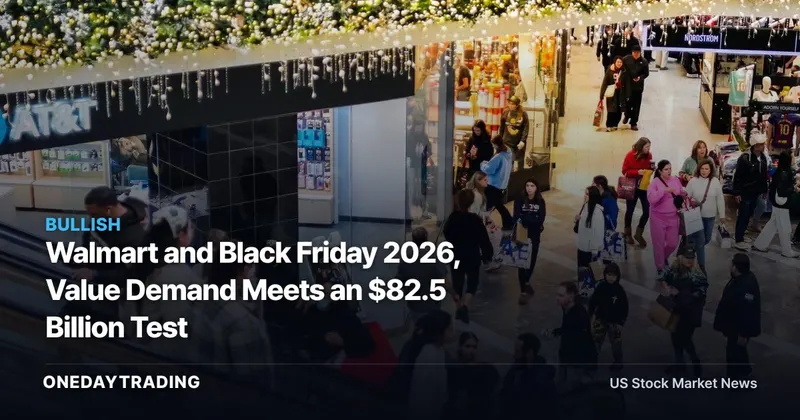
Walmart and the broader retail sector enter Black Friday 2026 with a constructive demand signal and a harder profitability test: shoppers still intend to spend, while their focus on deals determines where that spending lands. On 2026/11/27, CNBC reported that retailers and surveys expected robust holiday activity even as inflation kept value at the center of purchasing decisions.
Black Friday is a promotional shopping event in which retailers compete for concentrated holiday demand through deals. For investors, the distinction between demand and profitable demand is crucial. Strong traffic can support sales, while deeper markdowns can make the income-statement benefit less certain.
The early evidence favors participation rather than retreat. Adobe found that consumers spent $82.5 billion online in the first 22 days of November, a 9.1% year-over-year increase. That is a firm spending result for the period, though it does not establish the final Black Friday, Cyber Monday or full holiday-season totals.
Inflation Has Not Eliminated Holiday Demand
CNBC reported that October's consumer price index rose a seasonally adjusted 0.4%, while the personal consumption expenditures price index accelerated to a seasonally adjusted 3.8% in October compared with last year. Those readings frame the shopper's constraint: holiday demand persists alongside continued pressure on purchasing power.
The Conference Board estimated planned spending on gifts and nongifts at an average of $1,049 this year, up 5.9% from an average of $990 last year. Adjusted for inflation, planned spending was still projected to rise 3.2% year over year. The investor read-through is positive for retail revenue opportunities, though the precise effect of inflation on final holiday unit sales is unknown.
The Conference Board's Consumer Confidence Index was at its lowest since 2014 in September. That tension helps explain why value can coexist with robust spending: consumers may preserve holiday budgets while becoming more selective about timing and price. Brian McCarthy described shoppers as feeling pressure from prices and their financial position while still wanting to protect the holidays.
Deloitte and Salesforce Define the Promotional Window
Deloitte found that 87% of shoppers planned to participate in Black Friday and Cyber Monday sales this year, compared with 82% in 2025, the highest planned participation since 2016. Its survey of 1,200 consumers in mid-October also put expected spending at an average of $624 this holiday.
The participation figure strengthens the case for concentrated promotional demand, not unrestricted discretionary spending. Deloitte also found that 40% of Generation Z shoppers planned to use buy now, pay later during the holiday season. That planned use may widen access to purchases by deferring payment, while also showing how financing forms part of the value-seeking behavior.
Salesforce predicted $357 billion in global online sales and $84 billion in U.S. online sales from Nov. 24 through Nov. 30, with each total representing 6% year-over-year growth. It also projected that U.S. discount rates would be up 8% in November. The sales forecasts are not achieved results, and whether those predicted totals were reached remains unknown.
- Demand debate: The Conference Board's higher planned spending and Adobe's early online growth support the revenue case.
- Promotion debate: Salesforce's projected increase in discount rates raises the question of how much sales volume retailers must generate to offset heavier deals.
- Participation debate: Deloitte's stronger shopping intent indicates a broad audience, while the average expected spend shows that participation alone does not settle final retailer performance.
- Inflation debate: Nominal spending can rise even when the number of goods sold does not increase at the same pace, making final unit sales an essential missing measure.
Walmart, Target and Best Buy Compete for the Value Shopper
Walmart is leaning into deals, and John David Rainey said the holiday quarter was “off to a pretty good start.” The comment is encouraging for the largest listed name in this retail basket, but it remains an early qualitative assessment rather than a final holiday-quarter result.
Target is pricing thousands of products at $5 and under this holiday season. Michael Fiddelke said, “We're encouraged by the start of the quarter that we've seen so far.” For Target investors, the checkpoint is whether low-price merchandise attracts enough demand to support the quarter without requiring promotions that weaken the sales benefit.
Best Buy faces a more nuanced version of the same test. Jason Bonfig said shoppers were placing greater emphasis on value while also seeking product upgrades, sometimes at more premium price points. That mix could support revenue if upgrades convert, though the fact sheet provides no final sales, unit or profitability outcome.
Lowe's said its November sales to date were in line with expectations, according to Marvin Ellison, and the company was emphasizing deals for price-conscious customers. The evidence supports measured optimism rather than a definitive acceleration because final holiday-quarter performance is still unavailable.
TJX Companies and Gap Inc. Show the Other Side of Value
TJX Companies offers a direct test of the value thesis. Ernie Herrman said, “In the current environment, we believe value will be top of mind for many consumers this holiday season.” Even so, warmer weather at the beginning of the fourth quarter coincided with a sales slowdown, and the company issued weak fourth-quarter guidance below expectations for earnings and same-store sales.
Burlington Stores, identified as a competitor of TJX Companies, also posted weak sales and a lower-than-expected outlook. The pair shows why a favorable value proposition does not guarantee strong reported performance: company results still depend on whether shopper interest converts during the relevant selling period.
Gap Inc. reported flat comparable sales for its fiscal third quarter, with sinking sales at its Athleta and Banana Republic banners, and lowered guidance. Richard Dickson pointed to colder weather as a possible source of stronger spending and said, “This could be, and would be, a source of upside.” That statement is explicitly conditional, not evidence that the upside occurred.
The Retail Metrics That Decide the Holiday Trade
- Final online spending: Compare the eventual Nov. 24-to-Nov. 30 results with Salesforce's predictions of $357 billion globally and $84 billion in the U.S.
- Full-season sales: Check whether this year's forecast holiday sales exceeded $1 trillion; the fact sheet does not confirm that outcome.
- Retailer reporting: Examine the next holiday-quarter results from Walmart, Target, Best Buy, Lowe's, TJX Companies and Gap Inc. for evidence that promotional demand translated into reported performance.
- Demand quality: Separate nominal sales from final unit sales and compare realized discounting with Salesforce's projected 8% increase in U.S. discount rates during November.
Black Friday's Bull Case—and Its Limit
The bullish case for retail rests on three distinct signals: The Conference Board projected higher planned spending, Adobe measured strong online spending during the first 22 days of November, and Deloitte recorded broader planned participation in Black Friday and Cyber Monday sales. Together, they suggest that inflation is changing how consumers shop more clearly than whether they intend to shop.
The risk sits between the shopping cart and the income statement. Deal-seeking can direct demand toward retailers with compelling value, while elevated discounting can reduce the benefit of each sale. Weak outlooks from TJX Companies, Burlington Stores and Gap Inc. also caution against treating a sector-wide spending forecast as a guarantee for every company.
The next decisive evidence is not another expression of optimism. It is the final holiday sales total, realized online spending against Salesforce's forecast, final unit demand and each retailer's holiday-quarter performance. Until those figures arrive, the data support a favorable demand setup for Walmart and other value-focused retailers, with the profitability outcome still open.
Market data check: Walmart Inc.
Walmart Inc. last traded near $133.13 (+0.90%). Our composite signal — blending price momentum and news flow — reads 🟡 neutral. Price momentum scores 65/100 (firm).
Data as of publication. Price via market feeds; for reference only, not investment advice.
📊 Analysis
Signal Bullish
Why Rising planned spending and strong early online demand support retailers, although heavier discounts and unresolved final sales performance limit the signal.
Tickers$WMT$TGT$BBY$LOW$TJX$GAP
This article was independently written by OneDayTrading from public reporting. Read the original (CNBC)