Federal Reserve Decision: The Risk the Market Has Discounted
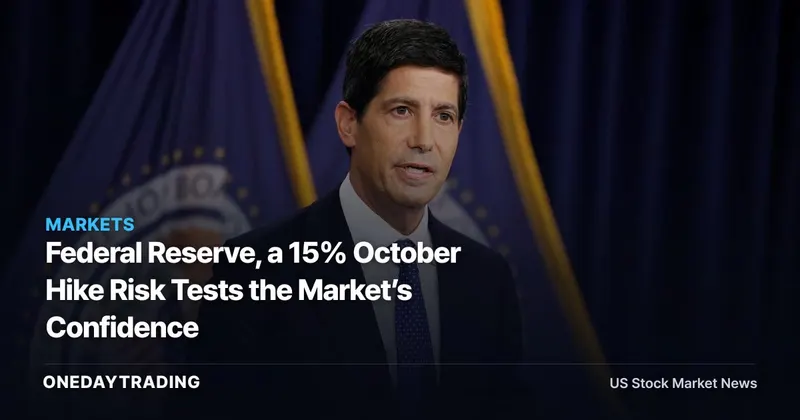
The Federal Reserve approaches its Oct. 28 interest-rate decision with the futures market assigning only a 15% probability to an October increase, according to CNBC Markets. For equity investors, the important issue is not a confirmed policy change but the gap between a market leaning strongly toward a hold and a Federal Open Market Committee decision that remains unresolved. That gap leaves rate-sensitive valuations and sector leadership exposed to either confirmation or repricing.
The central thesis is narrow: the market has priced a low probability of an increase, while the available inflation evidence still gives Kevin Warsh grounds to argue for one. His comments do not settle the choice. They make the assumptions behind the market’s confidence more important.
What Kevin Warsh Said—and Did Not Signal
Kevin Warsh said at an International Monetary Fund event in Bangkok that he was not signaling an interest-rate decision in either direction. That qualification matters because it prevents investors from treating his remarks as policy guidance. The confirmed event is uncertainty ahead of the meeting, not a promised hold or a prepared increase.
Warsh said that “The world has broadly conformed to our expectations,” according to CNBC Markets. The statement could be consistent with continuity after the Federal Open Market Committee unanimously raised interest rates in September. It does not establish whether Warsh considers another increase necessary at the next meeting.
He has also separated his own judgment from the Federal Reserve’s published outlook by saying, “Those aren't my forecasts.” The outlook contained one rate hike for 2026, leaving the timing undecided. Investors therefore cannot infer Warsh’s preferred October action from that collective projection alone.
Federal Reserve Communications Are Part of the Risk
Philip Jefferson and John Williams, whose role is tied to the New York Fed, delivered remarks indicating little urgency to raise rates. Those comments support the market’s expectation of a hold. Whether Warsh agrees with their public indications is unknown, as is whether earlier Federal Reserve communication conventions survived the leadership transition.
This distinction changes how the 15% probability should be read. It measures the futures market’s assessment of an October increase; it is not a statement from the Federal Reserve and does not eliminate the alternative outcome. If investors have interpreted Jefferson and Williams as reliable signals of Warsh’s position, any failure of that assumption would require a sharper reassessment than the probability alone suggests.
A communications surprise and an economic surprise are different risks. The economic evidence concerns inflation and financial conditions. The communications risk concerns whether public remarks by senior officials still reveal how the Federal Open Market Committee will decide. The fact sheet confirms neither question, so neither should be treated as resolved.
Inflation Keeps the October Debate Open
The consumer price index rose 3.7% for the year through September, while the producer price index increased 6.3%, according to CNBC Markets. Those readings do not dictate the committee’s decision, though they preserve an inflation-based argument for restraint. The same data implied that the next core personal consumption expenditures reading would be 3.1% year over year.
Core personal consumption expenditures is the underlying version of the Federal Reserve’s preferred inflation measure. The implied 3.1% year-over-year reading sits above the Federal Reserve’s 2% PCE goal. Warsh described that goal as “a firm, fixed target,” making the distance between the implied reading and the stated objective relevant to his policy judgment.
The evidence still stops short of revealing his vote. It does not show whether Warsh considers the inflation figures sufficient for another increase, whether he gives greater weight to other committee views, or how he will respond during the meeting. Persistent inflation supplies a case; it does not supply the outcome.
Chicago Fed Conditions and the Policy Transmission Question
The Chicago Fed’s National Financial Conditions Index remained negative after rising about 0.05 points since Jackson Hole. In the terms supplied by the source, conditions had tightened while remaining loose overall. The unresolved question is whether Warsh believes that tightening has already done enough.
For markets, this is the bridge from policy to equity valuation. Tighter financial conditions can raise the hurdle applied to future corporate cash flows, which may pressure companies whose valuations depend more heavily on distant earnings. A decision to hold could reduce the immediate need for such repricing, but the fact sheet provides no company-level evidence from which to identify a specific winner or loser.
The same limitation applies to sector leadership. Rate-sensitive shares could react more strongly if the Federal Reserve chooses the outcome carrying only a 15% market probability. That is a conditional valuation mechanism, not evidence that any named stock will rise or fall.
Investor Checkpoints Before the Oct. 28 Decision
- The decision itself: Confirm whether the Federal Open Market Committee raises or holds interest rates on Oct. 28. The present evidence supports uncertainty, not a forecast stated as fact.
- Warsh’s explanation: Listen for whether Kevin Warsh emphasizes the implied 3.1% year-over-year core personal consumption expenditures reading or the Federal Reserve’s 2% PCE goal.
- Committee alignment: Assess whether the final position matches the low-urgency indications from Philip Jefferson and John Williams. This will help test whether investors correctly interpreted senior officials’ public remarks.
- Financial conditions: Check whether Warsh treats the Chicago Fed index’s rise of about 0.05 points since Jackson Hole as sufficient tightening or as incomplete policy transmission.
Two Live Paths for Rates and Equity Valuations
The hold case rests on the market’s strong preference, the low-urgency remarks from Jefferson and Williams, and the possibility that Warsh moves toward the broader committee’s view. If that path prevails, the decision would validate the outcome already favored by futures pricing. Validation alone would not determine the scale or direction of any equity response.
The increase case rests on inflation: the 3.7% consumer price index rise for the year through September, the 6.3% producer price index gain, and the implied 3.1% year-over-year core personal consumption expenditures reading. Warsh’s description of the Federal Reserve’s 2% PCE goal gives that evidence policy relevance. A rate increase would challenge a market that assigns it only a 15% October probability, creating greater scope for valuation and sector-leadership adjustments.
Neither path is confirmed. The decisive checkpoint is the Oct. 28 Federal Open Market Committee decision and Warsh’s account of how inflation, financial conditions and other members’ views shaped it. Until then, the most defensible market read is not that a surprise will occur, but that investors have placed substantial confidence in communication assumptions the available facts cannot verify.
📊 Analysis
Signal Neutral
Why Markets heavily favor a hold, while persistent inflation and uncertainty around Kevin Warsh’s reaction leave a credible counter-scenario.
This article was independently written by OneDayTrading from public reporting. Read the original (CNBC Markets)