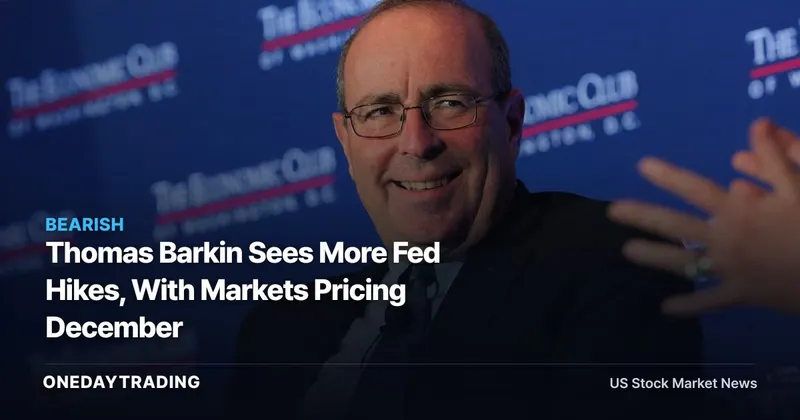
Thomas Barkin’s Rate Signal in One View
Thomas Barkin’s message creates a conditional headwind for rate-sensitive equities: inflation may require further Federal Reserve increases, although he favors a gradual pace. On 2026-11-05, CNBC reported that the central bank’s benchmark overnight borrowing rate remained in a 3.75-4% range.
The investable distinction is between direction and timing. Barkin indicated that rates may need to rise, while leaving both the amount and schedule unresolved. That combination supports caution on valuations without establishing that a specific increase will occur.
What Thomas Barkin Said About Further Rate Increases
The Richmond Federal Reserve president said inflation remains too high and monetary policy will need to adjust. He also described uncertainty as a reason to proceed gradually, making the pace of tightening the central issue rather than presenting a fixed rate path.
Barkin told CNBC’s Steve Liesman that unemployment was near record lows and inflation was too high. His assessment treated inflation as the most important current risk, while acknowledging that incoming information could affect how quickly policymakers act.
Thomas Barkin is not currently a voting member of the Federal Open Market Committee, though he will become one in 2027. His remarks therefore inform the policy debate without constituting a committee decision, and his future voting status gives his framework added relevance for the next stage of the rate cycle.
How the Federal Open Market Committee Reached This Point
The Federal Open Market Committee approved a 0.25 percentage-point rate increase in September 2026, according to CNBC. Officials largely agreed that another increase was likely before the end of 2026, establishing a tightening bias while preserving discretion over the next meeting.
Barkin characterized current policy as close to neutral. A neutral rate is a policy setting understood as neither restricting nor promoting economic growth. His concern is that policy may still be somewhat accommodative because consumption, which represents roughly two-thirds of the economy, remained relatively elevated.
That judgment matters more than the label alone. If policy is only near neutral while inflation is still too high, Barkin’s reasoning leaves room for additional restraint. If incoming information instead shows that existing policy is exerting sufficient pressure, gradualism gives the committee room to wait rather than follow a preset sequence.
CME Group Pricing and the Unpriced Risk
CME Group’s FedWatch tool showed markets assigning a better than 80% chance to a Federal Reserve rate increase in December 2026. The same pricing incorporated 1 additional move in 2027, meaning investors had already recognized a meaningful probability of further tightening.
The key market question is not simply whether Barkin sounds restrictive. It is whether subsequent information changes the expected amount or pace of increases beyond what the market already reflects. A gradual path close to existing expectations may produce less repricing than an indication that inflation requires faster or more extensive action.
The unresolved risk sits on both sides. A December 2026 increase is not confirmed, and neither is the additional move priced for 2027. The amount and timing of any future increase remain unknown, so market probabilities should not be read as Federal Open Market Committee commitments.
Rates, Equity Valuations and Sector Leadership
For equities, the transmission mechanism runs through the value assigned to future cash flows. If expected policy rates move higher, investors may apply more demanding valuation assumptions, creating greater pressure on shares whose investment cases rely heavily on earnings expected farther into the future. This is a conditional valuation mechanism, not evidence that any named stock has already risen or fallen.
A slower tightening pace offers the counterweight. Gradual adjustments give investors more opportunity to distinguish durable cash generation from valuations that depend on easier policy. Because the fact sheet identifies no company-specific exposure or market move, it does not support naming individual winners, losers or U.S.-listed tickers.
The tape already reflects a high probability of a December 2026 increase and another move in 2027. What it does not settle is whether inflation information will validate those expectations, force a more restrictive path or allow policymakers to stop after fewer adjustments.
Artificial Intelligence Adds an Inflation and Credit Dimension
Barkin identified artificial intelligence as one source of price pressure, while also saying it could eventually increase production and help ease inflation. The comment presents a two-stage possibility: near-term pressure alongside a later supply benefit. The measured contribution of artificial intelligence to inflation is unknown, so that channel cannot be quantified from the available evidence.
CNBC also reported estimated debt issuance to hyperscalers at more than $500 billion in 2026. Barkin described that financing activity as worth monitoring for possible credit issues, focusing concern on intermediaries that may be assuming risks rather than asserting that the hyperscalers themselves were poor credits.
The identities of the hyperscalers and intermediaries were not supplied, and the methodology behind the debt estimate was not provided. Those limitations prevent a company-level credit conclusion, though they establish financing structures around artificial intelligence investment as an additional area for investors to monitor.
Bull and Bear Conditions for Investors
Bear case: Inflation stays too high and reinforces Barkin’s view that policy must adjust. Expectations could then remain centered on a December 2026 increase and the additional move already priced for 2027, with valuation pressure concentrated in rate-sensitive parts of the equity market.
Bull case: New information supports patience and validates a gradual approach. In that scenario, the absence of a fixed amount or timetable limits the force of the tightening signal, while artificial intelligence eventually contributing to production could fit a less inflationary longer-term path.
Neither condition is established as an outcome. Barkin expressed a policy preference and risk assessment; he did not announce a Federal Open Market Committee decision or specify how much rates should rise.
Next Checks After Barkin’s Remarks
- December 2026 policy decision: Check whether the Federal Open Market Committee delivers the increase to which CME Group’s FedWatch tool assigned a better than 80% probability.
- Policy pace: Watch whether officials continue to favor gradual adjustments or indicate that inflation requires a different tempo.
- 2027 expectations: Compare incoming policy guidance with the 1 additional move reflected in market pricing and Barkin’s role as a voting member.
- Artificial intelligence financing: Look for clearer identification of intermediaries, credit exposure and the methodology supporting the estimate of more than $500 billion in hyperscaler debt issuance during 2026.
The next decisive signal is the Federal Open Market Committee’s December 2026 action relative to existing market pricing. Until then, Barkin’s remarks strengthen the case for monitoring inflation and the pace of policy adjustment, without resolving either the next decision or the eventual endpoint.
📊 Analysis
Signal Bearish
Why The prospect of additional interest-rate increases creates a conditional valuation headwind for rate-sensitive equities, although the expected gradual pace limits the signal’s severity.
This article was independently written by OneDayTrading from public reporting. Read the original (CNBC)