At a Glance
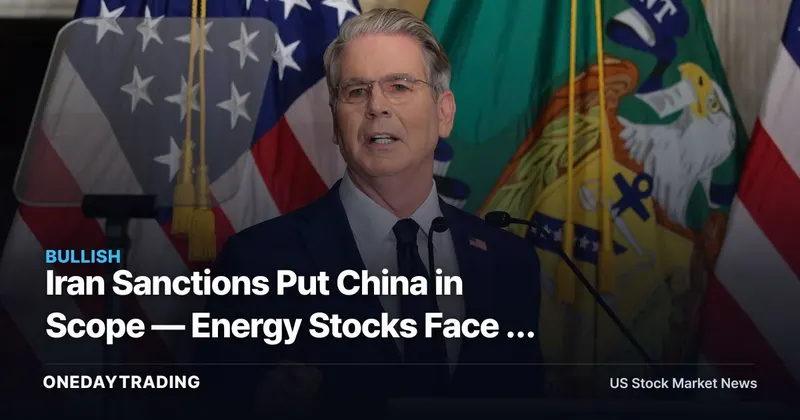
Iran sanctions and China exposure matter for U.S. energy stocks because CNBC reported that the Trump administration unveiled a plan to isolate Iran's economy through secondary sanctions on Iran's enablers, with China not exempt from the threat.
Secondary sanctions are restrictions aimed at third parties that keep doing business with a sanctioned country, meaning the policy channel runs through banks, buyers, shippers and trade intermediaries rather than Iran alone.
Why It Matters Now
The tape will treat this first as an oil-risk headline, not as a settled supply shock. The CNBC report gives investors a policy direction, but it does not provide barrels, deadlines, named Chinese buyers or enforcement thresholds.
That distinction matters for Exxon Mobil, Chevron and oil-service names. Integrated producers benefit when geopolitical risk lifts crude expectations, while refiners and transport users suffer if input costs rise faster than demand can absorb.
The China clause is the pressure point. If the Trump administration applies secondary sanctions broadly, compliance risk can move from Tehran-facing entities into global payment, shipping and insurance channels that touch Iranian commerce.
Key Debates
- Policy signal versus enforcement: CNBC reported a plan and a sanctions threat, but the provided summary does not specify implementation dates, penalties or targeted entities.
- Oil premium versus demand drag: Energy producers can gain from tighter perceived supply, while higher fuel costs can weigh on airlines, trucking and consumer spending.
- China risk: The phrase China not exempt raises the probability of friction with Chinese buyers or intermediaries, but the source does not say China has been sanctioned.
- Market pricing: Investors can price a risk premium before barrels change hands; the unpriced risk is the moment threats become enforceable actions.
Related Stocks & Sectors
- Exxon Mobil (XOM): Higher geopolitical risk around Iran can support upstream earnings expectations if crude prices firm.
- Chevron (CVX): Chevron's integrated oil exposure makes the stock sensitive to any sanctions-driven change in global crude pricing.
- Schlumberger (SLB): Oilfield-service demand improves when producers see durable pricing support, but policy headlines alone do not create new drilling budgets.
- Airlines: Fuel-sensitive carriers face margin pressure if sanctions risk translates into higher jet-fuel costs.
What to Watch
- Watch for a formal sanctions list that names companies, banks, vessels or intermediaries.
- Watch China's official response to any secondary-sanctions language tied to Iranian commerce.
- Watch WTI crude and Brent crude for whether traders price a durable risk premium or fade the headline.
- Watch next earnings guidance from energy producers and airlines for fuel-cost and margin commentary.
Overall Outlook
The setup is modestly bullish for U.S. energy stocks because CNBC's reported sanctions plan raises the probability of tighter perceived Iranian supply and a higher crude-risk premium. The risk is that investors overpay for a policy headline before enforcement details, targeted entities or actual trade disruption appear.
FAQ
Why do Iran sanctions affect oil stocks?
Iran sanctions affect oil stocks because restrictions on Iranian commerce can alter expectations for global crude supply. U.S. producers such as Exxon Mobil and Chevron can benefit if traders price tighter supply into oil futures.
What are secondary sanctions on Iran?
Secondary sanctions on Iran are penalties aimed at non-Iranian parties that help Iran conduct business. CNBC reported that the Trump administration's plan threatens Iran's enablers rather than only Iranian entities.
Is China exempt from the Trump Iran sanctions plan?
CNBC reported that the Trump administration signaled China is not exempt from the anti-Iran sanctions plan. That makes Chinese-linked trade, finance and shipping channels the key enforcement variable for investors.
Market data check: XOM
XOM last traded near $163.56 (-0.94%). Our composite signal — blending price momentum and news flow — reads 🟡 neutral. Price momentum scores 42/100.
Data as of publication. Price via market feeds; for reference only, not investment advice.
📊 Analysis
Signal Bullish
Why The sanctions plan is a positive catalyst for U.S. energy producers because stricter Iran enforcement can raise crude-risk premiums, though enforcement details remain the key uncertainty.
This article was independently written by OneDayTrading from public reporting. Read the original (CNBC)