What Changes With Covenant’s Dallas Factory
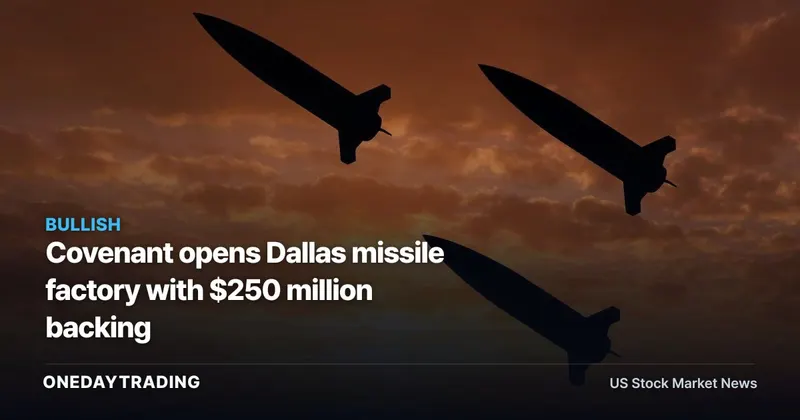
Covenant’s announcement matters to defense investors because it links venture-backed manufacturing capacity to the U.S. procurement pipeline. CNBC reported that the company opened its Dallas site, disclosed $250 million in funding across three rounds and announced one Department of Defense agreement with the Army and another with the Navy. Those announcements create a pathway from private capital to testing, qualification and potential maritime adaptation, but they do not establish delivered missile revenue.
Founded in 2024, Covenant is a Washington-based defense startup with more than 200 employees worldwide. Its Anthem is described as a long-range, heavy-payload cruise missile. CNBC reported that the company positions Anthem as another option for the U.S. military alongside systems such as RTX’s Tomahawk. For listed defense exposure, RTX is the clearest publicly traded reference in the supplied facts, while Covenant itself is not identified as a listed company.
The company’s Dallas factory is planned to begin serial production in Q1 2027. Covenant says the site will produce 1,000 Anthem missiles in its first year and eventually scale to 5,000 annually. These are stated production plans, not confirmed output. The investment question is therefore operational: can the factory move from opening day and qualification work to repeatable, cost-controlled production at the stated scale?
Why the Production Model Is the Investment Story
Missile manufacturing is a physical-capacity business. A larger facility can support more throughput, but the supplied facts do not disclose line configuration, supplier contracts, unit economics, test-failure rates or the capital required to reach the eventual 5,000-missile annual target. Investors should treat the factory’s square footage and planned volumes as indicators of intended capacity rather than evidence of realized utilization.
CNBC reported that Covenant says Anthem is a fraction of the cost of legacy systems, while the exact cost is unknown. That distinction is material. Without a disclosed price, investors cannot calculate revenue per missile, gross margin or the funding needed to sustain production. The company’s $250 million financing total shows the scale of private backing, but the amounts assigned to each of the three rounds and the allocation between research, facilities and inventory are also unknown.
Abby Denburg, Covenant’s president and chief growth officer, told CNBC: “There is a gap in the middle of that for affordable mass and strategic range, and that's the gap that Anthem was filling.” The statement frames the product around a space between short-range, low-payload drones and longer-range strategic systems. It is management’s positioning, not independent evidence of market share or procurement success.
Army and Navy Agreements Create Milestones, Not Earnings
The Army agreement is intended to accelerate testing and qualification. The Navy agreement is intended to adapt Anthem for maritime use. CNBC did not provide the financial terms, delivery schedules or detailed scope of either deal, so neither announcement can be translated into a specific backlog figure or forecast revenue.
For investors, qualification is the next verifiable gate. A successful test program could expand the addressable procurement channel, while delays or failed qualification would postpone the commercial significance of the Dallas plant. The Navy’s maritime adaptation also introduces a separate engineering and integration requirement; the supplied facts do not state how far that work has progressed.
Covenant already operates production facilities in Germany and Northern Israel. That footprint may give the company manufacturing experience across more than one location, but CNBC did not disclose the output, products or economics of those facilities. Their existence should not be treated as proof that Dallas can immediately achieve its planned missile volumes.
Winners & Losers
- U.S. defense manufacturing: CNBC’s report supports a constructive sector read-through because a new entrant is adding planned missile capacity and pursuing Army and Navy qualification routes. The effect is thematic; no public Covenant sales or earnings data were supplied.
- RTX: RTX is identified as the maker associated with the Tomahawk system that Anthem would join as another option for the U.S. military. Covenant’s entry could increase competitive attention around long-range cruise missiles, but the facts do not establish lost RTX orders or a change in Tomahawk demand.
- Venture-backed defense companies: Andreessen Horowitz, Peter Thiel’s Founders Fund, Lux, 8VC, Aleph and Lightspeed back Covenant. That syndicate and the $250 million raised over three rounds may reinforce investor interest in defense startups, although no valuation or return data were disclosed.
Risk Check
- Production risk: The 1,000-missile first-year plan and 5,000-missile annual target are forward-looking company plans. Serial production is not scheduled to begin until Q1 2027.
- Qualification risk: The Army and Navy agreements concern testing, qualification and maritime adaptation. Their financial terms, milestones and outcomes remain unknown.
- Cost uncertainty: Covenant describes Anthem as a fraction of legacy-system cost, but the exact missile price and cost structure were not provided.
- Competitive risk: Anthem enters a category that includes established systems such as RTX’s Tomahawk. The facts do not show comparative performance, orders or customer commitments.
Bottom Line
Covenant’s Dallas opening is a concrete expansion of planned U.S. missile capacity, backed by $250 million in private funding and accompanied by Army and Navy agreements. That combination is a positive signal for the defense-industrial theme and places RTX’s Tomahawk in a newly competitive narrative. The upside depends on qualification and the conversion of planned capacity into production; the live risks are timing, cost and execution. The next checkpoints are the start of serial production in Q1 2027, evidence of completed Army testing, and progress on the Navy’s maritime adaptation.
FAQ
When will Covenant begin serial production of Anthem missiles?
CNBC reported that Covenant plans to begin serial production in the first quarter of 2027. The company’s stated plan calls for 1,000 missiles in the first production year, with eventual scaling to 5,000 missiles annually.
How much funding has Covenant raised?
Covenant announced $250 million in funding over three rounds, according to CNBC. The amount allocated to each round and the use of proceeds were not disclosed in the supplied facts.
What Department of Defense deals did Covenant announce?
Covenant announced one Department of Defense deal with the Army to accelerate testing and qualification and one with the Navy to adapt Anthem for maritime use. CNBC did not provide the financial terms or detailed scope of either agreement.
📊 Analysis
Signal Bullish
Why The factory, venture funding and Army and Navy agreements are a positive catalyst for the U.S. defense manufacturing theme, although execution remains unproven.
This article was independently written by OneDayTrading from public reporting. Read the original (CNBC)