What Changes for Markets
The immediate market read-through is a collision between physical energy risk and uncertain military claims. CNBC reported that Brent crude reached $100 a barrel on Wednesday as the U.S. and Iran traded attacks near the Strait of Hormuz, a corridor whose disruption can quickly raise the risk premium attached to oil. That price move is a market signal, not proof that supply has been interrupted: the fact sheet does not confirm a shutdown, a lost cargo volume, or the outcome of future hostilities.
For investors, the key distinction is between confirmed asset damage and contested narratives. Iran’s Revolutionary Guards Corps claimed that Iranian forces struck two American vessels and eight oil tankers. U.S. Central Command responded that no U.S. Navy warship had been struck and that all IRGC attempted attacks failed. Whether Iran actually struck any American vessels is explicitly unknown in the supplied reporting, so any trade thesis that assumes a confirmed U.S. naval loss would outrun the evidence.
The tanker sequence does establish a mechanism for higher perceived geopolitical risk. CNBC reported that U.S. forces said they destroyed 10 Iranian tankers in the last week: four tankers in the Gulf of Oman and the M/T Derya near Iran’s Kharg Island were struck on Tuesday, while the U.S. military destroyed three Iranian tankers on Saturday. Centcom described the targeted vessels as part of a shadow network funding the IRGC. The identities of the eight oil tankers Iran said it struck, and of the three tankers destroyed on Saturday, remain unknown.
By the Numbers
The reported claims and counterclaims form a concentrated set of numbers. Iran’s Revolutionary Guards Corps said on Wednesday that it struck two American vessels and eight oil tankers in the Gulf after U.S. forces destroyed five Iranian tankers on Tuesday. U.S. Central Command denied that any U.S. Navy warship was hit. CNBC also reported Brent crude at $100 a barrel on Wednesday, a level that places the energy market’s attention on the Strait of Hormuz even though the fact sheet does not establish a sustained supply loss.
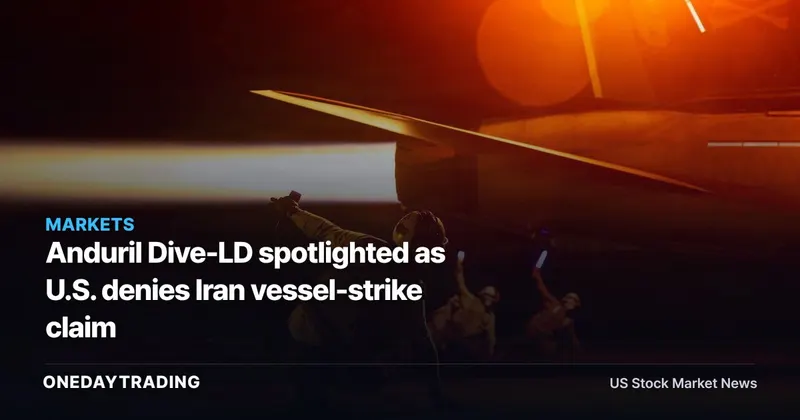
The autonomous-submersible story has a different financial scale. Iranian media described the vessel as Anduril’s Dive-LD autonomous undersea vehicle. A 2024 DefenseScoop cost report cited by CNBC put the price at $2.5 million each. U.S. Navy Captain Tim Hawkins said the underwater drone had malfunctioned more than a day earlier; the U.S. described it as an older, defective model that collected no sensitive data and carried no classified sonar or radar equipment. An Anduril spokesperson characterized Dive-LD as an attritable autonomous system, meaning it is designed to operate in dangerous environments where losing the vehicle is an expected possibility.
Winners & Losers
- Oil and energy exposure: Brent crude reaching $100 a barrel on Wednesday is the clearest confirmed market impact in the report. The potential benefit for producers is conditional on the price move persisting; the supplied facts do not identify any listed producer, quantify production changes, or establish a lasting premium.
- Defense-autonomy developers: Anduril’s Dive-LD received visibility because Iranian media identified the seized submersible as that system, while the U.S. described the vehicle as defective and older. That combination may sharpen investor debate over procurement economics, reliability and attrition, but Anduril is not identified as a listed company in the fact sheet.
- Saronic and unmanned maritime systems: CNBC reported that Saronic used an unmanned boat to rescue helicopter crew in the Hormuz Strait and later used its boats in a strike on an Iranian submarine and ship facility. The report supports strategic relevance for unmanned maritime systems, not a confirmed revenue, valuation or earnings effect; Saronic is described as a startup.
- Tankers linked to the reported shadow network: U.S. forces’ reported destruction of 10 Iranian tankers in the last week points to direct operational pressure on vessels Centcom said helped fund the IRGC. The fact sheet does not identify owners, insurers, cargoes or listed equities, so a company-specific loser cannot be named responsibly.
Risk Check
- Verification risk: The central military assertion remains contested. The fact sheet lists whether Iran actually struck any American vessels as unknown, limiting confidence in any market conclusion built on that claim.
- Escalation risk: Further U.S.-Iran hostilities could alter oil-market pricing, but the outcome of future hostilities is unknown. A $100 Brent print therefore cannot be treated as a forecast of a continuing trend.
- Supply-chain opacity: The reported tanker counts are not matched with identities for Iran’s eight claimed targets or the three tankers destroyed on Saturday. Without cargo and ownership details, investors cannot map the events cleanly to listed companies.
- Autonomy-performance risk: The U.S. description of the Dive-LD as defective and older, alongside Anduril’s explanation of an attritable design, leaves reliability and replacement economics as separate questions. The supplied reporting provides no test results, contract values or order data.
Bottom Line
CNBC’s report makes the market story a probability problem: Brent crude reached $100 a barrel as tanker attacks and counterclaims raised the perceived risk around the Strait of Hormuz, but the most dramatic claim—an Iranian strike on two American vessels—was denied by the U.S. and remains unverified in the fact sheet. Energy prices could stay sensitive to new incidents, while autonomous defense systems may attract greater attention after the Dive-LD episode and Saronic’s reported operations. The next useful checkpoints are confirmation of any additional vessel damage, clarification of tanker identities and ownership, and evidence that oil-market effects extend beyond Wednesday’s reported price.
FAQ
Did Iran strike two American vessels?
The U.S. denied Iran’s claim. U.S. Central Command said no U.S. Navy warship was struck and that all IRGC attempted attacks failed, while the fact sheet states that whether Iran actually struck any American vessels is unknown.
Why did Brent crude reach $100 a barrel?
CNBC reported that Brent crude reached $100 a barrel on Wednesday as the U.S. and Iran traded attacks near the Strait of Hormuz. The supplied facts do not confirm a shipping shutdown, a specific supply loss or how long the price level will last.
What is Anduril’s Dive-LD?
Iranian media described the reportedly seized submersible as Dive-LD, an autonomous undersea vehicle developed by Anduril. The U.S. called the vehicle defective and older, while an Anduril spokesperson described it as an attritable system designed for dangerous missions where loss is an expected possibility.
📊 Analysis
Signal Neutral
Why The report raises defense-technology visibility and oil-supply risk, but provides no confirmed listed-company earnings or outcome to establish a directional stock catalyst.
This article was independently written by OneDayTrading from public reporting. Read the original (CNBC)