
Key Takeaways
The crux of this comparison between Hasbro and other consumer cyclical stocks isn't simply share-price swings — it's the structural transformation of the underlying business. A company once heavily reliant on traditional toys is shifting its earnings base toward digital and licensed IP such as Magic: The Gathering and Dungeons & Dragons, and that shift is the real driver of the stock's divergence. It is also the variable that determines whether Hasbro can take on a relatively defensive character within the consumer cyclical group.
For Korean investors, this stock is less a direct holding candidate and more valuable as a gauge for reading global demand across the toy, character, and content-licensing industries, as well as the strength of the consumer economy.
What Happened
This coverage examines Hasbro's relative performance by measuring its stock against other names in the same consumer cyclical sector. Cyclical stocks tend to see their earnings and share prices swing together with household disposable income and consumer sentiment, so even within the same sector, a company's resilience can vary widely depending on the business portfolio it holds.
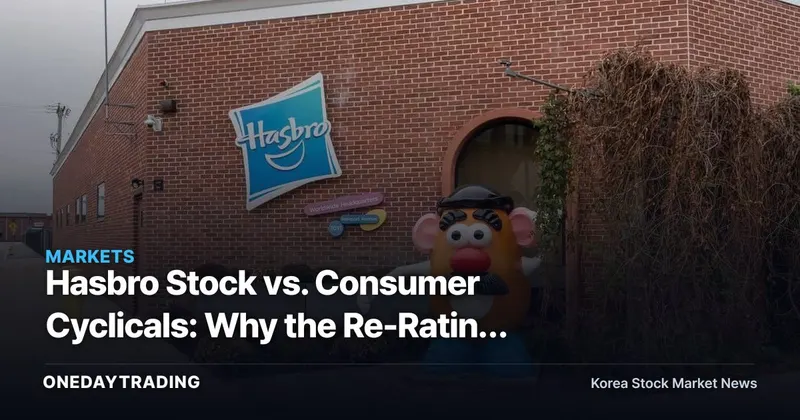
Alongside toy brands like Monopoly, Transformers, and Nerf, Hasbro owns the trading card game Magic: The Gathering and the tabletop RPG Dungeons & Dragons. The latter generate recurring revenue in digital, subscription, and licensing forms, giving them a different character from traditional toy sales that cluster around holiday and year-end seasons.
Background and Context
The toy industry is a textbook discretionary consumer good. When inflation and interest rates squeeze households, non-essential spending such as toys is the first to be cut, making revenue vulnerable during economic slowdowns. Game and licensed IP, by contrast, benefit from fandom-driven recurring demand and are relatively less sensitive to economic swings. If Hasbro's stock traces a different path from other cyclical names, that difference in business mix is what lies behind it.
Impact on the Market and Stocks
- Hasbro (HAS): If a larger share from the IP and gaming segments lowers earnings volatility, the stock could hold up more firmly than the cyclical average — but toy-segment inventory and slowing consumption remain downside factors.
- Mattel (MAT): A toy-focused rival behind Barbie and Hot Wheels; comparing it with Hasbro offers a yardstick for gauging the strength of toy demand and the impact of bringing character IP to film.
- Domestic toy and character-licensing companies: A recovery in global toy demand could serve as a positive signal for the upstream demand facing Korean firms engaged in OEM and character businesses.
- Content and game IP sector: Hasbro's success in monetizing its IP is a case study in the profitability of the character and game licensing business model, offering a reference point for valuation discussions across the related industry.
Investor Checkpoints
- Watch the next quarter's earnings for shifts in the revenue mix between the toy segment and the game/licensing segment, along with the margin trend.
- Check whether digital and subscription revenue from Magic: The Gathering, Dungeons & Dragons and the like keeps growing, and review the release schedule for new sets and content.
- Look at year-end shopping-season toy sales, retail-channel inventory levels, and U.S. consumer indicators (disposable income and consumer sentiment) together.
- Assess whether dividend-paying capacity, debt burden, and capital-allocation policy strike a balance with IP investment.
Outlook
The bullish scenario is one in which game and licensed IP grow steady recurring revenue, absorbing the volatility of the toy cycle, while brand expansion through film and content lifts profitability. In that case, Hasbro has room to earn a re-rating that sets it apart from the cyclical average.
The risks are equally clear, however. A prolonged consumer slowdown could weigh on earnings through toy-segment revenue and inventory burdens, while slowing growth in the IP segment or weak box-office performance from new content could unwind the premium baked into expectations. Given intensifying competition and the uncertainty of content hits, a reasonable approach is to engage while verifying the speed and quality of the business-mix transition quarter by quarter.
This article is content automatically summarized and analyzed based on an original news report. View original (Yahoo Finance)