
Allocating the foreign employment permit quota may look like a routine administrative procedure, but it is a variable that shapes the production capacity and labor-cost structure of labor-intensive industries plagued by chronic worker shortages. This batch of 12,630 new E-9 applications serves as a channel for supplying additional workers to sites where hiring domestic labor is difficult — shipbuilding, manufacturing, and the foundational "root" industries — and it carries greater significance for sectors where any delay in staffing translates directly into delivery schedules and costs. From an investor's standpoint, it is more accurate to read this not as a positive catalyst announcement, but as one piece of the easing of production bottlenecks that turns order backlogs into actual revenue.
Three-Line Briefing
- The Ministry of Employment and Labor will accept applications for new third-round 2026 foreign worker (E-9) employment permits from the 6th to the 20th of next month.
- The total allocation for this round is 12,630 workers, to be distributed across sectors suffering severe labor shortages.
- The key point to watch is whether production disruptions ease at sites heavily reliant on foreign labor, such as shipbuilding and manufacturing.
What's Changing
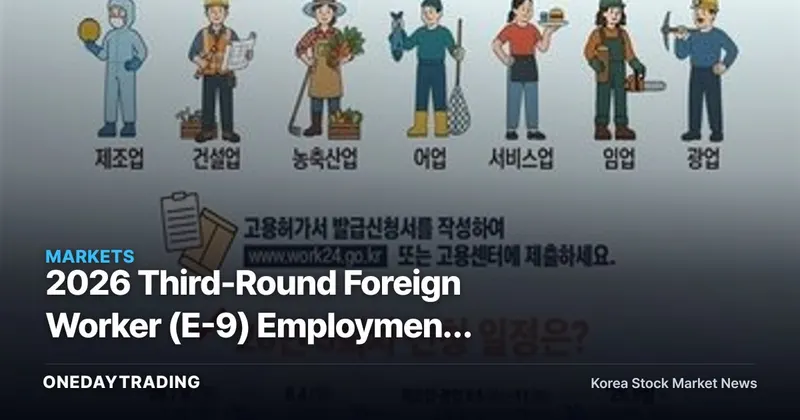
The E-9 visa is a system that allows non-professional foreign workers to work in manufacturing, agriculture and livestock, fishing, construction, shipbuilding, and certain service industries. Each round's acceptance of new employment permits is a key gateway through which employers can legally fill labor shortages, and this third-round allocation of 12,630 workers serves in part to meet first-half demand.
The crux is not the headcount itself, but the concentration among the sectors receiving placements. In shipbuilding and the root industries — which involve welding, painting, and assembly processes that domestic workers tend to avoid — a staffing gap immediately leads to process delays. When orders have been secured but ships cannot be built on schedule because workers cannot be found, the timing of earnings recognition is pushed back and companies even take on the risk of liquidated-damages penalties. Bringing workers into such sites can act as a primer for recovering capacity utilization.
That said, this round of applications is closer to a regular, scheduled procedure conducted within a fixed annual intake. A single round's allocation cannot resolve industry-wide labor shortages all at once, and one must also consider that there is a time lag before workers actually enter the country and are deployed on-site.
Numbers and Context
The total for this third round is 12,630 workers. The application period runs from the 6th to the 20th of next month, during which employers apply through this gateway to fill labor shortages. However, given the nature of the process — application, selection, and entry by round — the point at which this allocation is reflected in corporate earnings is likely to be confirmed gradually in second-half capacity-utilization figures rather than immediately.
Beneficiary and Adversely Affected Stocks
- HD Hyundai Heavy Industries, Samsung Heavy Industries, Hanwha Ocean (shipbuilding): With many processes such as welding and painting that depend on foreign labor, staffing directly affects how quickly order backlogs convert into revenue and whether build schedules are met.
- HD Hyundai Mipo, HD Hyundai Samho (mid-sized and block construction): With on-site labor supply — including subcontractors — running tight, the effect of additional staffing is relatively easy to feel.
- Small- and mid-cap parts makers in manufacturing and root industries: This helps stabilize labor costs and delivery schedules in machining and assembly processes where domestic hiring is difficult, but the intensity of the benefit varies widely by individual listed company.
- Labor-intensive sectors broadly that rely heavily on labor: If total labor-cost burdens — minimum wage, residency costs, and the like — rise simultaneously, the supply-demand (order flow) improvement may be partly offset.
Risk Check
- Regular quota allocation is not a direct catalyst that drives share prices higher, and may amount to no more than a secondary variable in industry supply-demand (order flow).
- Because of the time lag before entry and on-site deployment, the short-term impact on earnings is limited.
- Rising total labor costs — minimum-wage hikes, lodging and management expenses — may dilute the effect of expanded staffing.
- For shipbuilding stocks and others, fundamental variables such as orders, exchange rates, and steel-plate prices carry more weight, making it difficult to determine direction from the labor issue alone.
One-Line Conclusion
This allocation of 12,630 E-9 workers is a supporting mechanism that eases production bottlenecks in labor-short sectors, not a standalone momentum driver; it is reasonable to confirm the actual effect through second-half shipbuilding and manufacturing capacity-utilization rates, labor-cost trends, and the size of the next round's allocation.
HD Hyundai Heavy Industries: Real-Time Data View
HD Hyundai Heavy Industries recently posted a closing price of 590,000 won (+0.51% versus the prior day), and the signal light combining foreign and institutional supply-demand (order flow) with news and momentum is 🟢 buy-leaning. With foreign investors and momentum positive, it may be worth watching.
- ▲ Supply-demand (order flow) continuity — foreign investors net buyers for 6 consecutive days (+10.3 billion won)
Recent related news is mixed, with 2 positive catalysts and 2 negative catalysts.
※ Price and foreign/institutional supply-demand (order flow) data are provided by Korea Investment & Securities (KIS), as of the time of publication.
This article is content automatically summarized and analyzed based on the original news report. View original (Yonhap News)