
Key Takeaways
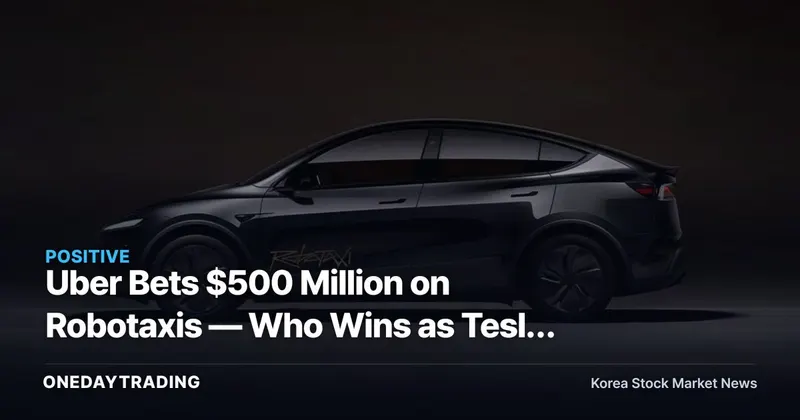
On the surface, the robotaxi race looks like a technology showdown between Tesla and Waymo, but the company deploying capital most aggressively is actually Uber — which doesn't build a single car. Uber is locking up a supply of self-driving vehicles through a $500 million investment in a bid to defend its platform dominance. For investors, the dividing line for profitability is less about who builds the best car and more about who controls demand and the operating network.
What Happened
In the autonomous taxi market, Tesla is competing with its own vehicles and FSD software, while Alphabet's Waymo is leaning on its experience running driverless operations built on lidar. Waymo has been moving to reduce its reliance on ride-hailing platforms like Uber by using its own app and operating directly.
Feeling threatened by this, Uber has chosen a strategy of pouring large sums into vehicle manufacturers and self-driving technology firms in order to tie robotaxi supply to its own app. According to reports, Uber is making an investment on the order of $500 million to secure self-driving vehicles ahead of rivals. It's a setup in which the platform operator that builds no cars is, paradoxically, placing the biggest bet.
Background and Context
Uber's core asset isn't vehicles — it's demand. In a structure where driver labor costs make up a large share of cost of revenue, replacing drivers with autonomous systems has the potential to dramatically improve per-trip profitability. But this only holds if Uber can keep autonomous supply locked inside its platform. If Waymo defects with its own app, Uber faces the worst-case scenario of holding the demand but losing the supply. The $500 million bet is both defensive and offensive in character — an attempt to lock down that supply chain in advance.
Impact on the Market and Stocks
- Uber (UBER): If it succeeds in securing self-driving vehicles, margins improve as driver costs fall — but the enormous upfront investment pressures near-term cash flow. Whether it can prevent supply dependency is the key variable for its valuation.
- Alphabet (Waymo): By reducing its reliance on Uber through its own app and direct operations, it could capture the entire fare, giving it a long-term profitability edge. The catch is that vehicle and operating costs fall on its own shoulders.
- Tesla: Owning both vehicle manufacturing and FSD gives it a vertical-integration advantage, but the regulatory gateway of licensing and safety validation for driverless commercial operations is the bottleneck to turning this into earnings.
- Semiconductors such as Nvidia: Whichever camp wins, demand for autonomous-driving compute rises, creating the potential for a structural positive catalyst in demand for inference chips and sensors.
- Domestic self-driving and parts stocks: Korean parts suppliers embedded in the lidar, camera, and automotive-semiconductor supply chains have an indirect path to benefit as global robotaxi volumes expand.
Investor Checkpoints
- Watch how Uber balances its self-driving-related investment outlays against operating cash flow in its quarterly earnings.
- Whether Waymo expands its own app and pulls away from the Uber platform — signs of supply dependency are the dividing line for Uber's share price.
- The actual timeline for commercial licensing and the expansion of operating areas for Tesla's driverless robotaxis.
- Changes in each country's autonomous-driving regulatory and insurance frameworks — an external variable that will dictate the pace of commercialization.
Outlook
In the optimistic scenario, Uber leverages its grip on demand to pit multiple self-driving suppliers against one another and establishes itself as a platform toll-collector. In that case, an asset-light model that builds no vehicles of its own could deliver the highest return on capital. Conversely, if a camp like Waymo — which owns the technology, the vehicles, and the app — breaks away through vertical integration, Uber's upfront investment risks going unrecovered while its bargaining power over supply only weakens. The decisive battleground of this competition lies not in vehicle-manufacturing capability, but in who can control demand, supply, and regulation all at once.
This article is content automatically summarized and analyzed based on the original news. View Original (MarketWatch)