
Summary
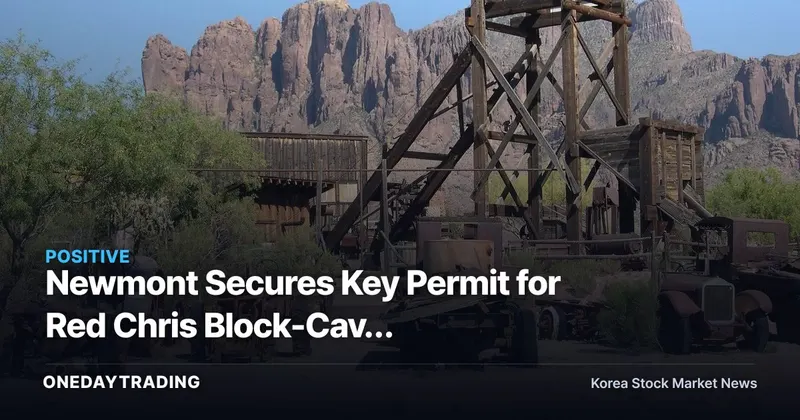
Newmont (NEM), the world's largest gold producer, has secured a key regulatory approval needed to convert the Red Chris mine in British Columbia, Canada, to block-cave underground mining. This is not a mere administrative formality but a structural turning point that can extend the life of a mine nearing the limits of open-pit extraction and lower its unit mining cost. Because Red Chris is an asset that holds both gold and copper, its significance for investors during a period of gold strength is far from trivial.
The Full Story
Red Chris is a polymetallic deposit containing both gold and copper, and it has so far been operated by the open-pit method of digging near the surface. With open-pit mining, costs rise steeply as the pit deepens, because the share of waste rock (stripping) that must be removed grows larger. The block cave that Newmont is pursuing is a bulk underground mining technique in which the lower part of the orebody is undercut so that the ore collapses under its own weight. While initial development costs are high, the per-tonne mining cost falls sharply versus open-pit once the operation is in full swing.
This permit is significant in that it removes one of the biggest sources of uncertainty in the conversion project — regulatory risk. Even when an orebody's reserves are confirmed, resource development projects are often delayed or scrapped at the environmental, Indigenous-consultation, or government-approval stages.
Structural Background
Through its acquisition of Newcrest, Newmont has increased its copper exposure and transformed from a pure gold miner into a combined gold-and-copper producer. With gold strong on safe-haven demand and central-bank buying, the strategy of simultaneously securing copper — where structural supply-demand (order flow) improvement is being discussed on the back of demand from power grids, electric vehicles, and data centers — acts as a buffer against price swings in any single metal. The underground conversion at Red Chris can be read as an effort to expand the long-term production base for both metals at once.
Impact on Stocks and Sectors
- Newmont (NEM): The direct party. The permit approval creates room to improve long-term production visibility and cost competitiveness, but the burden of block-cave development costs is a near-term driver of higher capital expenditure.
- Barrick Gold (GOLD): A peer large-cap gold-and-copper miner and a comparable that shares the themes of gold strength and copper growth.
- Korea Zinc: A non-ferrous metals smelter spanning gold, silver, and copper, and a representative related stock (ticker) for domestic investors during periods of metal-price strength.
- Poongsan: Engaged in copper processing and the brass/copper-alloy business, making it a domestic beneficiary candidate under a copper supply-demand (order flow) improvement scenario.
- Gold-related ETFs and the precious-metals sector: More affected by fund flows tied to gold and copper prices themselves than by individual mine-specific events.
Bullish vs. Bearish Scenarios
On the bullish side, the resolution of regulatory risk has raised the probability that the project moves forward, and if gold strength persists, expectations for the cash flow of a combined gold-and-copper asset grow. On the bearish side, the block cave is a long-term project with large upfront investment that takes several years to reach full production. Development delays and cost overruns are common in mining projects, and if gold prices correct, the benefit of improved mining costs could be diluted. Investors should clearly recognize that permit approval does not immediately translate into near-term earnings improvement.
Investor Action Points
- Check the scale of Red Chris development costs and the production start-up schedule in the next quarter's earnings and capital expenditure (CAPEX) guidance.
- Monitor trends in both spot gold prices and copper (LME) prices to gauge the earnings sensitivity of this combined asset.
- Use subsequent block-cave permits, groundbreaking, and reserve-update disclosures as checkpoints for project progress.
- Since domestic related stocks are driven more by the direction of metal prices than by Newmont-specific issues, avoid over-interpreting the linkage to individual stocks (tickers).
This article is content automatically summarized and analyzed based on the original news. View original (Yahoo Finance)