
Summary
Murata’s announcement that it will mass-produce the iPaS power board for AI semiconductors next year signals that the passive-components maker is expanding from chip-adjacent parts into the power-delivery architecture itself. According to The Elec, Murata is positioning iPaS as a next-generation growth product and has set a target of 50 billion yen in annual revenue within 18 months of mass production.
Investors should focus first on the actual transition to mass production and customer orders rather than whether the target is achieved. The Elec did not disclose the names of individual customers, production volumes, or selling prices.
What Happened
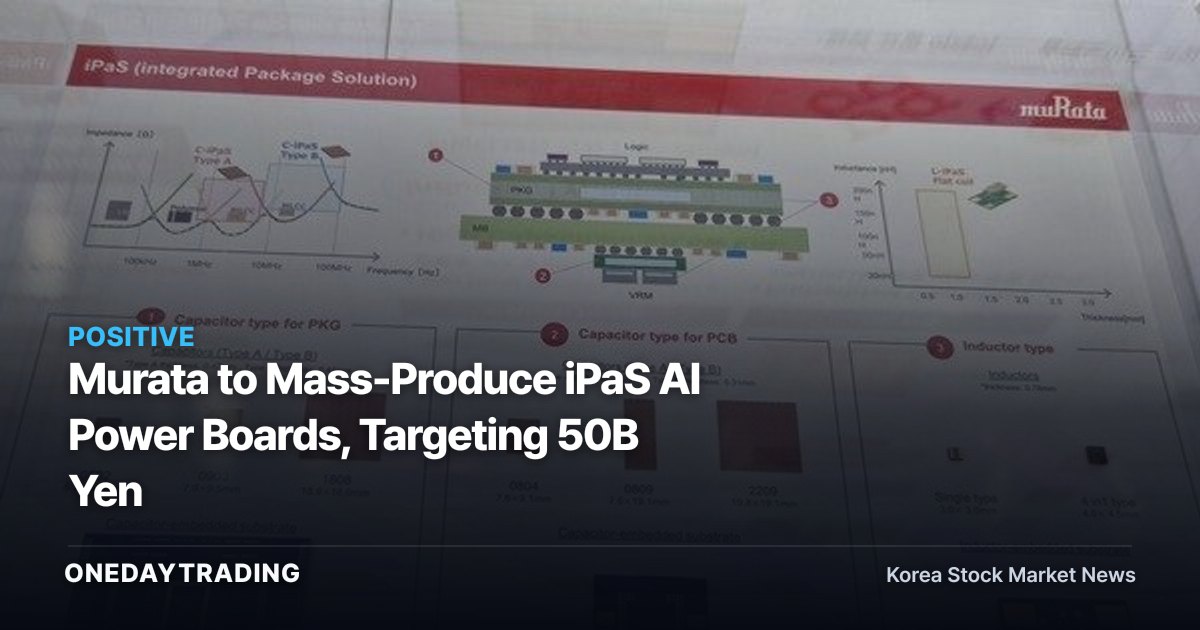
Murata exhibited iPaS at KPCA Show 2026, held on the 9th at Songdo Convensia in Incheon. iPaS (Integrated Package Solution) integrates capacitor or inductor functions into an ultra-small multilayer substrate. The array-based design allows required capacitance and electrical characteristics, dimensions, and circuit routing to be customized to customer requirements.
According to The Elec, Murata is developing separate capacitor and inductor versions. The capacitor version reduces the number of MLCCs mounted on the substrate surface, while the inductor version implements coil functionality in the substrate to support high-current delivery. The company said it also plans to develop a product combining both functions on a single substrate.
A Murata representative explained that iPaS commands a higher unit price than general-purpose products and that big tech companies are the customers, adding, “It should be in mass production next year.”
Structural Background
Conventional power modules were placed around AI accelerators and supplied power through board traces. iPaS targets a vertical power delivery (VPD) structure, placing the power module directly beneath the AI accelerator. This mechanism shortens the power-transfer distance to reduce losses and frees chip-mounting space by shrinking the surface area occupied by passive components.
As AI accelerators deliver greater computing performance, their power consumption and current requirements increase, making it crucial to supply current stably within limited space. Murata first unveiled an iPaS sample at FLEX Japan in 2023 and presented an applied power module at ECTC in 2024. The power module reduced surface capacitors by more than 60% while achieving voltage fluctuation characteristics similar to existing solutions, The Elec reported.
Stock (Ticker) and Industry Sector Impact
- Murata: Once iPaS enters mass production, high-value substrate-based products will be added to passive-component revenue centered on MLCCs and silicon capacitors. The 50 billion yen target set by the company equals about 5% of capacitor revenue of 936.4 billion yen in fiscal 2025 (April 2025–March 2026).
- Electronic Components Industry Sector: Big tech companies, including hyperscalers developing AI semiconductors, are cited as key customers, illustrating the growing importance of customer-specific design for power-delivery components. However, The Elec report contains no competitor-specific order or market-share data.
Bullish vs. Bearish Scenarios
The bullish scenario is one in which application discussions with GPU and AI-accelerator customers lead to actual orders and mass production. If mass production proceeds as planned and revenue expands, Murata may increasingly be viewed as broadening its AI power-solutions business.
Conversely, if mass production is delayed or volumes fall short of the target, the projected revenue contribution will change. Because individual customers and selling prices have not been confirmed, 50 billion yen is a company-stated target, not realized earnings. Lower actual production volumes would also weaken the link between the growth-product narrative and earnings.
Investor Action Points
- Check the start date of iPaS mass production and actual shipment volumes in the next filings and earnings announcements.
- Watch whether application discussions with GPU and AI-accelerator customers convert into orders.
- Monitor revenue breakdowns between capacitor and inductor versions and progress on developing an integrated product.
- Track revenue recognition and changes in iPaS’s share of the capacitor business during the 18-month period after mass production, when the 50 billion yen target applies.
Frequently Asked Questions
What is iPaS?
iPaS is a power board that integrates capacitor or inductor functions into an ultra-small multilayer substrate. It is designed to support a vertical power-delivery structure that places the power module beneath an AI accelerator.
When is Murata’s iPaS mass-production target?
Murata announced plans to begin mass production next year. Based on The Elec’s report, the specific production date and actual output volume have not been disclosed.
What is the iPaS revenue target?
Murata has set a target of 50 billion yen in annual iPaS revenue within 18 months after mass production begins. This amount represents about 5% of its 936.4 billion yen in capacitor revenue for fiscal 2025.
This article is automatically summarized and analyzed based on the original news report. View the original article (The Elec)