
Summary
With the cruise visit to Korea by 5,000 employees of Wuliangye — one of China's flagship liquor companies — now confirmed, a signal has emerged that demand for group incentive tourism is reviving. The duty-free, cosmetics, casino, and travel sectors react sensitively to shifts in the composition of inbound visitors, given the high per-capita spending of Chinese travelers. That said, distinguishing whether this is a one-off event or a structural recovery is the crux of any investment judgment.
What Happened
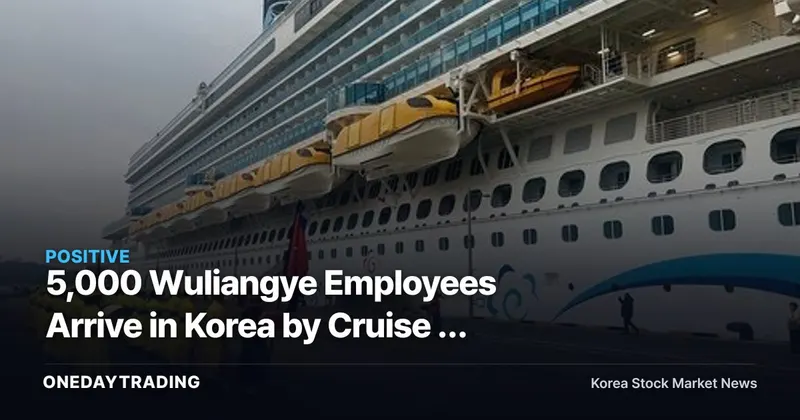
On the 25th, the Korea Tourism Organization announced it had successfully attracted a visit by roughly 5,000 people, including employees of Chinese liquor company Wuliangye Group. It is an incentive group tour run by the company to reward its staff, and what stands out is that this is a large-scale arrival by cruise ship rather than by air.
Unlike ordinary free independent travel (FIT), incentive tourism follows a pre-arranged itinerary and shopping route, and the company often covers the costs, which tends to push per-capita spending higher. With a group of 5,000 entering the consumption chain — duty-free, shopping, lodging, food and beverage — all at once, it can make a visible short-term contribution to the revenue of the related sectors.
Entry via cruise also means bypassing the constraint of available airline seats. With the recovery of Korea-China air routes still slow, if maritime arrivals function as a complementary channel, it becomes possible to attract large groups without waiting for additional flights.
Structural Background
In Korea's inbound tourism, Chinese visitors are the core axis of duty-free and cosmetics spending. Group tourism was effectively halted through the THAAD dispute and the pandemic, and even during the subsequent recovery, the old daigou (reseller)-centered revenue structure collapsed, leaving the duty-free industry burdened by referral commissions and falling per-capita spending. Against this backdrop, the return of corporate incentive groups is meaningful in that some high-quality demand is coming back.
Impact on Stocks and Sectors
- Duty-free / Retail: For Hotel Shilla, Shinsegae, Hyundai Department Store and others, group tourist purchases feed directly into downtown and airport duty-free revenue. If the share of high-spending incentive groups rises, companies can expect to defend revenue while lowering referral commissions.
- Cosmetics: For Amorepacific and LG Household & Health Care, the direct path to benefit is clear, given that skincare and color cosmetics are the core purchase items of Chinese groups. A recovery in the duty-free channel can lead to an improved revenue mix for domestic brands.
- Casinos: Paradise and GKL (Grand Korea Leisure) are foreigner-only casinos whose earnings are tied directly to the number of Chinese visitors. If casinos are included in the group tour route, this translates into higher drop (betting volume).
- Travel / Transport: For travel agencies such as Hana Tour, along with ground transport and lodging, the volume of group arrivals is itself the revenue base. An expansion of cruise port calls also produces spillover effects for tourism infrastructure near the ports.
Bull vs. Bear Scenarios
On the bullish side, if this 5,000-person draw does not end as a one-off but instead acts as a catalyst that pulls in incentive tourism from other Chinese companies and groups, the expected recovery in foreign-investor-driven revenue for the duty-free and cosmetics sectors in the second half could be confirmed in earnings. Conversely, the bearish scenario is one in which it ends as a single event, or in which group per-capita spending is not as high as hoped, leaving the actual contribution to operating profit limited. It should also be viewed in a balanced way that duty-free and cosmetics stocks have, in many cases, already partly priced in expectations of a Chinese consumption recovery, so valuation pressure and exogenous variables such as Korea-China relations and the yuan exchange rate remain ever-present.
Investor Action Points
- In duty-free operators' next-quarter earnings, check the change in the referral commission rate, the share of foreign-investor-driven revenue, and the trend in per-capita spending.
- Use the monthly number of Chinese arrivals to Korea and trends in group visa issuance to gauge whether this draw is a structural recovery.
- Compare Amorepacific's and LG Household & Health Care's commentary on duty-free channel revenue alongside their on-the-ground earnings in China to discern the substance of the benefit.
- Track supply-side indicators such as added Korea-China flights and cruise port-call schedules, in tandem with the yuan and won exchange rate levels.
Hotel Shilla Through Real-Time Data
Hotel Shilla's latest closing price is 48,750 won (+1.77% from the prior day), and the signal light that combines foreign and institutional investor supply-demand (order flow) with news and momentum is 🟢 Buy-leaning. With foreign investors, news, and momentum all positive, it merits attention.
Recent related news is favorable, with 1 positive catalyst and 0 negative catalysts.
※ Price and foreign/institutional investor supply-demand (order flow) data are provided by Korea Investment & Securities (KIS), as of the time of publication.
This article is content automatically summarized and analyzed based on the original news. View original (Yonhap News Industry)