
3-Line Briefing
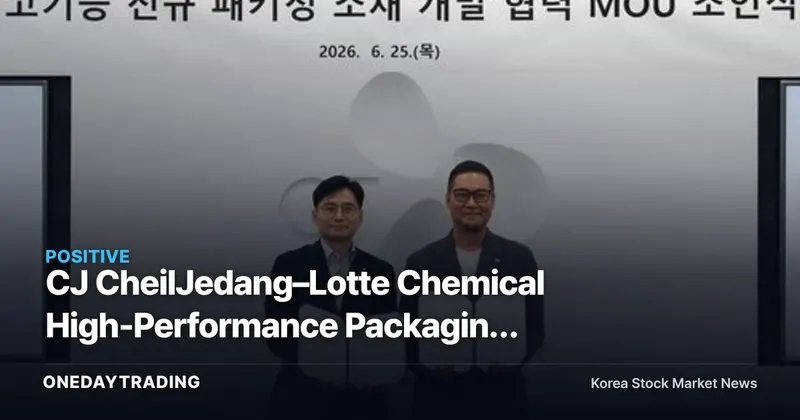
- CJ CheilJedang announced on the 26th that it has signed a memorandum of understanding (MOU) with Lotte Chemical to jointly develop high-performance new packaging materials.
- The collaboration brings together the two companies' strategic directions: raising the value-add of food packaging and moving beyond commodity petrochemicals.
- That said, the deal is currently at the MOU stage, and specific figures such as the products it will be applied to, the investment scale, and the commercialization timeline have not been disclosed.
What Changes
This agreement is significant because it goes beyond a simple buyer-supplier relationship to form a vertical collaboration in which a food company and a chemical company design materials together from the ground up. For a food company, packaging is not just part of the unit cost — it is a key variable that determines freshness shelf life, on-shelf competitiveness, and compliance with eco-friendly regulations. CJ CheilJedang has a large share of home meal replacement (HMR) products such as Hetbahn and Bibigo, which rely heavily on functional packaging features like oxygen and moisture barriers and microwave heat resistance. Bringing high-performance materials in-house affects both product differentiation and pricing power.
For Lotte Chemical, the significance is different. Its business structure, centered on commodity plastics (PE and PP), has faced ongoing profitability pressure from oversupply and shrinking spreads. The shift toward high-value-added specialty and eco-friendly materials aligns precisely with the structural improvement the company has been pursuing, and securing stable downstream demand through a major food customer serves as a lever to reduce the uncertainty of commercializing new materials.
The Numbers in Context
The information disclosed so far is limited to the fact that the agreement was signed; quantitative metrics such as the specific products, material specifications, and supply volumes have not been provided. As a result, it is still too early to gauge the impact on earnings. Investors should watch, step by step, which product lines the jointly developed materials are applied to (shelf-stable HMR, beverages, frozen foods, etc.), how large a share recyclable and biodegradable materials will account for, and whether a concrete timeline for mass-production adoption emerges.
Beneficiary and At-Risk Stocks
- CJ CheilJedang — Directly tied to differentiating its HMR products by bringing functional packaging in-house, and to managing packaging costs and regulatory risk.
- Lotte Chemical — Fits its strategy of moving beyond commodity petrochemicals into high-value-added materials, and offers a chance to secure downstream demand anchored by a major customer.
- Korea's eco-friendly and recycled-materials value chain — Indirectly affected by the trend toward adopting recycled materials if food-chemical collaborations spread.
- Competing food and packaging companies — Could face relative pressure if competition over differentiated functional packaging intensifies.
Risk Check
- An MOU is a statement of intent with weak legal force, so there is a possibility it does not lead to an actual joint-development or supply contract.
- Material development and mass-production adoption typically take several months to several years, so the near-term contribution to earnings is limited.
- For Lotte Chemical, the downturn in its core commodity petrochemicals business is a structural drag that could overshadow any gains from new materials.
- High-performance and eco-friendly materials carry higher costs, so whether this adds to food production costs or can be passed on through pricing is a key variable.
Bottom Line in One Sentence
Material collaboration between food and chemicals is a positive signal that fits both companies' long-term strategic direction, but because it is at the MOU stage and lacks concrete figures, it is too early to translate the expectations into earnings until an actual joint-development contract and a mass-production timeline emerge.
CJ CheilJedang by the Real-Time Data
CJ CheilJedang's latest closing price is 173,200 won (-3.56% from the previous day), and the signal light combining foreign and institutional supply-demand (order flow) with news and momentum is 🔴 Caution. Foreign investors, institutional investors, and momentum are all negative, so caution is warranted right now.
- ▼ Dual-engine selling — Foreign investors −11.5 billion won and institutional investors −700 million won selling in tandem
- ▼ Trend alignment — Aligned to the downside over the short and medium term (-3.6% on the day · -10.4% over 1 week · -16.1% over 1 month)
- ▼ 52-week position — In the bottom 1% of its 52-week range
Recent related news is favorable, with 1 positive catalyst and 0 negative catalysts.
※ Price and foreign/institutional supply-demand (order flow) data are provided by Korea Investment & Securities (KIS) and are as of the time of publication.
This article is content automatically summarized and analyzed based on the original news report. View original (Yonhap News)