
Summary
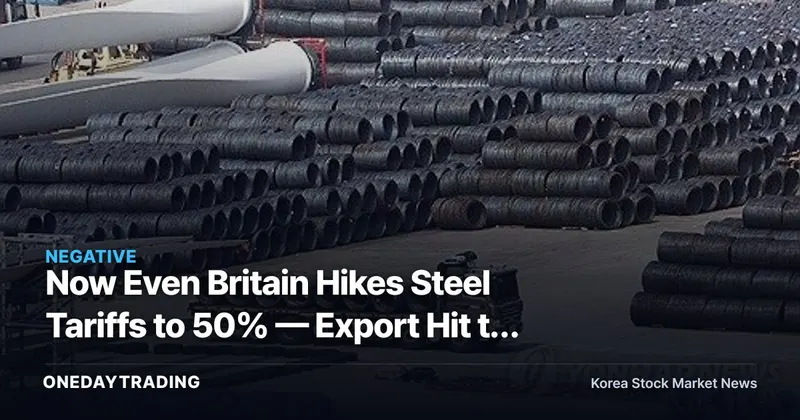
Following the EU, Britain has raised its steel import tariff to 50%, lifting the global protectionist barrier yet another notch. Korean steelmakers with sales exposure to Europe now face the direct burden of eroded price competitiveness. The outcome of the government's compensation and negotiation efforts is the variable that will drive short-term share-price volatility.
What Happened
The British government has decided to raise its tariff rate on steel imports to 50% from current levels. This comes after the EU moved to strengthen its steel safeguard by reducing tariff-rate quotas (TRQ) and imposing high tariffs on volumes above the quota — and with Britain now following suit, the entry barriers to Europe's two major markets have risen simultaneously.
The Korean government has stated that it will review the impact of these measures on domestic exports and respond with all-out efforts in compensation talks. For steel, the pressure from the U.S. Section 232 tariffs and the EU safeguard is now compounded by Britain, marking the onset of overlapping trade pressure across major advanced markets.
A 50% tariff is effectively a level at which competing on price becomes impossible. Since the same product can be supplied more cheaply by local British output or by volumes from tariff-free trade-agreement countries, Korean producers are left in a structure where they must accept either reduced volumes or shrinking margins.
Structural Background
As cheap steel flowing out of China's excess production capacity pressures the global market, the essence of this trend is that the U.S., EU, and Britain have one after another turned toward protecting their own industries. Even though Korean steel is not Chinese, it is often lumped together within the aggregate caps of safeguard measures, leaving it in a position to take unintended collateral damage.
While Europe's share of Korean steelmakers' revenue is not as large as that of the U.S. or Asia, the more fundamental risk is the secondary effect: when global volumes are blocked in one market, supply floods into the remaining markets and pushes unit prices down across the board.
Stock & Sector Impact
- POSCO Holdings: As Korea's top steelmaker with a high export share in flat-rolled products, it has the greatest direct exposure to the strengthening of European trade barriers. Combined with slowing downstream demand, margin pressure in its standalone steel division could come to the fore.
- Hyundai Steel: Alongside its exports of bar, section, and flat-rolled steel, it is highly dependent on automotive steel-sheet volumes for the Hyundai Motor Group, making it sensitive to European automaker demand and changes in the trade environment.
- Dongkuk Steel & SeAH Steel: With export dependence on the U.S. and Europe across products such as heavy plate and steel pipe, their pricing power could weaken when tariffs rise.
- Steel distributors & processors: If export volumes are redirected to the domestic market, it could lead to weaker domestic distribution prices and weigh on profitability.
Bull vs. Bear Scenarios
From the bearish view, the key risk is that the tariff domino running from the U.S. to the EU to Britain pressures both export unit prices and volumes simultaneously, and that an industry recovery could be delayed unless China's supply glut is resolved. If negotiations drag on, the uncertainty itself acts as a valuation-discount factor.
On the bullish side, one can counter that Europe's share of Korean steel stocks' revenue is not decisive, and that — since they already trade in low-PBR territory — much of the negative catalyst is already priced into the shares. Securing quotas or exemptions through government talks, or a coincidence of Chinese production cuts and domestic stimulus, could become an unexpected rebound driver.
Investor Action Points
- Confirm, through trade-authority announcements, the final quota and tariff effective dates for the UK and EU safeguards and whether exemptions for Korean steel are granted.
- Check whether each steelmaker's European export share and average selling price (ASP) trend actually turn down in next quarter's earnings.
- Watch global supply variables such as Chinese steel output cuts and property stimulus alongside the price trends of coking coal and iron ore.
- Use disclosures on the government's compensation and negotiation outcomes, and changes in each company's U.S. and European orders, as short-term momentum indicators.
POSCO Holdings Through Real-Time Data
POSCO Holdings' latest closing price is 323,000 won (-2.56% from the prior day), and the signal light — combining foreign and institutional supply-demand (order flow) with news and momentum — is 🟡 Neutral · Wait-and-See. With positive and negative signals mixed, it is a zone to watch.
- ▲ Order-Flow Continuity — Foreign investors net buyers for 8 straight days (+4.5 billion won)
- ▼ Trend Alignment — Short- and mid-term downward alignment (day -2.6% · 1 week -16.0% · 1 month -27.8%)
- ▼ News Flow — 0 positive vs. 3 negative — negative catalysts dominate
Recent related news is negative, with 0 positive and 3 negative items.
※ Price and foreign/institutional supply-demand (order flow) data are provided by Korea Investment & Securities (KIS), as of the time of publication.
This article is content automatically summarized and analyzed based on the original news. View original (Yonhap News, Industry)